


Large-Scale Catering: Buffet Stove Sizing Rules
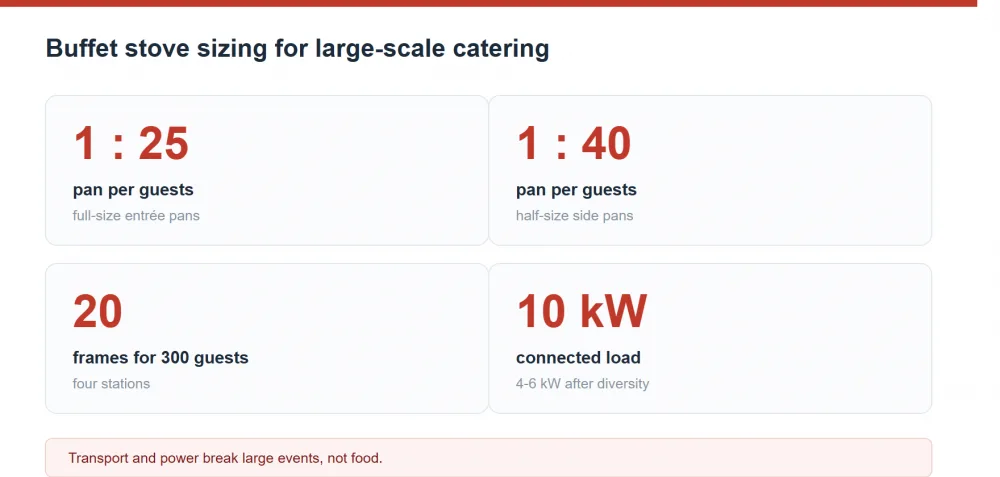
Short answer: for large-scale catering, plan 1 full-size 8 qt pan per 25 guests for the entrée and 1 per 40 guests for sides, plus one spare frame per station. A 300-guest event therefore needs about 12 entrée pans, 8 side pans and 20 frames across four stations. See the frames in our chafing dish range.
The two sizing rules that cover most events
| Guests | Entrée pans (8 qt) | Side pans (4 qt) | Frames | Staff on the line |
| 50 | 2 | 2 | 4 | 1 |
| 100 | 4 | 3 | 7 | 2 |
| 200 | 8 | 6 | 14 | 3 |
| 300 | 12 | 8 | 20 | 4 |
| 500 | 18 | 12 | 30 | 6 |
The rule assumes a plated-equivalent portion of about 150 g for sides and 200 g for entrées, with one refill. If the event runs longer than three hours, add one frame per station rather than making pans deeper.
Split the line into four stations
- Hot entrées: half the frames, 8 qt pans, roll-top lids.
- Sides and vegetables: a quarter of the frames, 4 qt pans.
- Carving or live cooking: two frames plus overhead heat lamps.
- Cold and dessert: chilled displays and cake stands, no heat.
Station count matters more than total pan count. Four stations of five pans serve faster than two stations of ten, because queue time is driven by how many people can be served at once.
Transport volume: the constraint nobody plans
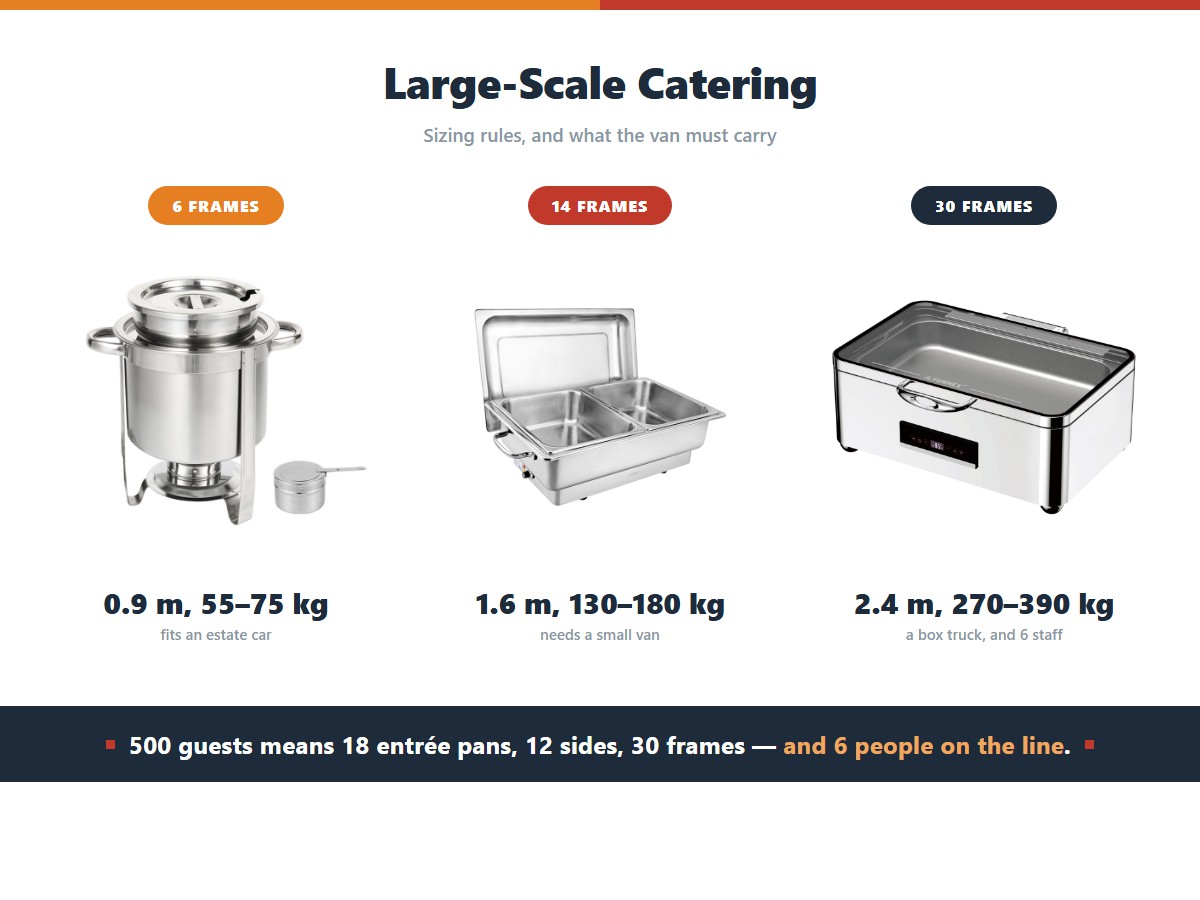
Twenty stacked frames with pans occupy roughly 1.8 cubic metres and weigh 180-260 kg. That is a 3.5 t van with the seats out, or a small box truck. Check the load before you promise a client a 300-guest line:
| Frames | Stacked height | Approx. weight | Vehicle |
| 6 | 0.9 m | 55-75 kg | Estate car |
| 14 | 1.6 m | 130-180 kg | Small van |
| 20 | 2.0 m | 180-260 kg | 3.5 t van |
| 30 | 2.4 m | 270-390 kg | Box truck |
Power for a 300-guest line
Twenty electric frames at 500 W is 10 kW connected, but diversity brings the real draw to 4-6 kW once thermostats cycle. Plan at least four circuits, keep carving and induction on their own breakers, and confirm the venue's supply before the event — not on arrival.
Always carry spares
One spare frame per station, one spare element per five electric units, and one box of fuel cans per four fuel units. A failed element at 19:00 with 300 guests waiting is not a repair problem, it is a reputation problem.
A worked example: 300-guest wedding
Two hot entrées, three sides, one carving joint and a dessert table, served over ninety minutes. The plan reads like this: entrée station with six full-size pans (three per dish, one refill each), side station with six half-size pans, carving station with two frames under heat lamps, and a cold and dessert area that draws no power at all. Total fourteen frames on the hot side, plus two spares kept in the van.
Staffing is four on the line: one carving, one on entrées, one on sides and one floating for refills and clearing. Power is four circuits at 16 A, with the carving lamps on their own. Transport is a 3.5 t van loaded with fourteen stacked frames, pans nested, and a trolley for the last twenty metres. That is the whole specification — and it came from two rules and one guest count, not from a catalogue.
Print the plan and pin it inside the van door. Drivers load against it, chefs cook against it, and the on-site lead checks it before the doors open. A sizing sheet that lives only in a spreadsheet is the reason events arrive one station short.
Frequently Asked Questions
How many chafing dishes for 300 guests?
About 20 frames: 12 full-size entrée pans, 8 half-size side pans, plus carving and dessert stations. Add two spares for a three-hour service.
Should I use full-size or half-size pans for large events?
Full size for entrées, half size for sides. Half pans refill faster, waste less late in service and let you run more variety in the same counter length.
How much space does a 300-guest buffet line need?
Roughly 12-15 m of counter for four stations, plus 1.5 m of guest aisle and a 60 cm staff corridor behind the line.
Can I rent additional frames for one event?
Yes, and it is usually cheaper than buying for a one-off. Check that rented frames match your pan size so pans can be swapped between them.
What is the biggest risk at large events?
Power and transport, not food. Confirm the venue supply and the vehicle load before the event, and carry spares for both.