




9QT Extra-Large Chafing Dish for Large-Scale Banquet Events
Short answer: A 9 QT chafing dish serves 55–70 guests as a single serving point, enough for one main on a mid-size banquet line, and the four numbers to check are 8.5 L of actual capacity, 600–800 W of element power, a 430 × 330 mm footprint and a rim temperature that holds within 5°C of setpoint for four hours. It is a larger pan, not a faster one, so the right question on a large banquet is how many units you have, not how big each is. See chafing dish sizes.

Banquet lines are where the temptation to buy one big unit instead of several correct ones is strongest. A 9 QT pan looks generous, it costs less per guest than a full-size unit, and it looks impressive on a table. The problem is that a single pan is a single serving point, and a single serving point in a room of 300 people is a queue. Capacity per pan and throughput per point are different numbers, and a banquet is a throughput problem.
Pan Size Against Serving Points
| Unit | Capacity | Guests per pan | Serving points | Guests per hour | Line for 300 guests |
|---|---|---|---|---|---|
| 4 QT mini | 3.8 L | 25–35 | 1 | 30–40 | 8–10 units |
| 6 QT | 5.7 L | 40–50 | 1 | 40–50 | 6–8 units |
| 9 QT | 8.5 L | 55–70 | 1 | 55–70 | 5–6 units |
| 11 L full size | 11 L | 65–80 | 1 | 65–80 | 4–5 units |
| 4-pan rectangular | 16–20 L | 120–180 | 4 | 120–180 | 2 units |
| 9-pan rectangular | 36–42 L | 300–420 | 9 | 300–420 | 1 unit |
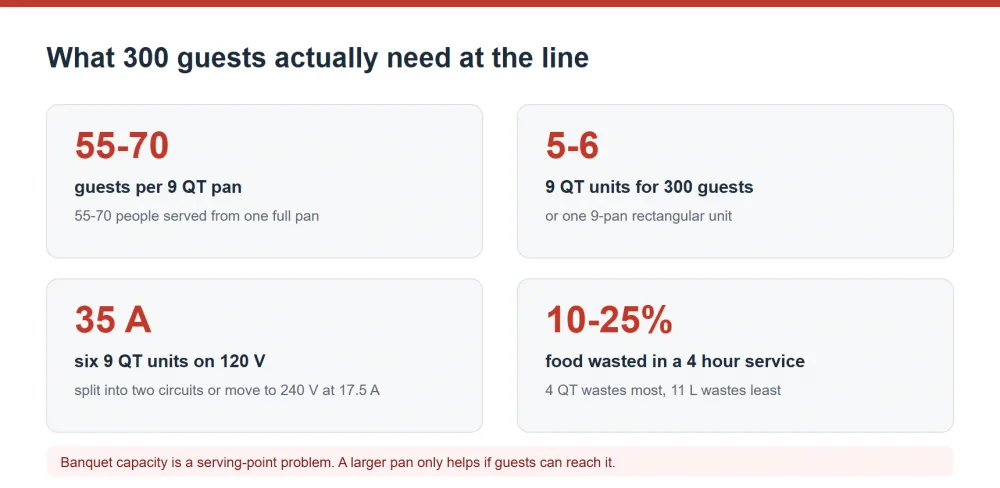
Read the last two columns together. Six 9 QT units and two 4-pan rectangular units both feed 300 guests, but the rectangular pair gives eight serving points against six, and eight points clears a 300-guest room in 25 to 35 minutes where six points takes 40 to 50. The 9 QT is a good pan; it is a mediocre point. On a banquet where the food is pre-plated onto the table, the point count matters less; where guests serve themselves, it is the whole calculation.
Power and Circuit Requirements
| Configuration | Total power | Current at 120 V | Current at 240 V | Circuit | Notes |
|---|---|---|---|---|---|
| 1 × 9 QT, 700 W | 700 W | 5.8 A | 2.9 A | 10 A | Normal outlet |
| 2 × 9 QT | 1,400 W | 11.7 A | 5.8 A | 15 A | Shared circuit with care |
| 3 × 9 QT | 2,100 W | 17.5 A | 8.8 A | 20 A | Dedicated |
| 4 × 9 QT | 2,800 W | 23.3 A | 11.7 A | 30 A | Dedicated |
| 6 × 9 QT | 4,200 W | 35.0 A | 17.5 A | 40 A, or two 20 A | Split the load |
| 2 × 4-pan rectangular | 2,800–3,600 W | 23.3–30.0 A | 11.7–15.0 A | 30–40 A | Heavy but only two units |
The circuit column is where a banquet line gets redesigned on site. Six 9 QT units on 120 V draw 35 A, which is more than a 30 A branch and near the limit of a 40 A supply, and the honest answer at that point is to split the load across two circuits or move to 240 V, where the same six units draw 17.5 A. A 9-pan rectangular unit on one 20 A circuit avoids the problem entirely, which is the electrical argument for the large unit as well as the throughput one.
Refill Economics Over a Four-Hour Banquet
| Unit | Refills per pan, 4 h | Waste per pan | Waste per 100 guests | Refill labour, 4 h | Verdict |
|---|---|---|---|---|---|
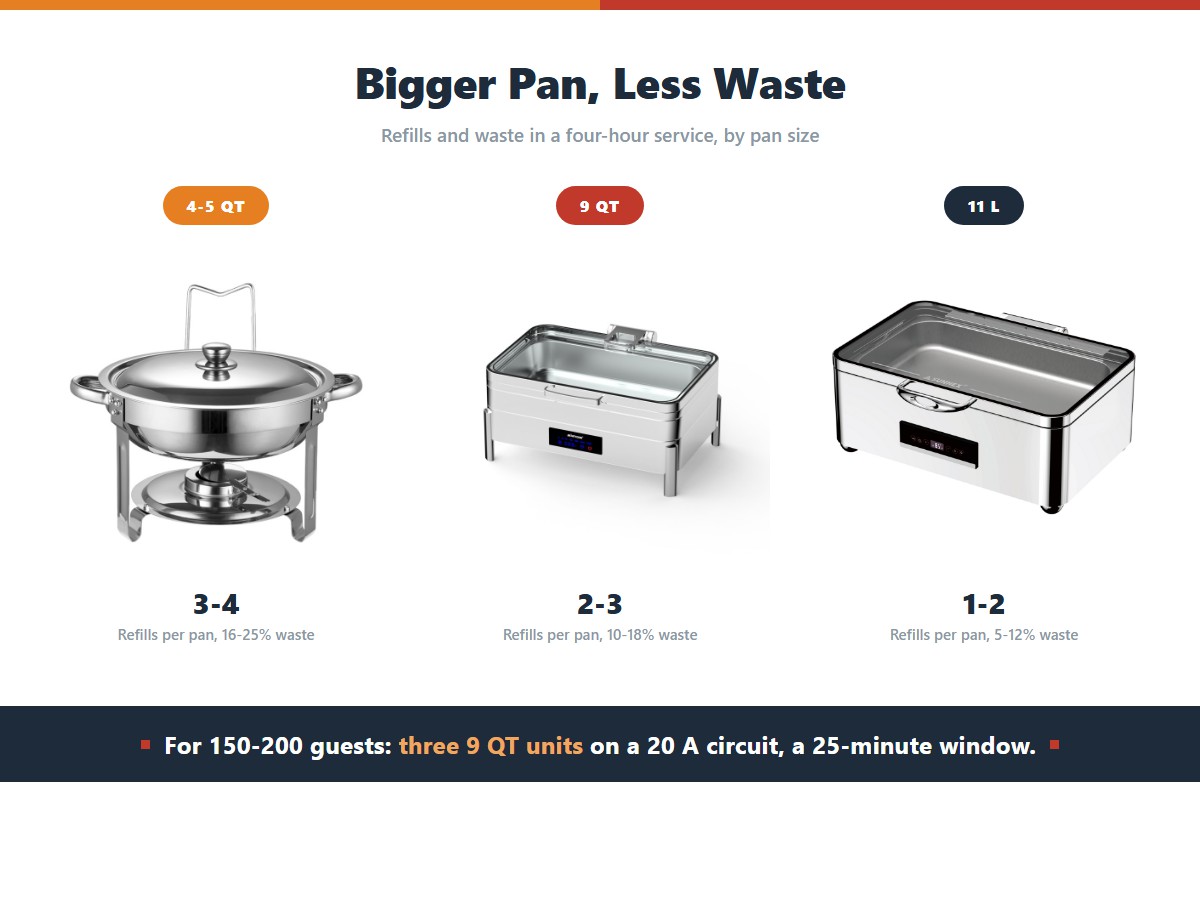
| 4 QT | 3–4 | 16–25% | $73–$114 | 15 min | Too small, too many refills |
| 6 QT | 2–3 | 10–18% | $46–$82 | 10 min | Reasonable |
| 9 QT | 2–3 | 10–18% | $46–$82 | 10 min | Reasonable |
| 11 L | 1–2 | 5–12% | $23–$55 | 7 min | Good |
| 4-pan rectangular | 1–2 per pan | 5–12% | $23–$55 | 15 min for 4 pans | Good |
The refill column is the real argument for the 9 QT over the 6 QT, and it is a weak one. Both need two to three refills over four hours and both waste in the same band, because the waste is driven by how many times a pan is partly emptied and topped up, not by the volume. The volume argument only starts to work past two hours of service. Below that, a 9 QT and a 6 QT behave almost identically and you should buy the cheaper one.
Banquet Line Setup, by Guest Count
| Guests | Service style | Recommended line | Units | Total power at 120 V | Service window |
|---|---|---|---|---|---|
| 60–100 | Self-service | 2 × 9 QT | 2 | 11.7 A | Under 20 min |
| 150–200 | Self-service | 3 × 9 QT | 3 | 17.5 A | 25 min |
| 250–350 | Self-service | 1 × 4-pan + 2 × 11 L | 3 | 24–26 A | 25 min |
| 300–450 | Self-service | 1 × 9-pan rectangular | 1 | 23–30 A | 25–35 min |
| 400–600 | Pre-plated, staffed | 4 × 4-pan, 2 stations | 6 | 47–60 A, two circuits | Continuous |
| 600+ | Pre-plated, staffed | 3 × 9-pan, 3 stations | 3 | 70–90 A, three circuits | Continuous |
Note the last two rows: for pre-plated service the recommendation is multiple stations rather than one large line, and the power requirement goes up with the number of stations even though the total food volume does not. This is the opposite of the intuition, and it is correct. A pre-plated banquet moves food at a rate set by the number of servers, not by the size of the hot well, so the constraint is people and stations.
Trade-offs and Common Mistakes
The weakness of a 9 QT pan is that it looks efficient and is not. A 9 QT unit at 700 W costs about $0.07 an hour against $0.04 for a 6 QT, so the bigger pan costs more to run for the same service, and it is also the unit that needs a dedicated circuit sooner. The case for it is narrow: long service, a dish that suits a large pan, and a line that is not short of points already.
The commonest mistake is buying a banquet line by total capacity. The arithmetic that matters is guests divided by 30 for the number of serving points, and the pan size is a separate decision made afterwards. A line that has the right number of points and the wrong pan size performs better than a line with the right volume and too few points, and the second arrangement is what most people buy.
Frequently Asked Questions
How many guests does a 9 QT chafing dish serve?
55 to 70 guests as a single serving point, and it takes one to two refills over a four-hour service. For a self-service banquet the more useful number is throughput: a 9 QT unit clears 55 to 70 guests an hour, so 300 guests need five or six units or one 9-pan rectangular unit, not three 9 QT units.
Is a 9 QT chafing dish better than a 6 QT for a banquet?
Only for services longer than two hours. Over four hours both need two to three refills and both waste in the same 10 to 18% band, because the waste is driven by the number of refills rather than the pan volume. Below two hours the smaller pan is cheaper to run and does the same job, and it needs less circuit capacity.
How many chafing dishes do I need for 300 guests?
Five or six 9 QT units, or one 9-pan rectangular unit, or a 4-pan rectangular plus two full-size units, depending on the service style. The calculation that matters is guests divided by 30 for the number of serving points, and the pan size is a separate decision. A line with the right number of points performs better than one with the right volume and too few points.
What power supply does a banquet line of chafing dishes need?
Six 9 QT units on 120 V draw 35 A, which exceeds a 30 A branch and approaches the limit of a 40 A supply. Either split the load across two circuits or move to 240 V, where the same six units draw 17.5 A. A single 9-pan rectangular unit on one 20 A circuit is the easiest arrangement electrically as well as the fastest on throughput.
Does a bigger chafing dish waste less food?
Not much. A 4 QT pan wastes 16 to 25% over four hours, a 6 QT and a 9 QT both waste 10 to 18%, and an 11 L wastes 5 to 12%. The waste comes from topping up a partly emptied pan rather than replacing it, so what reduces it is pre-plating into smaller pans and replacing rather than topping up, not a larger pan.

Electric Chafing Dish Food Warmer
Commercial Hotel Electric Visual Buffet Chafing Dish with 400W fast heating, 11L capacity and digital temperature control with ±2°C tolerance. On a banquet line this is a point that serves 65 to 80 guests with a pan that needs only one refill over a four-hour service, and the visible window removes the temptation to lift the lid during a rush.

Electric Chafing Dish-W07
900W rapid heating chafing dish with intelligent temperature control, multi-safety protection and an anti-dry-heat alarm, adjustable from 45 to 89°C. The dry-heat alarm matters on a banquet line, where a unit can be switched on and then forgotten while the room fills, and the adjustable range lets one unit cover a 45°C dessert and an 85°C stew.
Browse the full chafing dish range for current models and configurations.
Related reading
- Large-Scale Catering: Buffet Stove Sizing Rules
- Disposable Chafing Dishes Bulk: Cheap Options for Large Events
- Rectangular Chafing Dishes: Ideal for Large Food Servings
- Large Buffet Lines: How Many Stoves per 100 Guests?
- Store Buffet Equipment Between Events: Damage Guide
- How to Choose a Chafing Dish Supplier for Banquet Halls