




All-You-Can-Eat: Why Buffet Stoves Pay Off Fast
Short answer: an all-you-can-eat room serving 200 covers a day needs 8-12 pans holding food above 60°C for a three-hour window, and buffet stoves pay back in under 12 months because they cut refill labour and waste at the same time. Budget 1 full-size pan per 25 covers on the hot line. See the frames in our chafing dish range.
The economics are different from a la carte
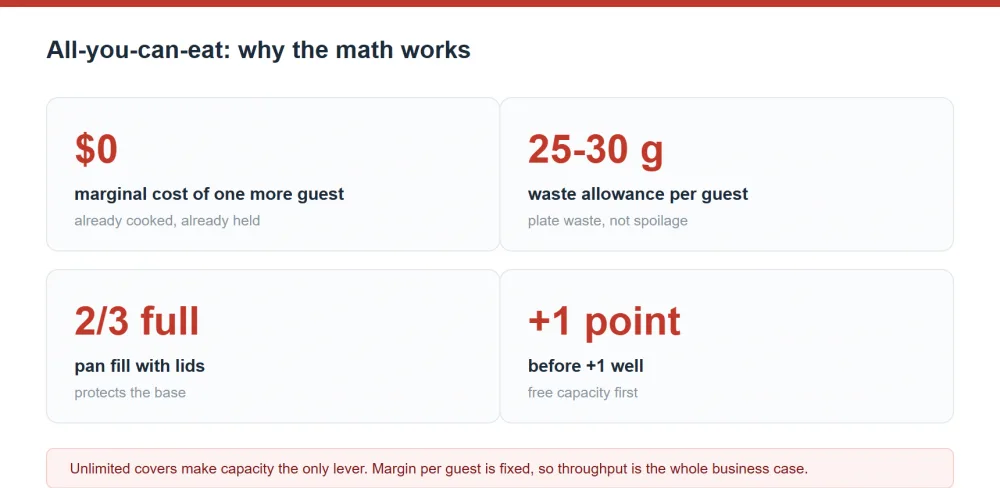
In an a la carte kitchen, food cost is controlled per plate. In an all-you-can-eat room, the guest decides the portion, so the only levers are how much you put out, how long it stays presentable, and how often staff must walk the line. Equipment touches all three.
| Lever | What it costs when it fails | What equipment changes |
| Holding temperature | Food below 60°C gets complained about and discarded | Thermostat and water bath hold 60-74°C without attention |
| Refill frequency | 2-3 staff minutes per pan per round | Larger pans and roll-top lids cut rounds |
| Over-production | 8-15% of food cost | Half-size pans for the tail of service |
| Presentation | Guests judge value by how the line looks | Clean lids and even heat keep colour and texture |
How many pans for an AYCE room
| Daily covers | Full-size hot pans | Half-size pans | Frames needed |
| 100 | 4 | 3 | 7 |
| 200 | 6 | 4 | 10 |
| 300 | 8 | 6 | 14 |
| 400+ | 10 | 8 | 18 |
Plan the count around the busiest 90 minutes, not the whole day. An AYCE room usually sees two waves — lunch at 12:00 and dinner at 19:00 — and both hit the line within a short window.
Why the payback is faster than in a restaurant
A restaurant line can hide a slow pan behind a menu. An AYCE line cannot: the guest sees everything, takes everything, and notices immediately when a pan is half empty or the food has dried at the edge. That visibility turns equipment quality into revenue, not just cost.
| Item | Cheap setup | Proper buffet stoves |
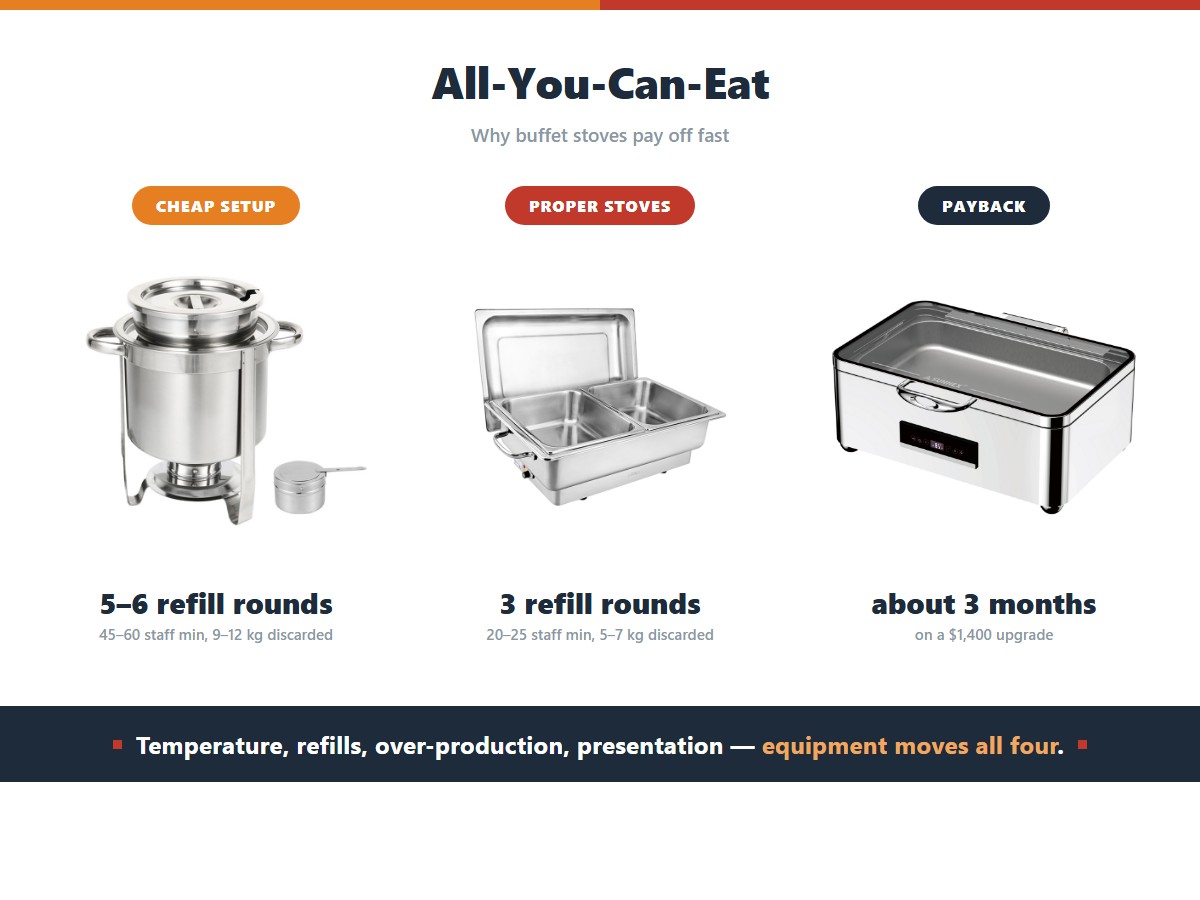
| Refill rounds per service | 5-6 | 3 |
| Staff minutes per service | 45-60 | 20-25 |
| Food discarded per day | 9-12 kg | 5-7 kg |
| Monthly labour and waste cost | $1,250 | $760 |
| Payback on a $1,400 upgrade | — | About 3 months |
Waste control is a pan-size decision
Most AYCE waste comes from keeping full pans on the line until close. Swap to half-size pans after the first 90 minutes: the pan looks full, the food stays fresher because it turns over faster, and you cook less of what nobody is eating. Operators who make this one change typically report 8-15% lower food cost with no drop in guest satisfaction.
Labour: the number nobody budgets
Every refill round is a walk from the kitchen to the line, a lid lift, a pan swap and a wipe. In a 200-cover room that is 20-30 minutes per service, or roughly 150 hours a year. At $12 an hour that is $1,800 — more than the equipment upgrade that removes a third of the rounds.
Five equipment choices that suit AYCE specifically
- Roll-top lids — guests serve one-handed and the lid stays clear of the food.
- 65 mm pan depth — deep enough for volume, shallow enough to refill fast.
- Thermostat at 60-70°C — not maximum, which dries sauces and splits cream.
- Replaceable elements — a failed element must not close a station at 19:30.
- One spare frame per station — the swap takes seconds and saves the service.
Frequently Asked Questions
How many pans does an all-you-can-eat buffet need per 100 guests?
Four full-size pans and three half-size pans for a hot line with two entrées, two sides and one vegetarian option. Add a separate dessert or carving station if the menu includes them.
Is electric or fuel better for AYCE?
Electric for a fixed room: the thermostat holds temperature through a three-hour service, and there are no cans to swap while guests are watching the line.
How do I stop food drying out on the line?
Keep the water bath at 1 inch, set the thermostat to 60-70°C rather than maximum, keep lids closed between guests, and use half pans late in service so the food turns over faster.
What is a normal food cost for an AYCE buffet?
Typically 28-35% of revenue. Equipment-driven waste control usually moves that by 2-4 points, which is more than most menu changes achieve.
Do I need a separate circuit for each pan?
No. Two 400-600 W units can share a 16 A circuit. Keep carving and induction stations on their own breakers.