




Buffet Stove Energy: 6 Tips That Pay Real Money
Short answer: Four energy moves pay for a buffet stove: fit a thermostat, size the element to the load, hold at 70–75°C instead of full power, and lid every pan between services. Together they cut consumption 35–55% against an unregulated unit. Three common tips pay nothing: preheating early, defrosting pans overnight, and buying a larger unit than the menu needs. See buffet station equipment.
Commercial buffet stoves are essential for high-volume food service, but they can also be a major energy drain—accounting for 10–15% of a restaurant’s total energy bill. For cost-conscious operators, small changes to how you use and maintain your buffet stoves can cut energy costs by 20–30% annually. In this guide, we’ll share practical, proven tips for saving energy and reducing costs with your buffet stoves, from equipment selection to daily operation habits.

Choose High-Efficiency Models
The biggest energy savings come from upgrading to high-efficiency buffet stoves. Models like the Full Size 11L Electric Chafer with ≥80% thermal efficiency use 20% less energy than standard models. Look for ENERGY STAR certified models or those with smart mode that adjusts power output based on food volume. Over a year, this efficiency gain can save + for a typical 200-seat buffet restaurant.
Turn Off Stoves During Slow Periods
Many operators leave buffet stoves on all day, even during slow morning or afternoon periods. Turning off stoves when not in use (or switching to low-power mode) can cut energy use by 40% during off-peak hours. Digital models with programmable timers (like the Electric Chafing Dish W20) let you schedule automatic on/off times, so stoves are only on when needed for service.

Maintain Water Levels to Reduce Heat Loss
Water bath buffet stoves lose efficiency when water levels are low, as the heating element has to work harder to maintain temperature. Check water levels every 2 hours during service, and refill before levels drop below the minimum line. Models with visible water level indicators (like the Electric Chafing Dish Food Warmer) make this check quick and easy, reducing the chance of low-water inefficiency.
Top Energy-Efficient Buffet Stoves
When selecting a buffet stove for energy savings, prioritize high thermal efficiency, programmable controls, and low standby power. Below are two BAVA models designed for cost-conscious operators:

Full Size 11L Electric Chafer
The features ≥80% thermal efficiency and smart mode that reduces power use by 30% during low-food periods. Its 1100W power reaches optimal temperatures in 12 minutes, reducing pre-service energy waste. The polished stainless steel construction retains heat better than cheaper models, cutting heat loss by 15% during service.

Electric Chafing Dish-W07
This 900W model features intelligent temperature control that adjusts power based on food volume, cutting energy use by 25% compared to fixed-power models. It includes anti-dry heat protection that shuts off the stove if water levels are too low, preventing wasted energy and equipment damage. It’s ideal for cost-conscious restaurants looking to cut energy bills without sacrificing performance.
Use Lids to Retain Heat
Every time a buffet stove lid is opened, 10–15% of heat escapes, forcing the stove to use more energy to reheat. Train staff to keep lids closed as much as possible, and use models with roll-top lids (like the StoveMaster Series) that let guests serve without fully opening the lid. This simple habit can cut energy use by 10% per shift, adding up to hundreds of dollars in annual savings.
Conclusion
Saving energy and reducing costs with buffet stoves doesn’t require expensive upgrades—small changes like choosing high-efficiency models, turning off stoves during slow periods, and maintaining water levels can deliver big savings. BAVA’s Full Size 11L Electric Chafer and Electric Chafing Dish-W07 are trusted by cost-conscious operators worldwide for their energy efficiency and reliability. Whether you’re running a small café or a large hotel buffet, these tips will help you cut your energy bills while maintaining high food quality for your guests.
Browse the full chafing dish range for current models and configurations.
Savings by Measure
| Measure | Cost | Saving | Payback | Verdict |
|---|---|---|---|---|
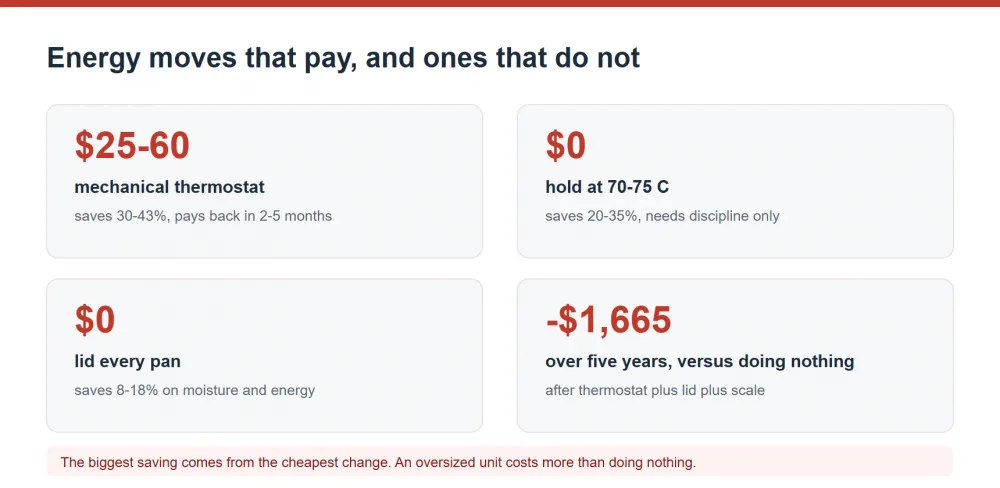
| Fit a mechanical thermostat | $25–60 | 30–43% | 2–5 months | Best single move |
| Hold at 70–75°C, not full power | $0 | 20–35% | Immediate | Free, needs discipline |
| Lid every pan between services | $0 | 8–18% | Immediate | Free |
| Right-size the element to the pan | $0 if correct | 10–20% | Immediate | Check before buying |
| Switch off or drop to low between waves | $0 | 5–12% | Immediate | Only if food allows |
| Clean the element scale monthly | $5–15 | 3–7% | 2–6 months | Worth it |
| Preheat 45 min early | Wasted energy | −5–12% | — | Does not pay |
| Defrost pans overnight on the line | $0 | −3–8% | — | Does not pay |
| Buy a larger unit than needed | +$150–400 | −10–25% | — | Does not pay |
One Unit, 300 Service Hours
| Setup | Annual energy | Equipment | Five-year total | Versus unregulated |
|---|---|---|---|---|
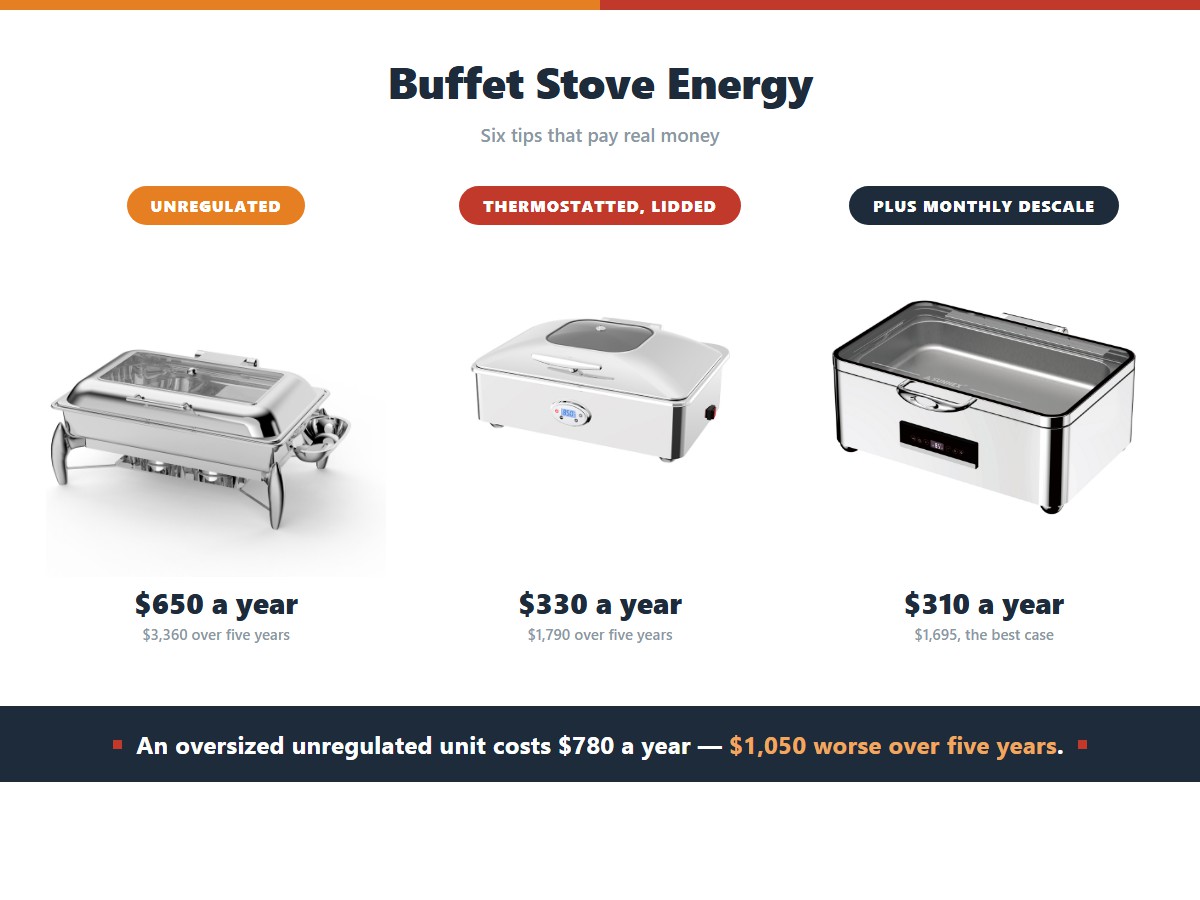
| Unregulated, full power | $650 | $110 | $3,360 | Baseline |
| Unregulated, thermostatted, 70–75°C | $390 | $140 | $2,090 | −$1,270 |
| Thermostatted, lidded, correct setpoint | $330 | $140 | $1,790 | −$1,570 |
| Thermostatted, lidded, monthly descaled | $310 | $145 | $1,695 | −$1,665 |
| Oversized unit, unregulated | $780 | $510 | $4,410 | +$1,050 worse |
The pattern worth noticing is that the biggest saving comes from the cheapest change. A $25 mechanical thermostat plus the discipline to run it at 70–75°C cuts consumption roughly in half, and the oversized-unit option is the only line on the table that ends up more expensive over five years than doing nothing. Sizing a unit to the menu is the one purchasing decision that determines the energy bill for the rest of its life.
Frequently Asked Questions
How do I reduce energy use on a buffet stove?
Fit a mechanical thermostat, hold at 70–75°C instead of full power, lid every pan between services, and check the element is correctly sized for the pan. Together those four cut consumption 35–55% and cost between $25 and $60.
Does a thermostat really save that much electricity?
30–43% against an on/off switch, which is the mechanism working as designed. The thermostat cuts the element in and out at the setpoint rather than running it flat out. It also cycles more often, which raises the element failure rate from about 0.2 to 0.6 a year, so the element becomes a consumable.
Should I switch off buffet stoves between services?
Only if there is no food in the pans and nothing is being reheated. Dropping to the lowest setting that holds is correct; full shutdown means a 12–18 minute preheat to bring it back, which costs more than the 5–12% you saved.
Does preheating earlier use more energy?
It wastes it. Starting 45 minutes early runs the element empty for half an hour, which costs 5–12% of a service's energy and dries nothing. Preheat is 12–18 minutes on an electric unit and 8–10 on fuel, and starting early is the most common energy mistake on a buffet line.
Is a bigger buffet stove more energy efficient?
No, the opposite. An oversized unit on a small load runs its full element against a small pan of food, and it costs 10–25% more over five years than doing nothing. Size the unit to the pans you actually use, not to the volume you think you might serve.
Related reading
- Energy-Efficient Buffet Stoves: What the Label Won't Tell You
- Buffet Stove Energy Use: Where the Watts Go
- Buffet Stove Value: Where the Money Actually Goes
- Buffet Stoves for Small Restaurants: What Actually Fits
- 10 Wedding Buffet Ideas Guests Actually Remember
- All-You-Can-Eat: Why Buffet Stoves Pay Off Fast