




Can Buffet Stoves Reduce Labor Costs in Your Restaurant?
Short answer: Buffet stoves reduce buffet labour by 0.5–1.6 staff hours per 120-cover event, which is a 15–25% reduction in service labour rather than a headcount cut. At $25 an hour that is $12–40 per event saved. They replace supervision and reheating, not people, so the honest framing is hours saved rather than roles removed. See buffet station equipment.
Where the Labour Actually Goes
| Activity | Without stoves | With stoves | Hours saved | Notes |
|---|---|---|---|---|
| Site setup | 45 min | 20 min | 0.42 h | Parallel preheat |
| Reheating batches | 3 batches, 55 min | 2 batches, 30 min | 0.42 h | Faster recovery |
| Watching hot food | Dedicated, 60 min | Intermittent | 0.75 h | The biggest gain |
| Temperature checks | Not required | Required, logged | −0.08 h | An honest cost |
| Guest surge response | Reheat from cold | Hot well buffer | 0.33 h | Flexibility value |
| Breakdown recovery | Varies | Varies | 0.00 h | Needs a spare |
| Total per 120 covers | 2.6 h | 1.0–1.5 h | 0.5–1.6 h | 15–25% reduction |
Annual Labour Economics, One Unit
| Events per year | Hours saved | At $18/h | At $25/h | At $35/h | Equipment | Payback |
|---|---|---|---|---|---|---|
| 15 | 0.5 h | $135 | $188 | $263 | $180 | 6–16 months |
| 30 | 1.0 h | $540 | $750 | $1,050 | $320 | 4–7 months |
| 60 | 1.2 h | $1,296 | $1,800 | $2,520 | $470 | 2–4 months |
| 120 | 1.4 h | $3,024 | $4,200 | $5,880 | $860 | 1.7–3.4 months |
| 250 | 1.6 h | $7,200 | $10,000 | $14,000 | $2,400 | 1–2 months |
The most important word in this article is hours, not heads. In a busy operation those hours go back to serving rather than onto a redundancy list, and that is the honest expectation to set with a team. Anyone promising headcount reduction from two stoves has misunderstood what the equipment does.
The labour question deserves a more careful answer than a percentage, because the same piece of equipment produces very different results in different kitchens. A buffet stove removes two specific jobs from the line: holding food at temperature without supervision, and reheating batches that have cooled below service temperature. It does not remove cooking, it does not remove plating, and it does not remove the person who stocks the pans. What it does is take the most interruptible, least skilled task on a buffet line and make it automatic, which is worth something in every kitchen and worth a great deal in some.
There is a second, less obvious labour effect that only appears in venues running more than one service a day. A hot well is a buffer. When a surge of guests arrives forty minutes early, a kitchen with a hot well serves them from a held temperature, while a kitchen without one starts a fresh batch and adds twenty-five minutes to the wait. That twenty-five minutes is staffed time that would otherwise have been spent on the floor, and it is why the guest surge row in the table above is a real gain rather than a rounding error.
What the Numbers Assume
| Assumption | Conservative | Typical | Optimistic | Note |
|---|---|---|---|---|
| Guests per event | 60 | 120 | 200 | Drives the volume of food handled |
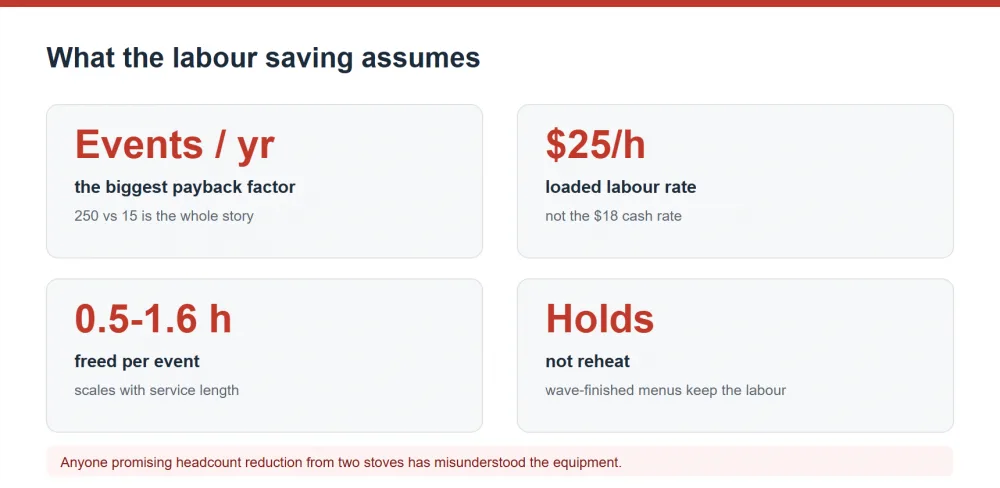
| Events per year | 15 | 60 | 250 | The single biggest factor in payback |
| Labour rate loaded | $18/h | $25/h | $35/h | Including employer costs |
| Service length | 2 hr | 3 hr | 4 hr | Longer service, more saved |
| Hours freed per event | 0.5 h | 1.0 h | 1.6 h | See the breakdown above |
| Years the unit lasts | 3 | 5 | 8 | With the element replaced once |
Two of these rows deserve attention. Event volume is the biggest factor in payback by a wide margin, which is why the same unit can be a two-month investment in a hotel running 250 breakfasts and a never-earning asset in a hall that hosts fifteen events a year. And the labour rate is often understated: a fully loaded rate including employer costs, holiday cover and the manager time that goes into covering a gap is closer to $25 than to $18.
When the Saving Does Not Materialise
| Situation | Why the saving is lost | What to do instead |
|---|---|---|
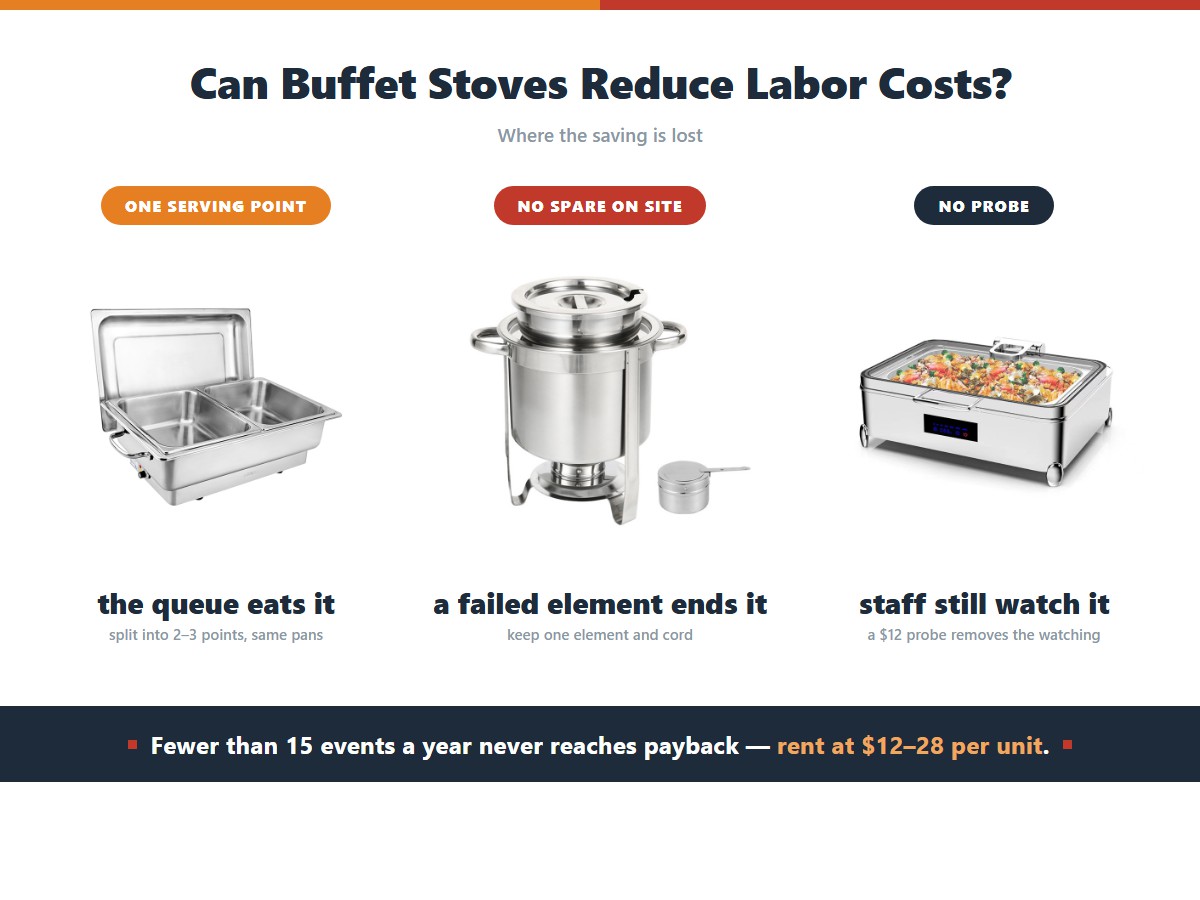
| One long serving point | The freed time is consumed by the queue | Split into 2–3 points, same pans |
| No spare unit on site | A failed element ends the service and the saving | Keep one spare element and cord |
| Volunteer-staffed operation | Nobody is paid, so nothing is saved in cash | Treat it as a quality improvement |
| Fewer than 15 events a year | Never reaches payback | Rent instead, $12–28 per unit per event |
| No temperature probe on the line | Staff cannot verify, so they still watch it | A $12 probe removes the need to watch |
| Menu needs reheating mid-service | Reheat batches are still there | Hold hot wells ready to receive |
The last row of the first table and the first row of the second are the same point made two ways. A buffet stove holds; it does not reheat. If your menu requires food to be finished in waves, the reheating labour stays, and the equipment only removes the supervision component. That is still a real gain, but it is a smaller one, and it should be presented that way to anyone deciding whether the purchase makes sense.
Frequently Asked Questions
Can buffet stoves reduce staff numbers?
Not reliably. They reduce supervision and reheating hours by 0.5–1.6 hours per 120-cover event, which in a busy operation returns to serving rather than to a headcount reduction. Expect fewer overtime hours, not fewer people.
How many staff hours are saved per event?
Roughly 0.5 to 1.6 hours for a 120-cover event, a 15–25% reduction in service labour. The largest single gain is about 45–75 minutes of not having to watch hot food continuously.
What is the labour payback period?
Two to seven months for an operation running 30 or more events a year. Below 15 events a year it never pays back, and heavily volunteer-staffed operations may never realise the saving in cash terms.
Do buffet stoves replace kitchen staff?
No. They remove reheating and holding work from the line, not cooking. A kitchen still produces the food; the stove simply keeps it at temperature without someone standing beside it.
Is the labour saving bigger than the energy saving?
By two orders of magnitude. Energy is $0.22–0.40 an hour while labour saved is $4–9 an hour of served time. Any return-on-investment argument should be built on labour.
Related reading
- Top Brands for Buffet Warmers in the Market – how to judge a brand before you buy
- Buffet Stove Price Breakdown: What Drives the Cost – where the money in a $320 unit goes
- High-Traffic Buffets: Why Cheap Warmers Fail – which parts decide failure at high duty
- Buffet Stove Maintenance: The Monthly Checklist – the ten minutes that protect the element
- 5 Buffet Stove Features That Matter (and 3 That Don’t) – where to spend and where not to
- Commercial buffet station equipment – the current range with published specifications