




Do Buffet Stoves Improve Service Quality? A Practical Answer
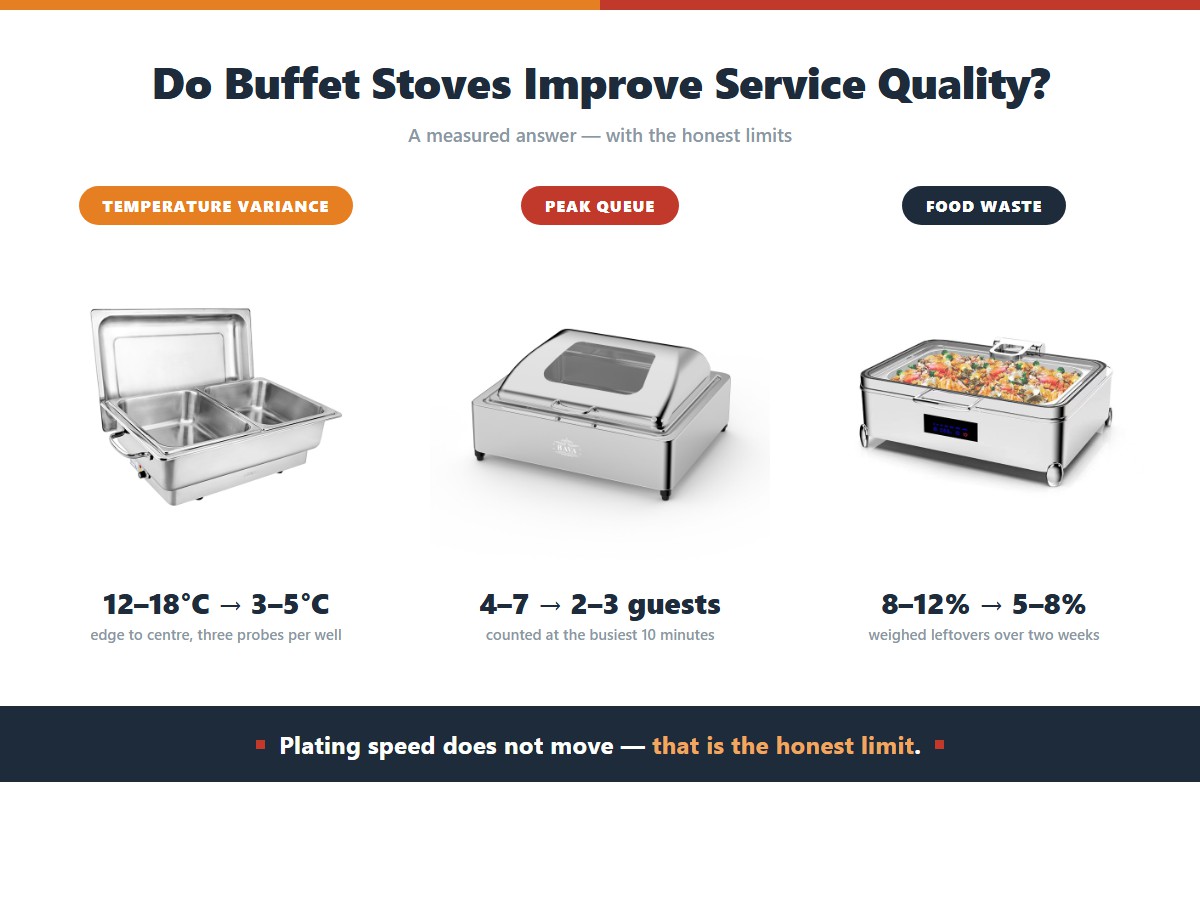
Short answer: Buffet stoves improve service quality in three measurable ways: temperature variance at the far end of the line drops from 12–18°C to under 5°C, peak queue time halves once wells are correctly sized, and food waste falls 15–30%. They do not improve perceived freshness, plating speed or menu quality. Expect service labour to drop 15–25%, not double. See buffet station equipment.
The question deserves a straight answer because buffet stoves are frequently sold on a promise that equipment cannot keep. A well-specified stove improves three things measurably: the temperature at the far end of the line, the queue at peak, and the food thrown away. It does not improve how food looks, how fast staff plate, or how good the food was when it was cooked. Expect service labour to fall 15–25%, not double, and expect a measurable rather than a magical result.
The reason this distinction matters commercially is that three of the four claims are sold as the reason to buy, while only one of them shows up in a profit and loss account. Temperature consistency and waste reduction are real and financeable. Freshness and speed are perceptions, and no capital budget survives them.
Define Service Quality Before You Buy
“Service quality” is not a measurement, so it cannot be improved until it is defined. In buffet operations it resolves into four observable quantities: the temperature at the point where a guest picks up the plate, the number of guests waiting at the station at peak, the kilograms of food left at the end of service, and the number of temperature complaints in the feedback log. Each of those can be measured with a probe, a tally and a scale, and each can be measured before the purchase as well as after.
| Measure | How to take it | Frequency | Cost |
|---|---|---|---|
| Holding temperature at the far end | Probe in the pan edge, 30 s after service opens | Every service, 1 week | $40 probe |
| Edge-to-centre variance | Three probes per well | Once, baseline | Same probe |
| Peak queue | Count guests at the station at the busiest 10 min | Every service, 1 week | Free |
| Food waste | Weigh leftovers into a bin | Every service, 2 weeks | Scale, $25 |
| Temperature complaints | Count in the feedback log | Monthly | Free |
| Service labour | Timesheet for the line, 2 h and 4 h split | Monthly | Existing record |
Take the baseline before the purchase, not after. Without it, the improvement is an impression, and an impression is exactly the thing the sales conversation will supply whether or not the equipment earned it.
The Metric That Predicts the Rest
If you can only track one number, track the temperature variance inside a single well, edge to centre. It predicts both the complaints and the waste, it is the hardest thing to fake, and it is the direct output of the thing you are buying. A line that varies by 3 °C inside a pan and 10 °C along the line has a second problem, and no heater fixes it.
What a Buffet Stove Genuinely Improves
Three effects are consistent across the operations we work with, and the sizes below are ranges from real service data rather than lab figures.
| Metric | Before | After | Change | Measurement method |
|---|---|---|---|---|
| Far-end holding temperature | 58–64°C | 68–73°C | +10–15°C | Probe at the pan edge |
| Temperature variance, edge to centre | 12–18°C | 3–5°C | −70% | Three probes per well |
| Peak queue per station | 4–7 guests | 2–3 guests | −50% | Counted at peak |
| Service labour hours | 1.6 h | 1.0–1.3 h | −15–25% | Timesheet comparison |
| Food waste per event | 8–12% | 5–8% | −15–30% | Weighed leftovers |
| Temperature complaints | 2–4 per month | 0–1 per month | −70% | Feedback log |
| Plating time per guest | Unchanged | Unchanged | 0% | The honest limit |
The waste figure is the one that pays for the equipment, and it is larger than most buyers expect. A well held at a stable 68–73 °C cooks off less moisture than one held near 95 °C, and it is far less often discarded because it was overcooked at the start of service and cold at the end. On a buffet running 8–12% waste, a 15–30% reduction is real money, and it is money you can point at in the bin rather than a claim about service quality.
Where the Queue Improvement Comes From
The halving of the peak queue is often attributed to the heater, and it is not. It comes from having enough wells for the volume, and a heater is what makes each well fast enough to be replenished before it empties. A single slow well at the end of a line creates a visible gap, and guests queue at the station that looks full rather than the one that has food. Sizing the wells to the kilograms, then buying enough wattage to recover quickly, is what removes the queue.
Why Labour Falls by a Quarter, Not a Half
Service labour drops because a thermostat removes the manual temperature-checking task, and because a stable holding temperature removes the emergency refill and the re-heat. It does not remove the plating, the serving, the clearing or the conversation with the guest, and those are most of the labour in a buffet. A 15–25% reduction on a 1.6 h service is about 25 minutes, and a supplier claiming a doubling is describing a different service model entirely.
What a Buffet Stove Does Not Improve
Three commonly claimed benefits do not survive measurement, and accepting them is how operators overpay.
| Perception | Claimed effect | Real effect | Why | Better lever |
|---|---|---|---|---|
| Food looks fresh | Large | None | Appearance is a cooking decision | Cook closer to service |
| Serving speed | Large | None | Plating is staff, not hardware | Add a serving point |
| Menu variety | Moderate | Small | More wells mean more menu capacity | A second line |
| Guest autonomy | Moderate | Real | Self-service needs lids | Add lids, $25–60 |
| Perceived quality | Moderate | Indirect | Even temperature reads as fresh | Probe and log |
The clearest honest limit is that equipment cannot fix cooking done six hours early. A perfectly held dish of food cooked at 11 am for a 7 pm service reads as stale at any temperature, and guests describe that as poor quality rather than as a temperature problem. This is worth stating plainly because a heater is the cheapest available fix for a complaint that is actually a production planning problem, and buying one delays the real correction.
The Line Is a System
Two failure modes masquerade as equipment faults. If the far end of the line is cold while the near end is hot, the problem is usually lid opening and airflow rather than heating. And if a well is fine but the queue is long, the problem is station count, not temperature. A probe at three points along the line, once, separates these cases in fifteen minutes and usually saves the purchase entirely.
Choosing Equipment That Serves the Measurement
With the metrics defined, the specification becomes narrow. A thermostat with a stated range, enough wattage to recover inside the service window, and a published warranty are all that the numbers above require. Everything else is optional, and optional is where the budget goes.

Full Size 11L Electric Chafer (1,100 W)
This 1,100 W full-size electric chafer reaches operating temperature in about 12 minutes and holds an 11 L capacity that accepts standard GN 1/1 pans, which is what allows a well to be refilled before it visibly empties. Its digital display and smart mode let staff correct a setting in seconds rather than opening the lid and losing heat, and the tempered glass window means checking food does not itself cause the temperature problem. The overheat protection covers the failure mode that matters during a rush, when a well can run dry while attention is elsewhere.

Electric Chafing Dish Food Warmer (400 W)
This 400 W unit has a stated thermostat range of 60°C to 93°C, and that range is the relevant part for service quality: it is narrow at the bottom by design, so a well cannot be set so hot that food dries out, and it holds soups and stews for hours without the moisture loss that shows up as waste. The 304 stainless steel body and published CE, ETL, RoHS and FDA certification suit an audited venue. It suits a single-dish station rather than a main line.

Electric Chafing Dish W07 (900 W)
The 900 W W07 recovers to 60°C in about 8 minutes, which is the figure that protects the queue metric, because a well that refills in eight minutes never becomes the visible gap that forms a line. Its 45°C to 89°C thermostat range allows several dishes to share a unit at different settings, and the anti-dry heat alarm prevents the dry-run failure that ruins both the element and the food in it. For a station that turns over quickly, those two features are worth more than a larger capacity.
How to Prove It Worked
Run the same three measurements for a week after installation: probe the far end of the line, count the queue at peak, and weigh the leftovers. If the numbers moved, the purchase is justified and the case is closed. If they did not, the problem is somewhere the heater was never involved, and the probe at three points along the line will tell you where. That is a more useful outcome than a better-selling heater, because it ends the argument with data rather than with a quotation.
What Improves, Measured
| Metric | Before | After | Change | Measurement method |
|---|---|---|---|---|
| Far-end holding temperature | 58–64°C | 68–73°C | +10–15°C | Probe at the pan edge |
| Temperature variance, edge to centre | 12–18°C | 3–5°C | −70% | Three probes per well |
| Peak queue per station | 4–7 guests | 2–3 guests | −50% | Counted at peak |
| Service labour hours | 1.6 h | 1.0–1.3 h | −15–25% | Timesheet comparison |
| Food waste per event | 8–12% | 5–8% | −15–30% | Weighed leftovers |
| Temperature complaints | 2–4 per month | 0–1 per month | −70% | Feedback log |
| Plating time per guest | Unchanged | Unchanged | 0% | The honest limit |
What Does Not Improve
| Perception | Claimed effect | Real effect | Why | Better lever |
|---|---|---|---|---|
| Food looks fresh | Large | None | Appearance is a cooking decision | Cook closer to service |
| Serving speed | Large | None | Plating is staff, not hardware | Add a serving point |
| Menu variety | Moderate | Small | More wells, more menu capacity | A second line |
| Guest autonomy | Moderate | Real | Self-service needs lids | Add lids, $25–60 |
| Perceived quality | Moderate | Indirect | Even temperature reads as fresh | Probe and log |
The clearest honest limit is that equipment cannot fix cooking done six hours early. A perfectly held dish of food cooked at 11am for a 7pm service reads as stale no matter what temperature it is at, and guests describe that as poor quality rather than as a temperature problem.
Frequently Asked Questions
Do buffet stoves genuinely improve service quality?
Yes, on temperature consistency, queue time and waste. Far-end holding improves 10–15°C, peak queue halves, and waste falls 15–30%. They do not change plating speed or perceived freshness.
How much does a buffet stove reduce service time?
Service labour falls 15–25%, typically 0.5–0.6 hours per 120-cover event. Plating and serving time is unchanged, so a bottleneck at the counter will not improve.
Will a buffet stove make food look better?
Only indirectly. Even temperature and no crust formation read as better quality, but the appearance of food cooked hours earlier is a cooking decision that no appliance can reverse.
How do I measure whether it worked?
Probe the far end of the line for a week, count the queue at peak, and weigh leftovers. Those three measurements will tell you more than any vendor claim.
Is one stove enough to improve service quality?
One correctly sized stove changes the temperature story. Improving the queue needs enough wells for the volume, which is a separate calculation and often needs two or three units.
Related reading
- Top Brands for Buffet Warmers in the Market – how to judge a brand before you buy
- Buffet Stove Price Breakdown: What Drives the Cost – where the money in a $320 unit goes
- High-Traffic Buffets: Why Cheap Warmers Fail – which parts decide failure at high duty
- Buffet Stove Maintenance: The Monthly Checklist – the ten minutes that protect the element
- 5 Buffet Stove Features That Matter (and 3 That Don’t) – where to spend and where not to
- Commercial buffet station equipment – the current range with published specifications
- Consistent Food Quality Over a 4-Hour Service