


Buffet Stove Setup for Catering: Field Checklist
Short answer: A catering setup checklist has eleven items and takes 45–60 minutes for a three-unit line: power or fuel confirmed, water pans filled cold, 8–18 minutes of preheat, food at 85°C, pans two thirds full, lids and probes packed, spare element and cord on site, a spare unit ready, serving point split, and a signed temperature log. See buffet station equipment.
Planning a catering event, whether it’s a corporate luncheon, wedding reception, or high-volume buffet service, requires meticulous attention to every detail of the setup. A poorly arranged buffet stove configuration leads to slow service, food temperature issues, and frustrated guests — all of which damage your reputation and repeat business. The ultimate buffet stove setup is one that runs seamlessly in the background, keeping food at peak quality while letting your staff focus on guest experience rather than equipment troubleshooting.
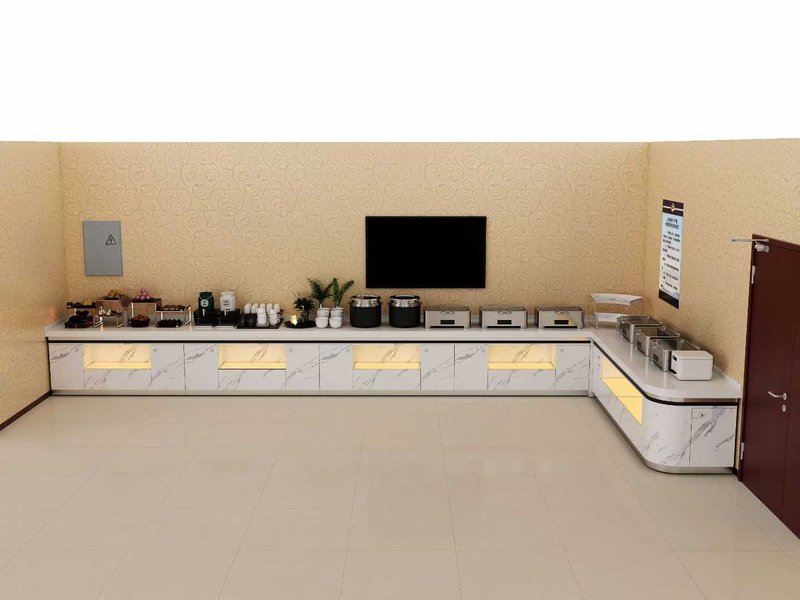
A seamless buffet stove setup starts with selecting the right equipment for your event’s volume and menu. Commercial-grade chafing dishes (buffet stoves) are non-negotiable for professional catering: they deliver even heat distribution, precise temperature control, and durability that consumer-grade warmers can’t match. For events serving 100+ guests, opt for high-capacity 11L GN 1/1 size chafers that reduce refill frequency, while smaller events may use compact 5.5L models for flexibility.
Layout Planning for Maximum Efficiency
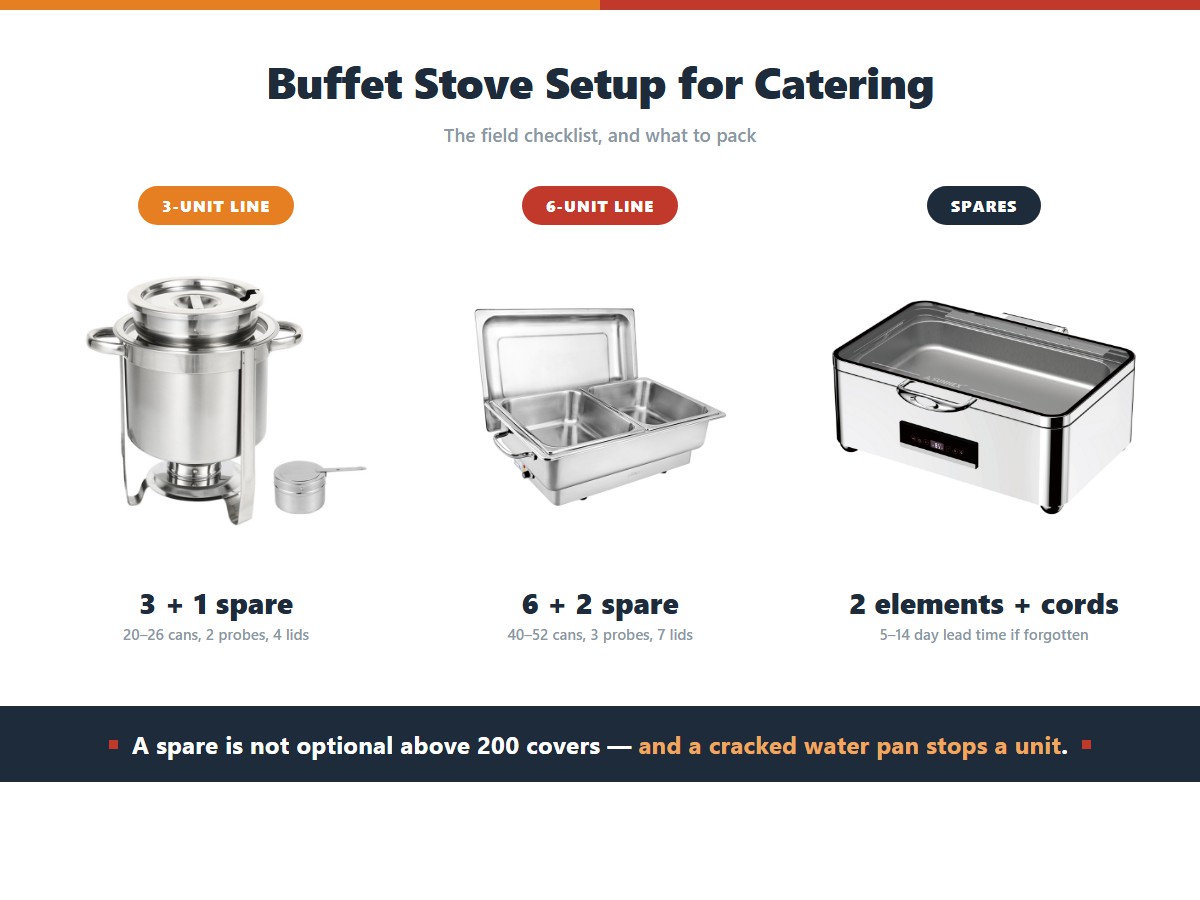
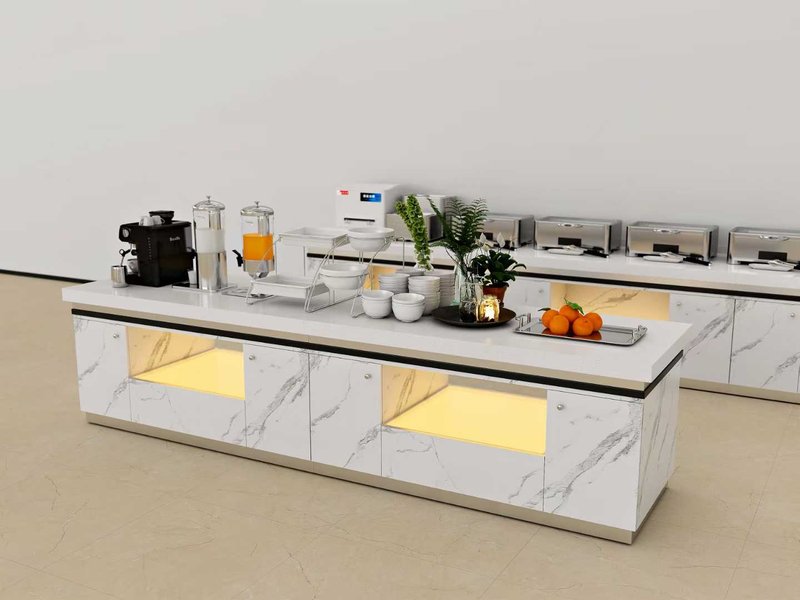
The physical arrangement of your buffet stoves is the biggest factor in seamless service. Place chafers in a logical flow that matches your menu: appetizers first, mains next, sides and vegetables, then desserts. Leave 3-4 feet of space between each station to prevent crowding, and ensure staff have clear access paths to refill or adjust equipment without disrupting the guest flow.
For cocktail-style events with multiple buffet stations, mirror the setup at each station so guests can move between them without confusion. Label each chafer clearly with the dish name and any dietary indicators (vegan, gluten-free) to reduce staff questions and speed up service. BAVA’s chafing dishes feature polished stainless steel surfaces that are easy to label with removable stickers or chalkboard signs.
Temperature Management for Consistent Quality
Seamless buffet service relies on zero temperature fluctuations. Preheat all chafers 30 minutes before service starts, and use models with digital temperature displays to monitor heat levels at a glance. For hot dishes, maintain a minimum of 60°C (140°F); for cold dishes, use separate chilled buffet stations to avoid cross-temperature contamination.
BAVA’s Electric Chafing Dish W20 simplifies temperature management with its OLED touchscreen and 3-layer base that retains heat even when the power fluctuates. Its 900W heating element reaches optimal temperature in 8 minutes, and adjustable temperature range (45–90°C) lets you customize settings for delicate dishes like fish or hearty stews. Overheat protection and auto shut-off features eliminate safety risks during long events.
Spotlight on BAVA Buffet Stoves for Catering

Electric Chafing Dish-W20
BAVA’s W20 Chafing Dish is built for high-end catering events that demand reliability and precision. Its OLED touchscreen lets staff adjust temperatures with one tap, while the 3-layer base retains heat efficiently to cut energy use. The 304 stainless steel construction is scratch-resistant and easy to sanitize between events, and its GN 1/1 size food pan accommodates large batches of mains or sides. With CE, ETL, and RoHS certifications, it meets strict safety standards for commercial catering worldwide.

Electric Chafing Dish-BA Series
The BA Series from BAVA offers flexible capacity options (5.5L–13.5L) to suit events of any size, from intimate weddings to large corporate galas. Its 400W heating element and smart temperature control maintain consistent heat, while dry burn protection prevents accidents if water levels drop. Available in rectangular, square, and round shapes, it adapts to any buffet layout, and its polished stainless steel finish adds a professional touch to your setup. It’s also certified by CE and ETL, making it a trusted choice for catering businesses of all sizes.
Staff Training and Workflow Integration
Even the best setup fails without trained staff. Train your team to check water levels in chafers every 30 minutes, monitor temperature displays, and refill dishes before they drop below 1/3 full. Assign one staff member per 3-4 chafers during peak service to ensure quick response times. For multi-day events, schedule daily equipment checks to clean food pans, descale heating elements, and test temperature controls before each service period.
Conclusion
The ultimate buffet stove setup is a balance of high-quality equipment, smart layout planning, and trained staff. By investing in BAVA’s commercial chafing dishes and following these setup best practices, you can deliver seamless catering experiences that keep guests coming back. Whether you’re hosting a 50-person wedding or a 500-person corporate event, the right buffet stove configuration ensures food quality, service speed, and guest satisfaction every time. Upgrade your catering setup today, and take the stress out of buffet service.
Browse the full chafing dish range for current models and configurations.
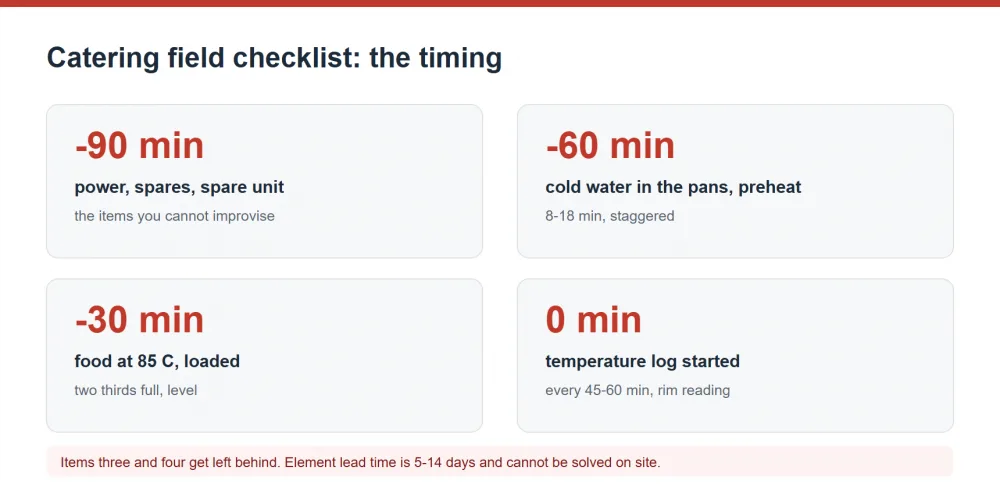
The Eleven-Item Field Checklist
| # | Item | Timing | Pass condition | If it fails |
|---|---|---|---|---|
| 1 | Power or fuel confirmed | −90 min | Correct voltage, dedicated circuit | Find power or switch to fuel |
| 2 | Transport cases counted | −90 min | Listed count matches | Stop, recount, source locally |
| 3 | Spare element and cord packed | −90 min | Both in the vehicle | 5-day lead time from here |
| 4 | Spare unit loaded | −90 min | Preheated or ready to swap | A failure ends the service |
| 5 | Water pans filled, cold | −60 min | Two thirds, level | Empty pan warps in 20–40 min |
| 6 | Preheat started | −60 min | 8–18 min, staggered | Late service |
| 7 | Food at 85°C | −30 min | Probed, not assumed | 15–25°C drop in the pan |
| 8 | Pans loaded two thirds | −15 min | Level surface, space for the probe | Overheating, 10–20% waste |
| 9 | Serving points split | −15 min | 2–3 points, 30 guests each | Wait 5–7 min instead of 1–2 |
| 10 | Lids, probes, gloves packed | −10 min | One lid and probe per pan | Excuses to skip the checks |
| 11 | Temperature log started | 0 min | Time and rim reading | No record of a safety failure |
Vehicle Load Checklist
| Category | 3-unit line | 6-unit line | Note |
|---|---|---|---|
| Buffet units | 3 + 1 spare | 6 + 2 spare | Spare is not optional above 200 covers |
| Fuel cans | 20–26 | 40–52 | Plus one spare per event |
| Spare element and cord | 2 each | 3 each | Lead time is 5–14 days |
| Probe thermometers | 2 | 3 | One per station plus one spare |
| Lids | 4 | 7 | One per pan plus one spare |
| Water pans and spares | 4 | 7 | A cracked pan stops a unit |
| Wet cloths and gloves | 6 | 12 | Cleaning during service |
| Log sheet or tablet | 1 | 2 | Every 45–60 min, rim reading |
Items three and four are the ones that get left behind, and they are the two that convert a five-minute problem into an unrecoverable one. A spare element has a five to fourteen day lead time, and a spare unit has none. Everything else on this list can be improvised on site; those two cannot.
Frequently Asked Questions
What should a catering buffet setup checklist include?
Eleven items: power or fuel confirmed, cases counted, spare element and cord packed, spare unit loaded, water pans filled cold, preheat started, food at 85°C, pans two thirds full, serving points split, lids and probes packed, and the temperature log started.
How long does it take to set up a catering buffet line?
Forty-five to sixty minutes for a three-unit line, of which the preheat is 8–18 minutes per unit and can be staggered. The active loading time is 15 to 20 minutes. Starting at minus 90 minutes gives room for a power problem, which is the reason people arrive late.
What spare parts should a catering team carry?
At minimum a spare heating element and power cord per two units, plus one spare unit for any event over 200 covers. Element lead time is 5–14 days and cannot be solved on site, which makes these the highest-value items in the vehicle.
How do you split a buffet line into serving points?
Plan 30 guests per serving point and split the same pans across two or three points rather than adding more pans. That cuts peak wait from five to seven minutes to one or two, at no equipment cost. One long line with a gap in the middle achieves nothing.
Do I need a temperature log for a private event?
You need the readings, and writing them down costs about ten seconds each. The log is the only record that a food temperature was checked, and it is the first thing asked for after any incident. A phone note is fine; memory is not.
Related reading
- Outdoor Catering: Buffet Stoves That Survive Wind
- Catering Event Timeline: From Setup to Takedown
- Free Buffet Setup Checklist (Printable PDF)
- Buffet Stove Maintenance: The Monthly Checklist
- Buffet Stove Setup: Water, Heat and Placement
- Large-Scale Catering: Buffet Stove Sizing Rules
- Buffet Stove vs Chafing Dish: Same Job, Different Build