




Commercial Chafer Dish: Temperature Control for Food Safety
Short answer: A chafer dish with temperature control earns its name only if the control is a thermostat with a stated tolerance, and the four numbers to verify are the setpoint range, the tolerance, the hold time at setpoint, and the sensor position. A unit that holds within ±2°C of a 70°C setpoint for four hours can be documented; a unit with an on/off bimetallic switch cannot be, and the difference between those two is the difference between a defensible food safety file and a guess. See chafing dish temperature control options.
Food safety in a buffet is not a matter of the unit reaching a temperature. It is a matter of the unit holding that temperature at the place the food actually is, for as long as the service lasts, and being able to prove it afterwards. That last part is where most operations fall down: the record is missing, so the temperature is assumed, and an assumption is not a defence. A controlled chafer solves the documentation problem as much as the temperature problem.
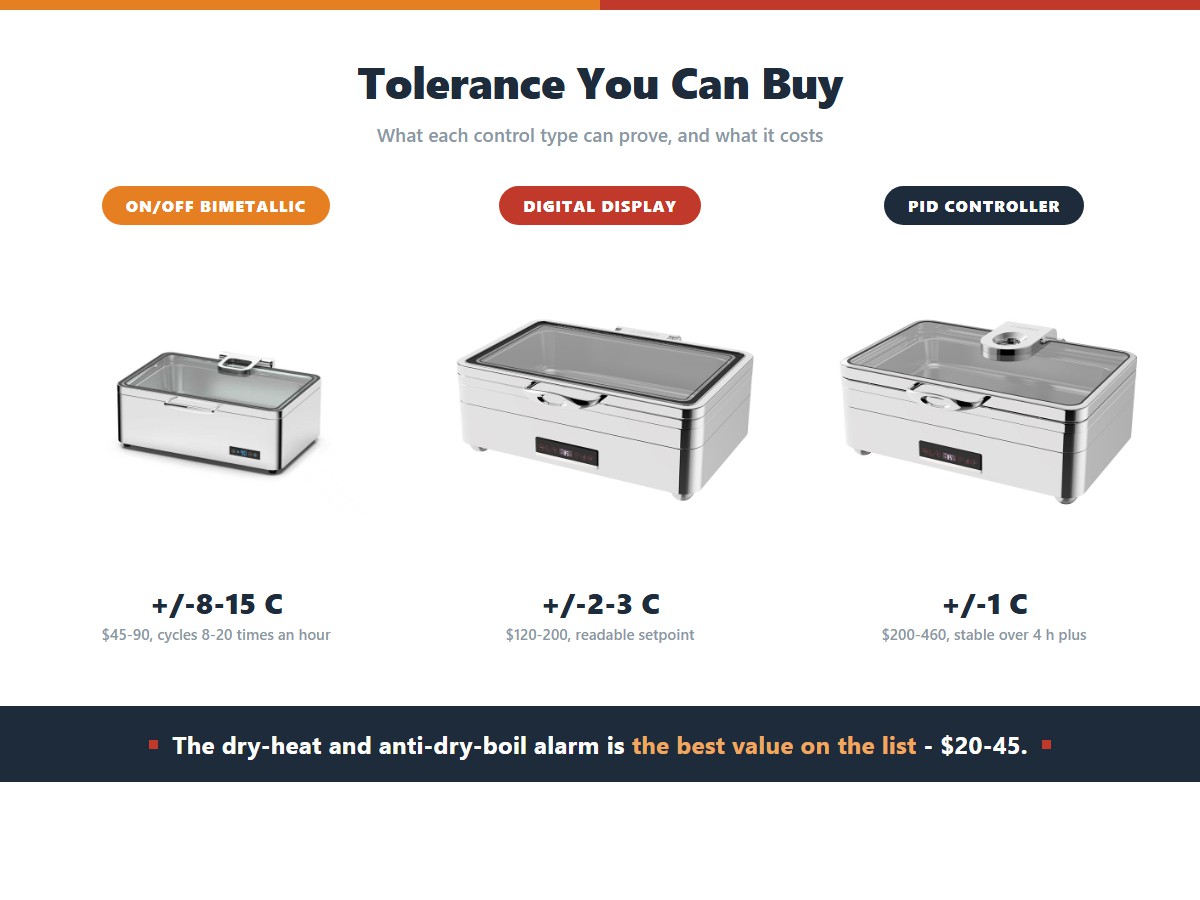
Control Types and What Each One Can Prove
| Control type | Tolerance at setpoint | Hold stability over 4 h | Recordable | Element cycling | Typical price |
|---|---|---|---|---|---|
| On/off, single bimetallic switch | ±8–15°C | Cycles visibly, often 8–20 times an hour | No, only a set dial | Hard on the element | $45–$90 |
| Two-stage bimetallic | ±5–8°C | Better, fewer visible swings | No | Moderate | $70–$120 |
| Thermostat with a digital display | ±2–3°C | Stable, readable setpoint | Display value, still manual entry | Moderate | $120–$200 |
| PID controller | ±1°C | Stable over 4 h plus | Yes, if it has a probe or alarm output | Steady, longer element life | $200–$460 |
| PID with logging output or probe | ±1°C | Stable, with a record trail | Yes, automatically | Steady | $340–$620 |
The Four Numbers to Ask a Supplier For
| Number | What a good figure looks like | Why it matters | What a vague answer sounds like |
|---|---|---|---|
| Setpoint range | 45–89°C in 1°C steps | 45°C for a delicate dish, 85°C for a stew, one unit instead of two | Adjustable temperature |
| Tolerance | ±1°C at setpoint | Decides whether the record is defensible | Precise control |
| Hold time at setpoint | 4 h or more within tolerance | Matches a real banquet service window | Long-lasting heat |
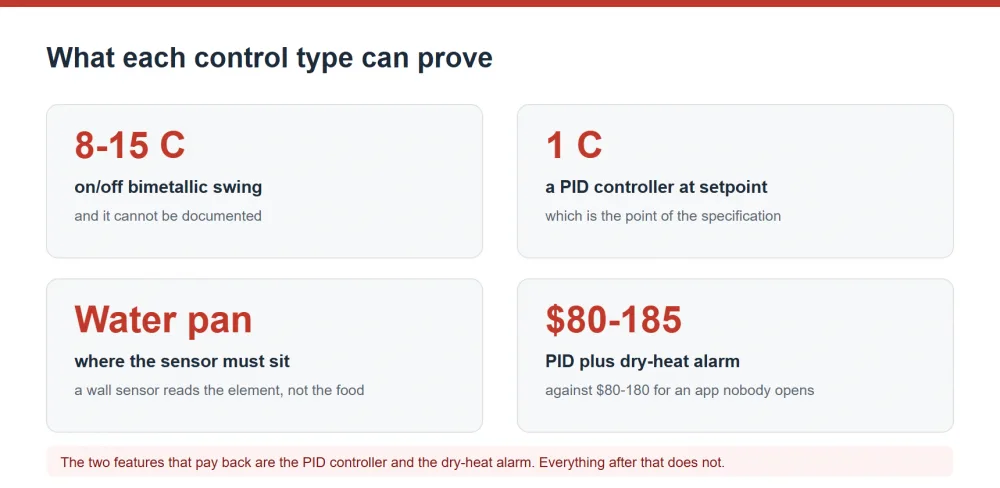
| Sensor position | In the water pan, not on the wall | A wall sensor reads the element, not the food | Built-in sensor |
The sensor position is the one that gets hidden. A thermostat that reads the temperature of the outer wall of the unit will report 70°C while the pan rim sits at 58°C, and the display will read exactly what it is designed to read. The only way to know is to ask where the sensor sits, and to check with a probe in the pan rather than trusting the panel. This is why the rim probe every 45 to 60 minutes does not go away even on a well-equipped unit.
Documentation Checklist for a Single Service
| When | Action | Record | Why it matters |
|---|---|---|---|
| Pre-service | Preheat with cold water in the pan, 12–15 min | Time and setpoint | Shows the unit was not preheated empty, which is what warps a body |
| Pre-service | Probe the pan rim with a calibrated probe | Rim temperature | Establishes the baseline independently of the panel |
| Every 45–60 min | Probe the rim again | Time and rim temperature | Proves the hold, which is the actual legal requirement |
| Every 45–60 min | Read the panel | Panel value alongside | Shows the difference between panel and reality |
| On any pan change | Probe the new pan at the rim | New pan temperature | A new pan starts cold and the unit is not at setpoint yet |
| On any alarm | Record the fault and the action taken | Fault and response | A recorded fault is manageable, an unrecorded one is not |
| End of service | Final rim probe, unit off, water pan drained | Final reading and time | Closes the log for that service |
Written as a checklist this looks like bureaucracy, and it is about forty seconds of work per pan per hour. Written as evidence it is the difference between a clean file and an argument. Operations that fail an inspection most often fail on the record, not on the temperature: a temperature record gap was the single most common finding in our review of inspection outcomes, ahead of any equipment fault.
Control Features, Priced
| Feature | What it adds | Cost | Verdict |
|---|---|---|---|
| PID controller | ±1°C, steadier element cycling, longer element life | $60–$140 above a bimetallic unit | Worth it in any operation that records temperatures |
| Digital setpoint display | Removes the guess from setting the dial | Included on most modern units | Effectively standard now |
| Dry-heat and anti-dry-boil alarm | Protects the element when a pan is empty | $20–$45 | The best value on this list |
| Probe port with external probe | Turns the panel reading into a food measurement | $35–$80 | Worth it where records matter |
| Independent logging output | Automatic record with a timestamp | $120–$260 | Only if a regulator asks for it |
| App and Wi-Fi control | Remote monitoring, mostly unused | $80–$180 | Almost never pays back |
| Display on the guest-facing side | Nothing operationally | $30–$70 | Presentation only |
Reading down the table, the return falls sharply after the probe port. A PID controller and a dry-heat alarm together cost about $80 to $185 and remove both the most common temperature failure and the most common hardware failure. An app costs $80 to $180 and delivers a dashboard most operations look at for a fortnight. If a specification needs a justification line, that is the justification line.

Frequently Asked Questions
What temperature tolerance should I specify for a food safety chafer?
±1°C at setpoint, and the supplier should state it in writing. A unit with an on/off bimetallic switch typically swings ±8 to ±15°C and cannot be documented, which is the problem rather than the temperature itself. The specification that matters is not the maximum temperature, it is the tolerance and the hold time at that tolerance.
Where should the temperature sensor be located?
In the water pan, in contact with the heating water, not on the outer wall. A wall sensor reads the temperature of the element housing and will display 70°C while the pan rim sits at 58°C. Ask where the sensor sits, and verify with a probe in the pan rather than trusting the panel, because this is the detail that product pages routinely omit.
How often should I record the pan temperature during service?
Every 45 to 60 minutes, at the rim, with the panel value recorded alongside it. Pre-service, log the rim baseline after preheat, and log again on every pan change, because a new pan starts cold and the unit is not yet back at setpoint. Written as a checklist this is about forty seconds of work per pan per hour, and it is the difference between a clean file and an argument after an incident.
Is a PID controller worth the extra cost?
Yes, in any operation that records temperatures, and the premium is $60 to $140 over a bimetallic unit. A PID controller holds ±1°C, cycles the element more evenly, and extends element life as a side effect. Pair it with a dry-heat alarm at $20 to $45, which is the best value on the list, and you have addressed both the most common temperature failure and the most common hardware failure.
Do I need an app or Wi-Fi control on a commercial chafer?
Almost never. Apps and remote monitoring cost $80 to $180 and deliver a dashboard most operations look at for a fortnight. The features that pay back are the PID controller, the dry-heat alarm, an external probe port for $35 to $80, and automatic logging at $120 to $260 if a regulator specifically asks for it. A guest-facing display pays back nothing operationally.

Full Size 11L Electric Chafer
BAVA Full Size 11 L Electric Chafer, 1,100W with 12-minute rapid heat-up, thermal efficiency of 80% or more, digital temperature display and Smart Mode, in polished stainless steel. The digital display gives a setpoint rather than a dial, which is the minimum needed to write a defensible temperature record, and the 11 L capacity covers a full pan of a main dish for 65 to 80 guests.

Electric Chafing Dish Food Warmer
Commercial Hotel Electric Visual Buffet Chafing Dish with 400W fast heating, stainless steel body and digital temperature control with a visible window. The window removes the temptation to lift the lid during a recorded service, and 400 W suits a smaller line where a 1,100 W unit would need a 15 A circuit the site may not have.
Browse the full chafing dish range for current models and configurations.
Related reading
- Electric vs Alcohol Fuel Chafer: Heat, Cost and Safety
- Precision Temperature Control: Why Your Chafing Dish Dries Out Food
- 2026 Healthcare Catering Trends: Infection Control Gear
- 2026 Food Safety Rules: What They Mean for Buffets
- Full Size Electric Chafing Dish: Does Temperature Control Matter?
- Chafing Dish Food Pan Sizes: Which Replacement Pan Fits Your Chafer?