


Energy-Efficient Electric Chafers: What the Savings Look Like
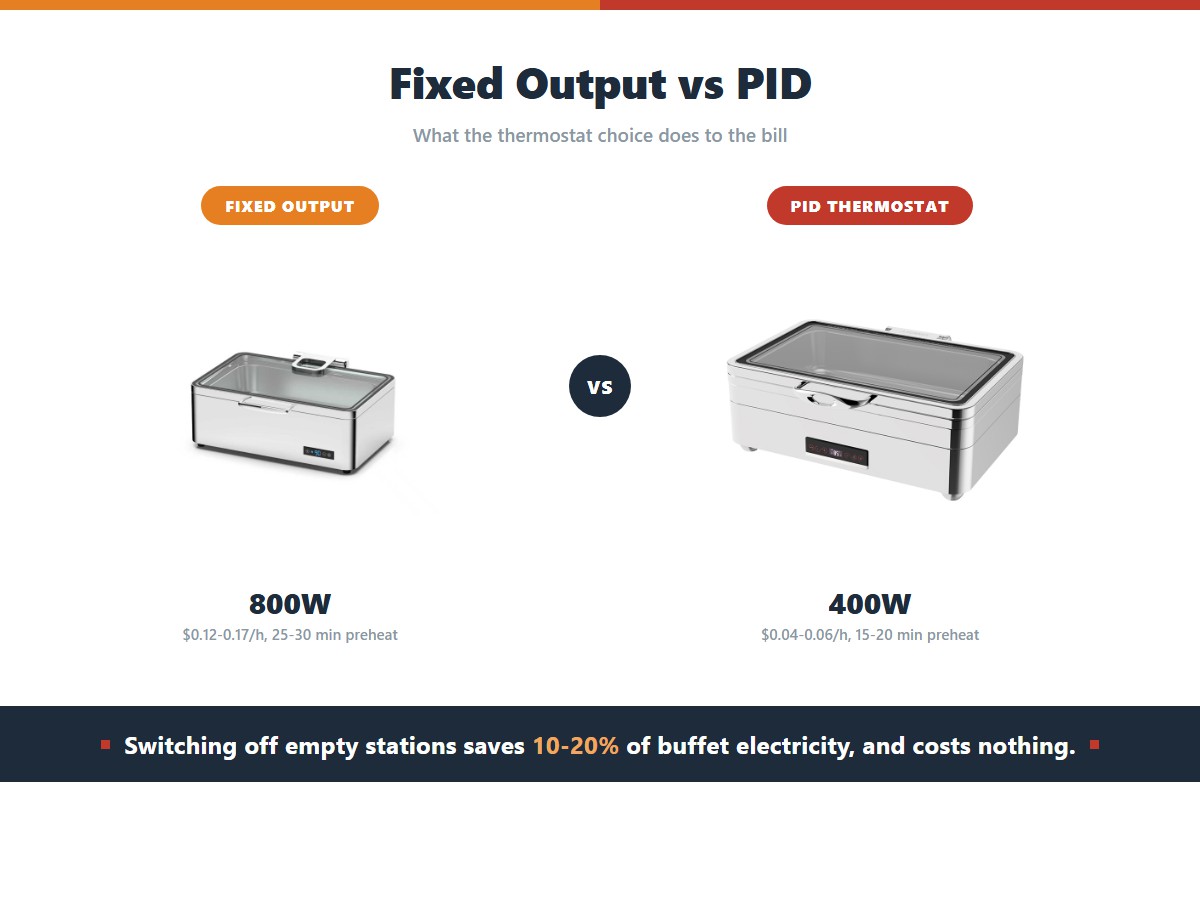
Short answer: the biggest energy saving in an electric chafing dish is not a more efficient element, it is a thermostat that cycles. A PID-controlled unit drawing 400–700 W holds 60–65°C at about $0.04–0.06 per hour, against 800–1,100 W on a fixed-output element at $0.12–0.17. Preheating falls from 25–30 minutes to 15–20, and switching off empty stations cuts buffet electricity by 10–20% at no cost. See electric chafing dishes and the kWh arithmetic.
Where the energy actually goes
An electric chafing dish does not heat the food directly. It heats a water pan, and the water pan insulates the food. Almost all of the energy leaves through the frame, the lid, the water surface and the base, and the only way to reduce that is to reduce the temperature difference between the water and the room, or to reduce the time the unit is on.
| Loss path | Share of total | How to reduce it |
|---|---|---|
| Base conduction to the counter | 30–40% | Insulated base, do not sit the unit on cold steel |
| Lid loss | 20–30% | Keep the lid closed, fit a lid, use a water pan to the full line |
| Frame and side losses | 15–25% | Thicker frame, better insulation, 304 rather than thin 201 |
| Water surface evaporation | 10–20% | Lid closed, keep the water level up, avoid a wide pan |
| Standing on, empty | 100% wasted | Switch off empty stations, use switched circuits |
Fixed output versus thermostat control
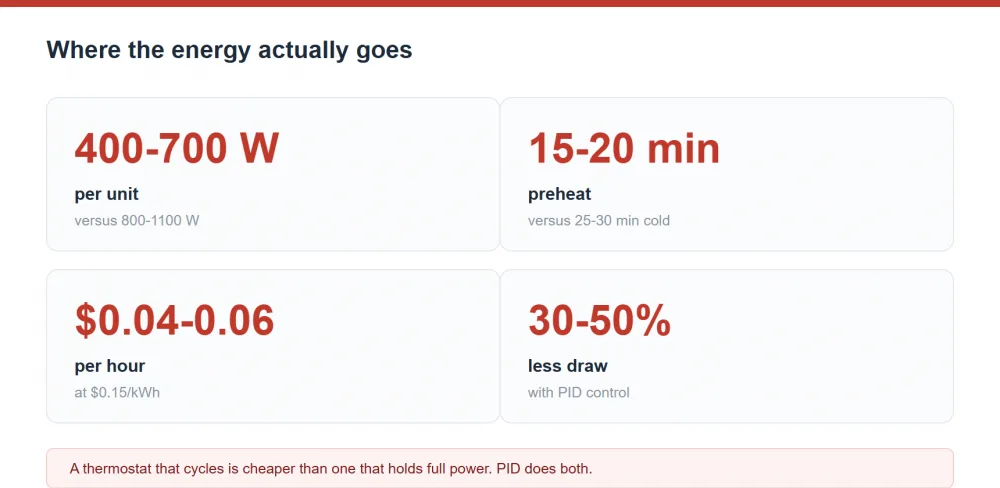
This is the single most important distinction in energy-efficient chafing equipment, and it is the one most product descriptions obscure.
| Feature | Fixed-output element | PID thermostat |
|---|---|---|
| Element rating | 800–1,100 W | 400–700 W |
| Power drawn in service | Continuous, 100% | 40–70% duty cycle |
| Cost per hour at $0.15/kWh | $0.12–0.17 | $0.04–0.06 |
| Preheat from cold | 25–30 min | 15–20 min |
| Temperature stability | Poor, drifts with the room | ±2°C or better |
| Response to a new pan | Slow, full power needed | Faster, controlled ramp |
| Dry-boil protection | Often absent | Usually included |
| Cost per unit | Lower | 20–40% higher |
The economics work because the running saving is recurring and the extra capital is not. A $60 premium on a unit that saves $0.08 an hour pays for itself in 750 operating hours, which is roughly three months of hotel breakfast service. Over five years, a PID-controlled unit in a site running 1,200 hours a year saves around $480 in energy alone, before the food-quality saving from stable temperature.
The five savings, ranked
| Saving | Typical effect | Cost | Effort |
|---|---|---|---|
| Switch off empty stations at end of service | 10–20% of buffet electricity | Free | A procedure |
| Replace fixed-output units with PID-controlled | 30–50% per unit | $40–120 per unit | Replacement cycle |
| Zone the line so unused sections are off | 5–15% | $60–200 per zone | Electrical work |
| Pre-heat at the last moment, not on schedule | 3–8% | Free | Procedure change |
| Use lids and maintain the water level | 5–12% | Free | Staff discipline |
Read that table again: the largest single saving is free and requires an electrician or a new appliance. The second largest costs less than the price of a service. This is why an energy-efficiency review of a buffet line should start with the operating routine rather than with the purchase order.
Where the money goes beyond the meter
The electricity bill is the visible number, but the larger saving is usually in food and labour.
| Source | Mechanism | Typical effect |
|---|---|---|
| Food waste | Stable temperature means less food is discarded as unfit or unappealing | 5–18% reduction in waste |
| Labour | No lighting, monitoring or refuelling, so fewer staff minutes per service | 3–8 min per unit per service |
| Equipment life | Less thermal cycling and no dry-boil damage | Longer element and seal life |
| Service quality | Fewer complaints about cold or burnt food | Hard to quantify, but real |
How to verify the claims on a quotation
A specification sheet full of adjectives tells you nothing. Ask for four specific numbers, in writing, and compare them across suppliers.
- Rated element wattage and the power draw in steady state. A supplier that quotes only the wattage is not telling you the duty cycle. Ask what the unit actually draws at a 60°C set point with a loaded pan.
- Temperature tolerance. A credible number is ±2°C at the food, measured in the pan, not the water. Ask how it is measured.
- Preheat time to 60°C with a full 8 qt pan, from cold. Anything above 30 minutes is not a fast preheat.
- Dry-boil protection and the alarm behaviour. What happens when the water evaporates? The answer should be a cut-out, not a smoke incident.
Honest limits
Three caveats. First, PID control saves less than the marketing suggests on a unit that runs only two or three hours a day, because the standing losses are small either way; the saving scales with hours of use. Second, a more efficient unit is not a better unit: a thin-gauge 201 steel frame with a PID thermostat will outlast it, and the energy saving does not compensate for a pan that warps. Third, and most importantly, no equipment change fixes a line that is switched on and empty for two hours after service. That is the largest waste in most sites and it is a management problem, not a specification problem.
Frequently Asked Questions
How much does an electric chafing dish cost to run per hour?
About $0.04–0.07 per hour for a 400–700 W PID-controlled unit at $0.15/kWh, against $0.12–0.17 for an 800–1,100 W fixed-output unit. Over an 8-hour service that is $0.33–0.55 versus $1.00–1.35. See How Much Electricity Does a Buffet Warmer Use for the full kWh table.
Does a higher wattage unit heat up faster?
It reaches a higher temperature faster, but that is not the same as holding food better. A 1,100 W unit reaches boiling in 6 minutes, then holds food perfectly well, and then spends the rest of the service boiling water. A 400 W unit takes 15–20 minutes to preheat and then cycles. For a line that preheats once and holds for six hours, the lower wattage unit is both cheaper and gentler on the food.
Are heat pumps or inverter elements more efficient?
Neither is a standard approach for chafing dishes. The relevant technology is the control, not the heating element, because the element is close to 100% efficient at converting electricity to heat and the losses are all in the heat path. A better-insulated frame and a thermostat that cycles will deliver more savings than any change to the element itself.
How do I reduce the energy a line uses without buying anything?
Four steps, in order of value: switch off empty stations at the end of service, keep the lids closed and the water pans full, pre-heat at the last moment rather than on a schedule, and run the line on switched circuits so unused sections are off. Together these typically cut 15–30% of buffet electricity with no capital cost. Then add a plug-in energy meter to a few units so you can prove the saving, which is what makes the next capital request easy to approve.
Does a temperature display save energy?
Not directly, but it saves food and it saves argument. Staff who can see the temperature do not open the lid to check it, do not add extra fuel, and do not discard food on suspicion. In several operations the display has been found to pay for itself through reduced waste rather than through the electricity bill.
Is it worth replacing working equipment for energy reasons alone?
Rarely. Replacing a working unit with a more efficient one rarely pays back on energy alone. The case for replacement is stronger when the unit is failing, when it is 201-grade and will need replacing anyway, or when the site runs long hours. If you want to prioritise, replace the units with the highest hours of use first, and run the free operating changes on everything else.
Top Picks for Energy-Efficient Service
All three models below use a thermostat that cycles rather than a fixed-output element, which is where the energy saving comes from. Ask the supplier for the steady-state power draw at a 60°C set point, not just the element rating.

Full Size 11L Electric Chafer
BAVA Full Size 11 L Electric Chafer. 1100W rating, 12-minute rapid heat-up, digital temperature display, Smart Mode, polished stainless steel body. The digital display and the temperature-controlled element mean the unit stops drawing full power once the pan is at temperature, and the visible set point removes the temptation to lift the lid and check. The 11 L capacity also means fewer refills, and every refill is an open lid and a temperature loss.

Electric Chafing Dish Food Warmer
400W electric chafing dish with digital temperature control and a visual glass lid. At 400 W this is the lowest-draw unit in the range, roughly $0.04 per hour at $0.15/kWh, and the visual lid lets staff check the level without opening the cover. A good fit for a breakfast line that runs 8 hours a day on a site with a high electricity tariff.
For a budget build, the Electric Chafing Dish-W07 is 900W with a 45–89°C adjustable range and an anti-dry-boil alarm, and the adjustable set point lets you turn a unit down on a quieter day rather than running it at full power.
Browse the full chafing dish range for current models and configurations.
Related reading
- Switching From Fuel to Electric Chafers: Worth It at Your Volume?
- Energy-Efficient Buffet Stoves: What the Label Won't Tell You
- Catering: Electric vs Fuel Chafers, by Event Type
- Gas vs Electric Buffet Stove: Which Fits Your Kitchen?
- Fuel vs Electric: The 5-Year Cost Nobody Calculates
- Infrared Heat Lamps: Why Fried Food Goes Under Them (Not Chafers)