


Rust-Resistant Buffet Warmers: Built for Humid Climates
Short answer: for a humid or salt-laden environment, specify 316 stainless, which contains 2% molybdenum and resists chloride pitting roughly four times better than 304. But the grade is only half the answer: a weekly rinse with fresh water does more to preserve equipment than any alloy, because no stainless steel survives continuous salt exposure indefinitely. In genuinely salt-laden settings such as coastal hotels and pool decks, 316 plus a rinse routine plus 1.2–1.5 mm gauge is the working specification. See rust-resistant buffet warmers and 304 vs 201 stainless for the alloy comparison.
What humidity actually does to stainless
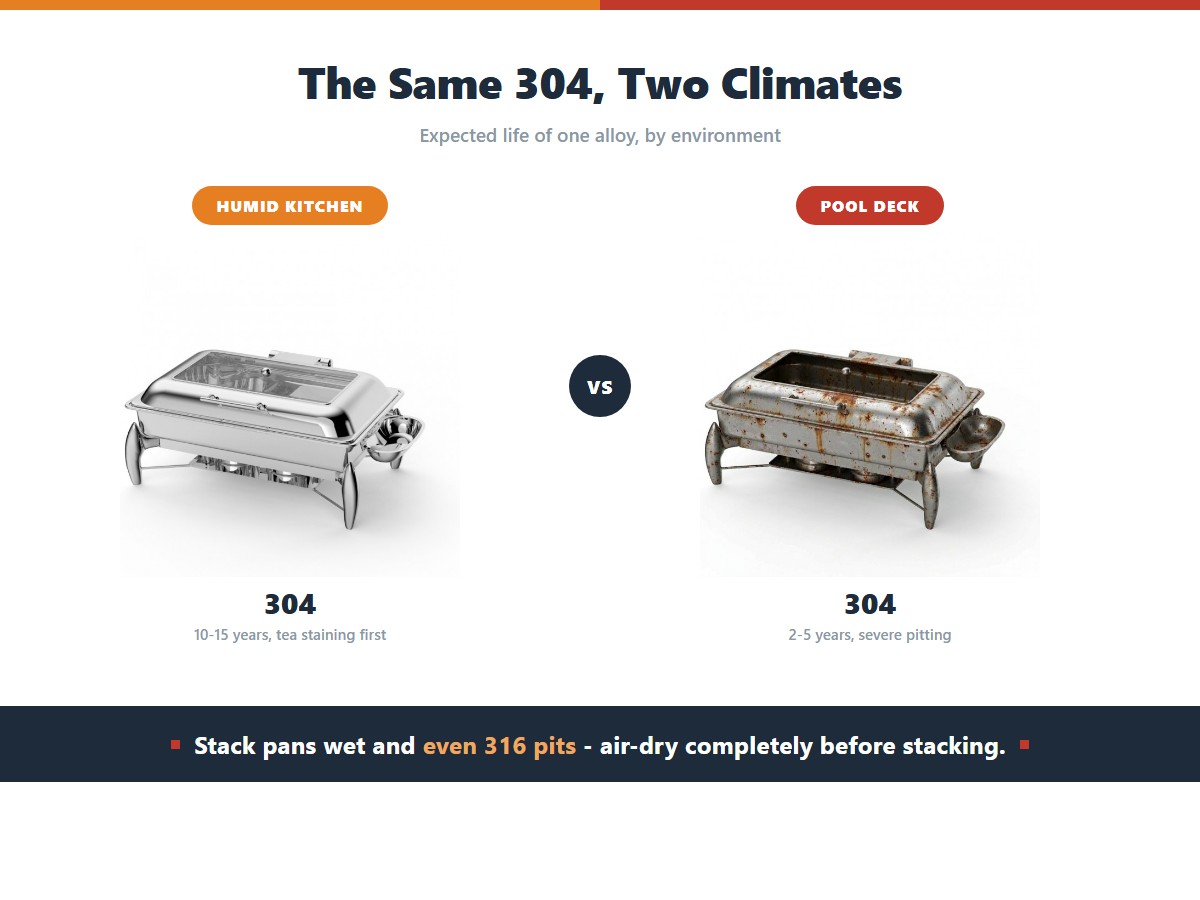
Stainless steel resists rust because of a passive chromium oxide layer, which reforms within hours of being damaged. What defeats it is chloride, which combines with the iron in the steel to form pits, and pitting is the failure that matters because it is local, invisible until it is deep, and it does not stop when the humidity drops.
| Environment | Chloride exposure | Failure mechanism | Expected life on 304 |
|---|---|---|---|
| Indoor, dry, air conditioned | Negligible | None | 15–20 years |
| Commercial kitchen, humid | Low, from food and wash water | Tea staining at seams, then pitting | 10–15 years |
| Tropical, high humidity | Moderate, from condensation | Pitting at welds and crevices | 8–12 years |
| Coastal, within 5 km of the sea | High, airborne salt | Surface pitting then rust staining | 5–10 years |
| Pool deck, chlorinated splash | Very high, from chlorine | Severe pitting and crevice corrosion | 2–5 years |
| Ship, open deck | Extreme, salt spray | Rapid general and crevice corrosion | Months to 2 years |
Choosing the material
| Grade | Chromium | Nickel | Molybdenum | Chloride resistance | Relative cost |
|---|---|---|---|---|---|
| 201 | 16–18% | 3.5–5% | None | Poor, tea stains in months | 1.0 |
| 202 | 17–19% | 4–5% | None | Poor, slightly better than 201 | 1.1 |
| 304 | 18–20% | 8–10.5% | None | Good, the standard for kitchens | 1.4 |
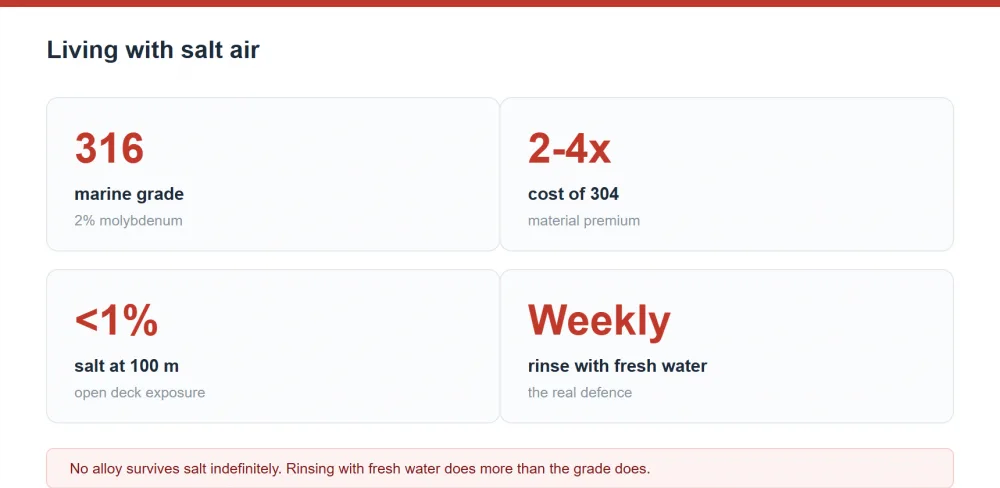
| 316 / 316L | 16–18% | 10–14% | 2–3% | Very good, 4x better pitting than 304 | 2.0–3.0 |
| 2205 duplex | 22% | 5% | 3% | Excellent, for splash zones | 3.0–4.0 |
The molybdenum is the whole story. It stabilises the passive layer against chloride attack, which is why 316 outlasts 304 by roughly a factor of four in a chloride environment even though the two look identical and behave identically in a dry kitchen. The cost penalty is real, so the right approach is to specify by exposure rather than to upgrade everything.
Where to spend the 316 premium
- Pool decks and outdoor buffets: 316, without question.
- Coastal hotels within a few kilometres of the shore: 316 for pans, water pans and all exposed frames.
- Enclosed dining rooms and galleys in coastal properties: 304 is usually adequate, with stainless fasteners specified as 316 because they are the first thing to seize.
- Any location with a chiller, an ice machine or a dishwasher nearby: 316 for the nearest units, because condensation carries chloride.
- Enclosed, dry, air-conditioned hotel buffets inland: 304, and the premium is wasted money.
The rinse routine, which is the real answer
Stainless steel is not rust-proof; it is rust-resistant, and the distinction matters. The passive layer is constantly being repaired, and a rinse with fresh water removes the chloride faster than it can attack. In coastal operations this is the single most effective measure available and it costs almost nothing.
- Weekly: rinse every exposed stainless surface with fresh potable water, including the undersides of pans, the frame base and the backsplash. Dry it. Ten minutes per unit.
- Weekly: clean the crevices with a nylon brush, because that is where the passive layer cannot reform. A crevice that is never cleaned will pit regardless of grade.
- Monthly: check the silicone seals, the hinges and the fasteners for the first signs of pitting or stiffening.
- Quarterly: verify the earth continuity and check the cable entries on any electrical unit in a damp location.
- Never: use a steel wool pad or a scouring powder. It removes the passive layer and leaves iron particles on the surface, and those particles rust. Use a non-abrasive pad and a neutral detergent.
Design details that reduce corrosion
| Detail | Bad practice | Good practice | Why |
|---|---|---|---|
| Welds | Grounded and left rough | TIG, ground flush, passivated | Ground welds have the same passive layer as the parent metal; rough welds do not |
| Seams | Folded and folded over | Welded and dressed | Folded seams trap salt and moisture |
| Fasteners | 304 screws in a 316 frame | 316 throughout | Small parts pit and seize first |
| Feet and bases | Open frame on a wet floor | Sealed base or removable feet | Standing water under the unit is the worst corrosion site |
| Gaskets | Glued rubber, replaced on failure | Replaceable silicone | Hardened rubber traps moisture against the pan rim |
| Storage | Pans stacked wet | Air dry completely before stacking | Wet-on-wet contact is the classic pitting scenario |
Honest limits
Two things operators should be clear about. First, 316 is not a solution for a genuinely marine environment on its own; on an open ship deck, even 316 with a rinse routine has a service life measured in a few years, and the honest answer there is often to accept replacement as a cost of operation. Second, and more usefully, in most "humid climate" situations the real problem is not the humidity at all. It is that equipment is washed with the wrong water, stored wet, or cleaned with steel wool, and those three habits cause more corrosion in a temperate kitchen than salt air causes in a coastal one. Fix the habits before you spend the money on the alloy.
Frequently Asked Questions
Will 304 stainless rust in a humid climate?
Not in the way carbon steel does. 304 will develop tea staining and small surface spots in a persistently humid environment, and in a coastal property those spots develop into pitting over several years, but it will not corrode through. The realistic expectation for 304 in a humid commercial kitchen is 10–15 years with attention, and 8–12 years without it.
Is 316 worth the extra cost for a coastal hotel?
Yes, for anything on the sea-facing side, and no for the inland side. 316 costs two to three times 304, and on a 40-unit installation that is a significant number. Specifying 316 for the exposed units and 304 for the protected ones typically halves the premium while keeping the vulnerable equipment protected, which is the approach we would recommend.
How often should I rinse equipment in a coastal location?
Weekly for exposed equipment, monthly for protected equipment, and immediately after any salt exposure such as a sea spray event or a cleaning chemical spill. The rinse needs to be fresh potable water, not a damp wipe, because the point is to remove the chloride rather than redistribute it. Ten minutes per unit per week is a realistic budget.
Does stainless steel need any protective coating?
Rarely, and coatings create their own problems. A clear passivation film applied at installation is not a coating in the paint sense, it is the standard manufacturing step that restores the passive layer, and you should require it to have been done. Actual lacquers and sealants trap moisture against the surface and are generally counterproductive on food-contact equipment. The exception is a non-stick coating on a food pan, which is a cooking-surface treatment and has its own care requirements.
What causes the brown spots that appear on stainless in a humid kitchen?
Almost always iron contamination transferred from a carbon steel source: a carbon steel wire wool pad, a grinding wheel, a tool that has touched mild steel, or a storage area with carbon steel shelving. The iron particles rust and the rust spot appears to be in the stainless. Remove them with a stainless-grade scouring pad and a nitric or citric acid cleaner, and find the carbon steel source. The fix is free, and the alloy is not at fault. See Rust Spots on Stainless Steel Buffet Equipment.
Should I upgrade my whole line to 316, or replace units as they fail?
Replace as they fail, with a policy that new exposed units get 316 and existing 304 is maintained properly. Wholesale replacement is only justified where you have a lot of exposed equipment, a high failure rate and a business case that includes the avoided downtime and the labour of emergency replacements, not just the material difference.
Top Picks for Humid and Coastal Locations
These three are the models we fit to humid and coastal sites. All bodies are 304 stainless, and 316 panels and 316 fasteners are available on request for exposed positions. Ask for the material certificate and the passivation certificate with the order.

Full Size 11L Electric Chafer
BAVA Full Size 11 L Electric Chafer. 1100W, 12-minute rapid heat-up, digital temperature display, polished stainless steel body. The welded and dressed seams matter more in a humid room than the alloy does, because a folded seam collects salt and moisture and pits from the inside out. Specify the 316 option for any unit on an open terrace or within sight of the sea.

Electric Chafing Dish Food Warmer
400W electric chafing dish with digital temperature control and a visual glass lid. The lower draw also means less waste heat into the room, which in a humid dining room is a bonus, because the air conditioning has less to remove. The visual lid reduces the number of times the pan is opened and exposed to the ambient salt load.
For a smaller site, the Electric Chafing Dish-W07 is 900W with a 45–89°C adjustable range and an anti-dry-boil alarm. The alarm matters in a humid kitchen, where condensation in the base is a common cause of a dry-boil event.
Browse the full chafing dish range for current models and configurations.
Related reading
- Chafing Dish Water Pan: Replacement Parts for Food Warmers
- Best Commercial Buffet Warmers for Hotels
- The Future of Chafing Dishes: Electric & Smart Food Warmers
- How Buffet Warmers Enhance Food Safety
- Why Stainless Buffet Gear Gets Rust Spots (And Fixes)
- Rust Spots on Stainless Steel Buffet Equipment: Causes and Removal
- Buffet Stove vs Traditional Warmers: Honest Comparison