




Heavy-Duty Chafing Dish for 24/7 Hotel Buffets
Short answer: A chafing dish for continuous operation is specified on hours per day, not on the phrase 24/7, and the numbers that decide it are a 1.2–1.5 mm body, an element rated for continuous duty, and a thermostat with a stated tolerance of ±1°C. Element life follows the duty cycle exactly: under 1,460 hours a year the element lasts 5–7 years, at 6,570 hours it lasts 1.5–2 years. See chafing dish duty cycle ratings.

A hotel that serves breakfast, lunch, afternoon tea and dinner has equipment running 16 to 18 hours a day and sitting idle in the gaps. That pattern is closer to a continuous duty cycle than to the intermittent duty a restaurant unit is designed for, and it is where the difference between a $150 unit and a $350 unit is actually paid for. It is also where most of the failures happen, because the failures are predictable: the element, the thermostat drift, the warped body, the pan that never dries.
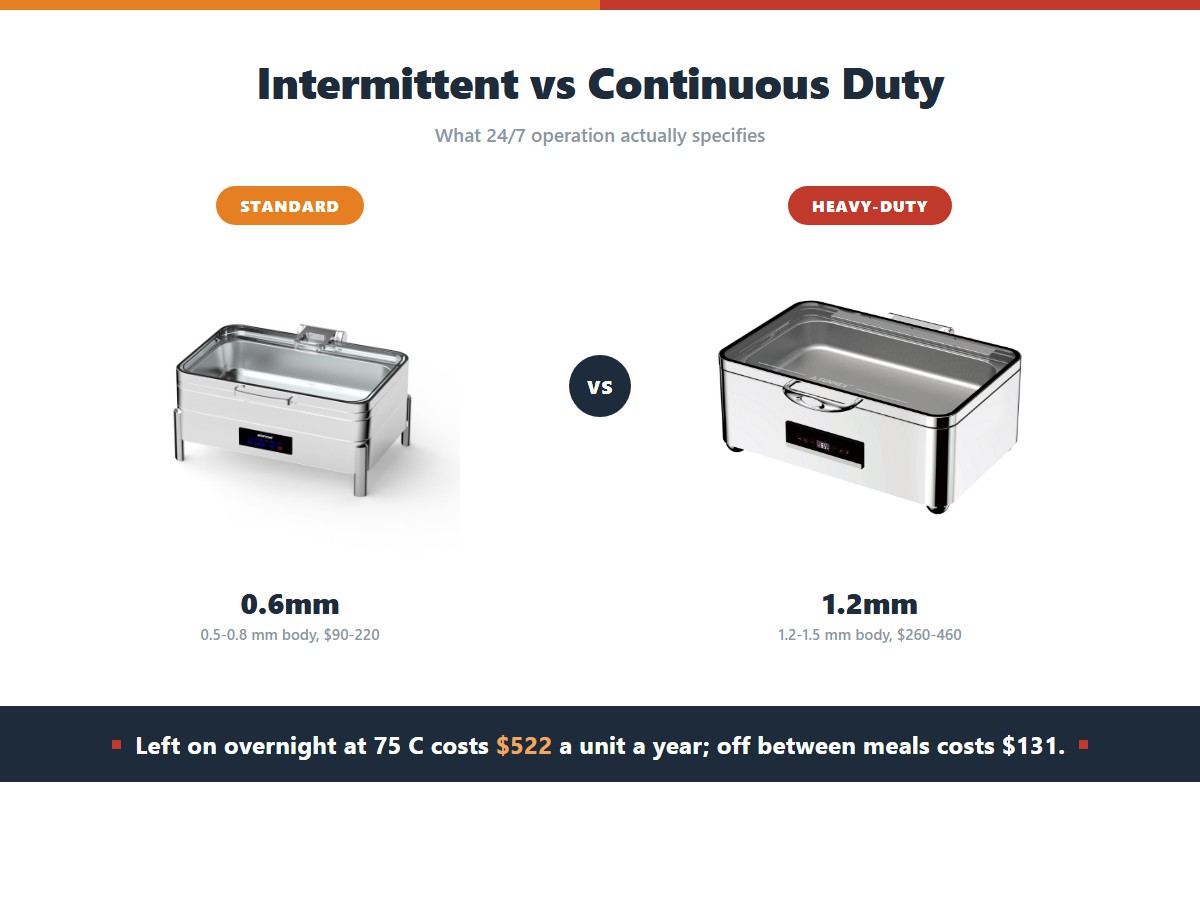
Continuous Duty Specifications, Compared
| Specification | Standard intermittent | Heavy-duty continuous | Why the difference matters |
|---|---|---|---|
| Body thickness | 0.5–0.8 mm | 1.2–1.5 mm | 0.5 mm warps permanently after 20–40 min of empty preheat |
| Steel grade | 201 or 304 | 304 | 201 pits in 6–14 months; a hotel unit should not pit in a year |
| Element rating | Intermittent duty | Continuous duty | An intermittent element in continuous use fails in 12–18 months |
| Thermostat | Standard bimetal or PID | PID, ±1°C, redundant sensor | Sensor drift shows as cold food at 3 am long before it shows as a failed unit |
| Element life at 18 h/day | 1.5–2 years | 2–3 years | At 6,570 h/yr the element is the consumable, not the body |
| Element life at 24 h/day | Under 1.5 years | 1.5–2 years | No element is rated to run without a cool period indefinitely |
| Warranty | 1–2 years | 2 years, parts 5 years | Parts availability matters more than the term |
| Cost per unit | $90–$220 | $260–$460 | About 2 to 2.5× the price, not 10× |
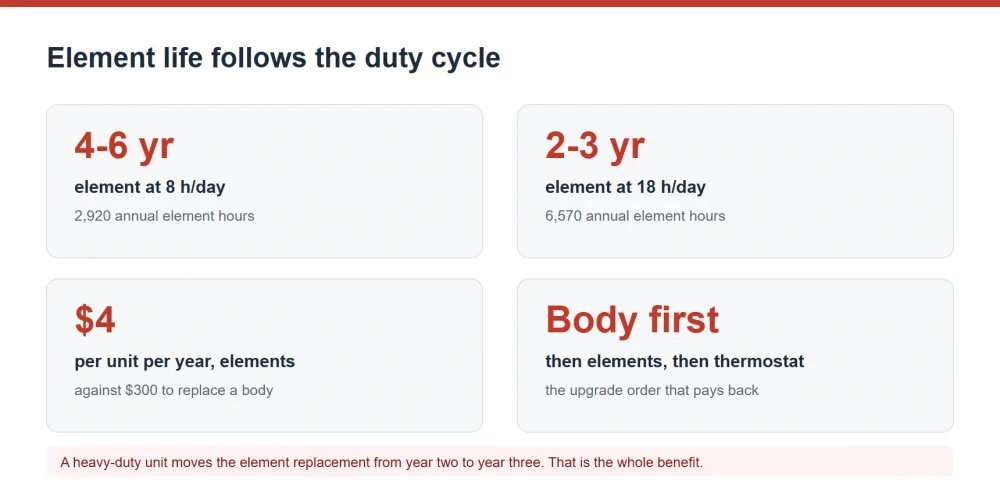
Element Life and Annual Cost by Duty Cycle
| Hours per day | Annual hours | Element life | Cost per unit per year | 20-unit hotel, 5 years | Body replacements |
|---|---|---|---|---|---|
| 4 | 1,460 | 5–7 years | Under $6 | $0 | None |
| 8 | 2,920 | 4–6 years | $6–$9 | $0 | None |
| 12 | 4,380 | 3–4 years | $9–$13 | $60–$80 | None |
| 16 | 5,840 | 2.5–3.5 years | $11–$15 | $90–$120 | None |
| 18 | 6,570 | 2–3 years | $13–$18 | $130–$180 | None |
| 24, no break | 8,760 | 1.5–2 years | $18–$24 | $180–$240 | Possible at year 8 |
The honest conclusion is that a heavy-duty unit does not make the element last forever, it moves the replacement from year two to year three. A 20-unit hotel running 18 hours a day should expect one element per unit around year three and one more around year five, which is $130 to $180 per unit across five years, about $4 per year. Against that, replacing twenty bodies at $300 each is $6,000, so the sensible upgrade order is body first, elements second, thermostat third.
What Continuous Duty Does and Does Not Fix
| Problem | Does heavy duty fix it? | Actual fix | Cost |
|---|---|---|---|
| Element burning out | Partly, 6–12 months longer | Accept the cycle and stock elements | $28–$45 per element |
| Warped body | Yes, at 1.2 mm or thicker | Never preheat an empty pan | Free |
| Rust spots | No | 304 grade, dry the pan, no chlorine on stainless | Free to $140 for a grade change |
| Cold food at 3 am | No | PID thermostat with a stated tolerance | $25–$60 |
| Food drying out | No | Hold at 70–75°C, use insulated covers | $25–$50 per cover |
| Water spots and scale | No | Removable water pan, weekly descale | Included on good units |
| Overheating complaints | No | Dry-heat and anti-dry-boil protection | $20–$40 |
| High energy bills | Partly, 10–15% | Switch off between meal periods, thermostat control | Free |
This table is the part most product pages leave out. A heavy-duty unit is a better body, and it is not a cure for every complaint a hotel raises. Cold food at three in the morning is a thermostat problem, and the fix is a $25 to $60 part, not a $400 appliance. Dried-out food is a setpoint and a cover problem. Energy bills are a switching discipline problem. Buying heavier hardware to solve a control problem is the most common expensive mistake in this category.
Switching Off Between Meal Periods
| Approach | Hours on per day | Cost per unit per year | 20 units | Element life | Verdict |
|---|---|---|---|---|---|
| Left on at 75°C overnight | 24 | $522 | $10,440 | 1.5–2 years | Worst on every measure |
| Left on at 45°C overnight | 24 | $395 | $7,900 | 1.5–2 years | Still running the element |
| Off between meal periods, preheat 15 min | 5–6 | $131 | $2,620 | 4–6 years | Correct |
| Off, preheat 30 min, 4 services | 8 | $175 | $3,500 | 4–6 years | Acceptable |
Switching off between meal periods is worth around $7,800 a year across twenty units and it extends element life from two years to four. It requires no capital and no new equipment, only a rule and a person who remembers the rule. In a hotel where the buffet is set up by a different shift each period, the rule has to be built into the handover, which is where it usually fails.
Frequently Asked Questions
Does a 24/7 rated chafing dish really run continuously?
It runs long duty cycles reliably, and it is a better body and a better element than a standard unit. It does not mean the element lasts forever, because no element survives indefinitely without a cool period. At 18 hours a day, expect the element to need replacing in year three and year five, and budget $130 to $180 per unit over five years for elements alone.
How much more does a heavy-duty chafing dish cost than a standard one?
Roughly 2 to 2.5 times, which is $260 to $460 against $90 to $220. The premium buys 1.2–1.5 mm body steel, a continuous-duty element and a PID thermostat with a stated tolerance. If your units run four to eight hours a day rather than sixteen to eighteen, the premium is not recovered and a standard unit with a $25 thermostat is the better purchase.
What actually causes cold food in an all-night buffet?
Almost always the thermostat rather than the element. A standard bimetal thermostat drifts over time, and drift shows up first as food at the rim sitting below 57°C in the quiet hours, not as a unit that has stopped working. A PID thermostat with a stated tolerance of ±1°C fixes it, and a unit that holds 75°C overnight will hold 57°C during a busy service without any change.
How do I stop a chafing dish warping in an all-day dining venue?
Never preheat it empty. Put cold water in the water pan before switching on, and the body heats through the water rather than directly. A 0.5 mm body warped by 20 to 40 minutes of dry heat never recovers, and a warped body will not seat a lid or take a water pan seal, which then leaks. This is a free fix and it prevents most of the warping seen in the field.
Should a hotel switch its buffet units off between meal periods?
Yes, and this is the single largest energy saving available. Leaving a unit holding 75°C through eight low-traffic hours costs about as much as running it at full power for two hours. Switch it off, drain the water pan, wipe it down, and preheat for 15 minutes before service. In a 20-unit hotel that difference is on the order of $1,000 a year with no capital cost at all.

Full Size 11L Electric Chafer
BAVA Full Size 11 L Electric Chafer, 1,100W industrial heating element, 1.5 mm stainless steel body and a 24/7 rated thermostat. The 1.5 mm body is the single most useful number for a unit that runs 16 to 18 hours a day, because it is what survives a mistimed preheat. 11 L capacity covers a full pan of a main dish for 65 to 80 guests.

Electric Chafing Dish Food Warmer
Commercial Hotel Electric Visual Buffet Chafing Dish with 400W fast heating, stainless steel body and digital temperature control. The lower power draw suits the low-traffic overnight period and the visible window avoids opening the lid during a recorded service. A sensible companion to the 1,100 W unit where the night shift needs a unit that is cheap to run rather than one that heats fastest.
Browse the full chafing dish range for current models and configurations.
Related reading
- Hotel Breakfast Buffet Equipment: What 100 Rooms Really Need
- 2026 Hotel Buffet Equipment Trends: Guest Experience & Efficiency
- Chafing Dish vs. Slow Cooker: Which Is Better for Buffets?
- How Heavy Is Commercial Buffet Equipment? Shipping Weight Guide
- Hotel Breakfast Buffet on a $5,000 Budget: Exact List
- Triple Cereal Dispensers & Dry Food Stations for Hotel Buffets