




Stackable Chafing Dish: Saves 40% Storage Space
Short answer: A stackable chafing dish is a nesting problem, not a stacking problem, and the four numbers that decide it are the closed height per unit, the total stack height in the crate, the weight of a full unit, and whether the lid and water pan nest inside the body. A unit that stacks to 220 mm and weighs 4.1 kg empty moves with one person; a unit at 290 mm and 6.8 kg needs two, which decides whether a van carries the fleet in one load. See chafing dish transport and storage options.

Any operation that moves equipment between venues lives or dies on this. A caterer with two vans and 120 units, a rental company with 400 units across a depot, a hotel that moves a breakfast line from the restaurant to the conference floor every morning, they are all constrained by cubic metres and by whether two people are needed to lift a unit onto a trolley. The word stackable is used loosely in this category, so the useful questions are specific.
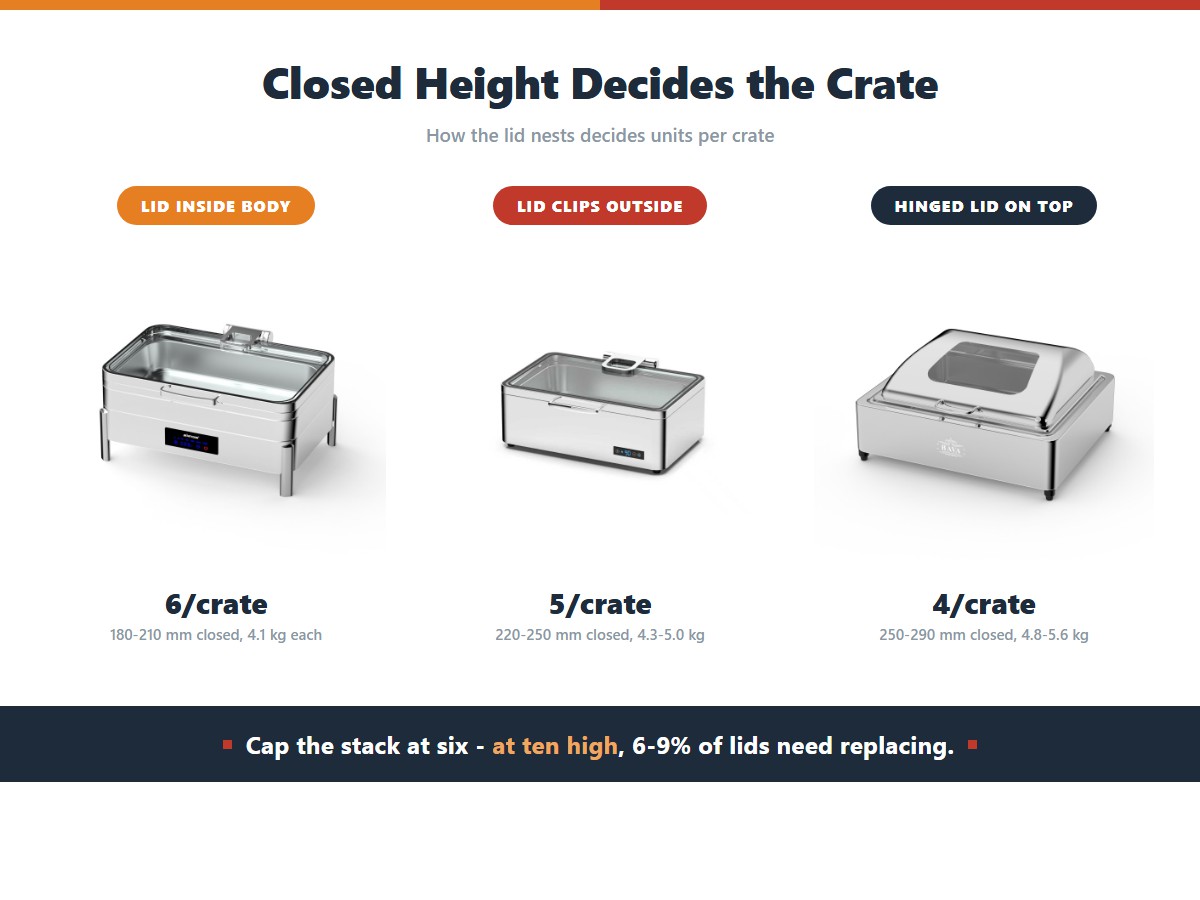
Stack Geometry, Measured
| Design | Closed height per unit | Units per crate | Full stack height | Empty weight | Two-person lift | Verdict |
|---|---|---|---|---|---|---|
| Fully nesting, lid inside body | 180–210 mm | 6 | 1,080–1,260 mm | 3.6–4.1 kg | No | Best for fleets |
| Body nests, lid clips outside | 220–250 mm | 5 | 1,100–1,250 mm | 4.3–5.0 kg | No | Good compromise |
| Body nests, hinged lid on top | 250–290 mm | 4 | 1,000–1,160 mm | 4.8–5.6 kg | Borderline | Acceptable |
| Shallow nesting, lid on top | 280–320 mm | 3 | 840–960 mm | 5.4–6.4 kg | Yes | Not for fleets |
| No nesting, rectangular | 300–360 mm | 2 | 600–720 mm | 8.5–14 kg | Yes | Line equipment only |
What One Vehicle Can Actually Carry
| Vehicle | Usable floor area | Units at 200 mm stacked | Units at 300 mm stacked | Difference per trip | Annual saving at 60 trips |
|---|---|---|---|---|---|
| Small van, 1.2 t | 2.6 m² | 180 | 120 | 60 units | $3,600 in hire |
| Medium van, 1.8 t | 3.8 m² | 265 | 175 | 90 units | $5,400 in hire |
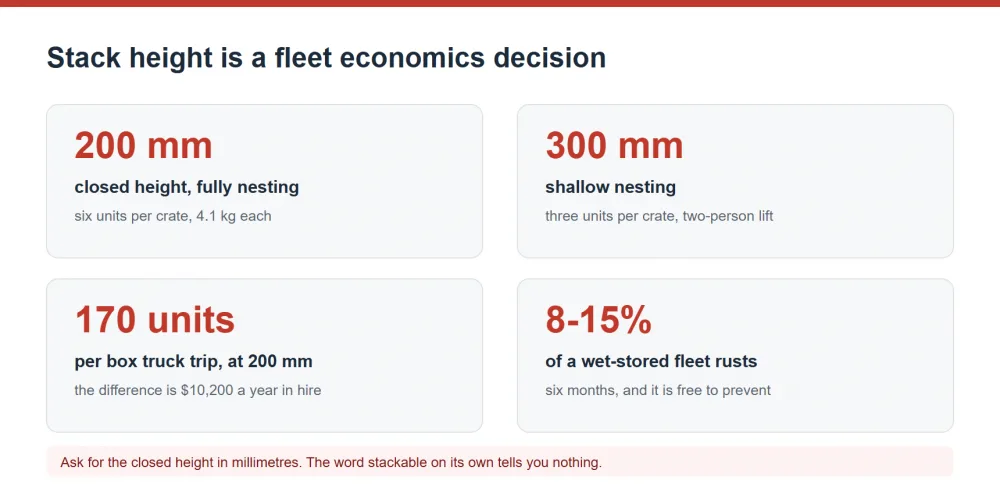
| Box truck, 4.2 t | 7.4 m² | 510 | 340 | 170 units | $10,200 in hire |
| Container, 20 ft | 27 m² | 1,900 | 1,250 | 650 units | $39,000 in hire |
Stack height is a fleet economics decision, not a convenience one. A 90 mm difference per unit is worth 170 units per trip in a box truck, and across sixty trips a year that is $10,200 of vehicle hire or the equivalent of two extra events served without a second truck. The specification is therefore worth asking for directly: closed height in millimetres, not the word stackable.
Storage Density and Damage Over Time
| Storage arrangement | Units per 10 m² | Damage after 12 months | Cause | Mitigation |
|---|---|---|---|---|
| Full nesting, 6 high | 240 | 2–4% of units need a lid replaced | Seal and rim contact | Interleave with foam, keep the rim dry |
| Full nesting, 10 high | 400 | 6–9% need a lid replaced | Weight of the stack on the bottom rim | Cap at 6, do not stack on a trolley for long |
| Side by side on shelves | 90 | Under 1% | — | Best for long-term storage, worst for space |
| Stored wet in a crate | 240 | Rust spotting on 8–15% | Trapped moisture against 201 steel | Dry fully before crating, never crate a wet unit |
| Fuel units stored with cans in | 240 | Fuel holder deformation | Cans left in the holder | Store fuel separately and empty |
The last two rows are where fleet damage actually comes from. A unit that goes into a crate damp will come out with rust spotting in six months, and a fuel holder that has been stored loaded will not sit flat when it is filled at the next event. Both are free to prevent, and both are invisible in a purchase order. Crating a unit dry and storing fuel separately is the whole discipline.
Buying Criteria for a Transport Fleet
| Criterion | Ask for | Why it matters | Red flag |
|---|---|---|---|
| Closed height | A number in millimetres | Drives units per trip and vehicle hire | The word stackable with no figure |
| Empty weight | Under 4.5 kg for one-person handling | Determines whether you need a second person per event | Over 6 kg with a full pan |
| Nesting | Lid and water pan inside the body | Determines stack height and lid damage | Lid clipped to the outside |
| Body thickness | 0.6–0.8 mm | A 0.5 mm body dents in a van and will not seal | 0.4–0.5 mm quoted |
| Steel grade | 304 | 201 pits in 6–14 months in a damp crate | 201 with no grade marking |
| Handle | Two side handles, riveted not welded | The handle fails from being lifted, not from heat | A single top handle |
| Element protection | Removable for storage | A fragile element should not ride in a stack | Fixed element, no removal |
| Spare parts | Published part numbers and prices | Turnaround depends on the part, not the unit | No part list published |
A single top handle is worth calling out, because it appears on a lot of otherwise decent units. A one-handed lift of a 5 kg unit is a strain injury waiting to happen, and it is also the reason a unit ends up on the floor. Two side handles at roughly 200 mm apart let one person carry a unit level, which is what makes a one-person setup possible at the venue.

Frequently Asked Questions
How many chafing dishes fit in one transport crate?
Six for a fully nesting unit at 180 to 210 mm closed, five if the lid clips to the outside, and three for a shallow-nesting unit. That is the difference between 240 and 120 units per small van, and across sixty trips a year it is $3,600 of vehicle hire. Ask for the closed height in millimetres, because the word stackable on its own does not tell you anything.
What weight can one person carry safely?
A single unit of 4 kg or less, and no more than 5 kg for something held at arm height, and certainly not 8 kg or more. Above that you need two people and a trolley. A unit with one top handle is the underlying problem, because a 5 kg unit lifted with one hand is a strain injury, and it is also how a unit ends up on the floor and gets dented.
How do I stop stackable units getting damaged in storage?
Cap the stack at six units, dry every unit completely before crating, keep fuel holders empty and stored separately, and never crate a unit while it is warm and wet. Stacked wet, 8 to 15% of a 201 steel fleet comes out with rust spotting within six months, and a fuel holder stored loaded will not sit flat when it is filled at the next event.
Does stacking affect the heating element?
It can, which is why a transport fleet should use a unit with a removable element. A fragile element should not ride in a stack with five units of steel above it, and if an element is damaged in transit the failure is not obvious until the unit is on a live service. A removable element also means it can be stored separately in a box, which protects it entirely.
Is a stackable chafing dish worth buying over a standard one?
Only if you transport more than about 20 units a year or you have a van with a floor area limit that is genuinely binding. Below that, a standard unit at $90 to $120 and a separate set of transit boxes will serve you better, because you can stack the boxes in the way that suits the load. The stackability matters when the vehicle, not the event, is the constraint.

Electric Chafing Dish Food Warmer
Commercial Hotel Electric Visual Buffet Chafing Dish with 400W fast heating, 11L capacity and digital temperature control with ±2°C tolerance. The visible window lets staff check food level without lifting the lid, which matters more in a transport fleet than in a fixed kitchen because a fleet unit is opened and closed many times a day. Two side handles and a removable element make it a unit one person can carry.

Electric Chafing Dish-W07
900W rapid heating chafing dish with intelligent temperature control, multi-safety protection and an anti-dry-heat alarm, adjustable from 45 to 89°C. The dry-heat alarm matters disproportionately in a fleet, because a unit left on in a closed van or a storeroom is the classic accident. 1.2 mm stainless steel body resists the dents that come from repeated handling.
Browse the full chafing dish range for current models and configurations.
Related reading
- Chafing Dish Fuel Holder: Safe Fuel Storage Solutions
- Dual Dry-Wet Heating Chafing Dish: One Dish, Two Modes
- Lift-Off Lid Chafing Dish for Quick Buffet Service
- 6QT Compact Chafing Dish for Small Catering Businesses
- How to Replace a Food Heat Lamp Bulb: Quick & Easy Tutorial
- 5 Chafing Dish Cleaning Mistakes That Rust Your Pans in 6 Months