




Stainless Steel Food Warmer: Deli Departments Best Bet
Short answer: A supermarket deli warmer is a different job from a restaurant chafing dish, and the four requirements that follow are 57–60°C held for the whole trading day, a shallow 4–7 L pan matching a deli tray, a body cleanable with food-safe sanitiser every two hours, and a unit staff can refill without closing the counter. The economics invert too: a deli unit runs 12–16 hours a day, so energy per hour matters more than energy per guest. See chafing dish food holding options.

A restaurant buffet serves a rush. A supermarket deli serves a trickle, from 07:00 to 21:00, with a lunch peak in the middle and a long afternoon where the same pan is being topped up rather than replaced. That changes everything: the unit has to hold safe temperature for fourteen hours at low load, the food has to look fresh rather than look hot, and the pan has to be refillable in thirty seconds by a staff member who is also serving a queue.
Deli Versus Restaurant: The Requirements Invert
| Requirement | Restaurant buffet | Supermarket deli | Why |
|---|---|---|---|
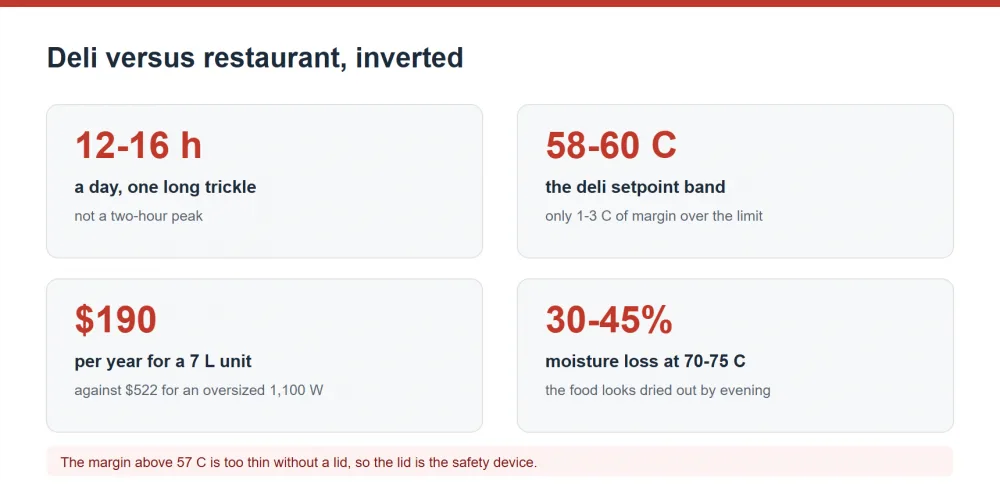
| Service pattern | 2–4 hour peak | 12–16 hours, one long trickle | The unit must hold at low load, not recover fast |
| Pan size | 11–16 L, banquet | 4–7 L, deli tray depth | A deep pan cannot be scooped from by staff and refilled by customers |
| Hold temperature | 70–75°C | 57–60°C | Deli food is displayed, and higher heat dries it out visibly |
| Appearance | Guest-facing, high standard | Guest-facing, continuously | Eight hours of visible food must still look fresh at 19:00 |
| Cleaning | Between services | Every 2 hours, sanitiser | Deli counters are wiped down continuously |
| Refill method | Swap a full pan | Top up the same pan | Topping up means disturbing the surface, which affects quality |
| Power circuit | Often a dedicated 20 A | Usually a shared counter circuit | Deli counters rarely have a spare 20 A branch |
| Wipe-down access | Open front | Top and front, full width | Sanitiser gets into the seams and has to be wiped out |
Hold Temperature and Food Quality Over a Trading Day
| Setpoint | Safety margin over 57°C | Moisture loss over 12 h | Appearance at 19:00 | Verdict |
|---|---|---|---|---|
| 45°C | None, below the limit | Low, 5–8% | Fresh | Unsafe, and a legal problem |
| 55°C | None | 8–12% | Acceptable | Still below the limit |
| 58–60°C | 1–3°C | 12–18% | Acceptable | Correct, but no margin for a door opening |
| 63–65°C | 6–8°C | 20–28% | Dry on the surface | Safe with margin, visible quality loss |
| 70–75°C | 13–18°C | 30–45% | Dry, shrink-wrapped look | Wrong for a display counter |
The 58 to 60°C band is the correct answer for a deli, and it is a compromise that has to be managed rather than a safe default. The margin above 57°C is only one to three degrees, which is not enough to absorb a customer holding the door open on a cold morning. Two things recover that margin: a lid, which is the difference between a 3-degree and a 12-degree swing, and a probe check every two hours with a documented action if the reading has dropped. A deli unit run open to the shop floor at 60°C with no lid is a unit that will fail a temperature check on a busy day, and it will fail for reasons that have nothing to do with the unit.
Energy Cost for a 13-Hour Day
| Unit | Power | Cost per hour | Cost per 13 h day | Cost per year | Verdict |
|---|---|---|---|---|---|
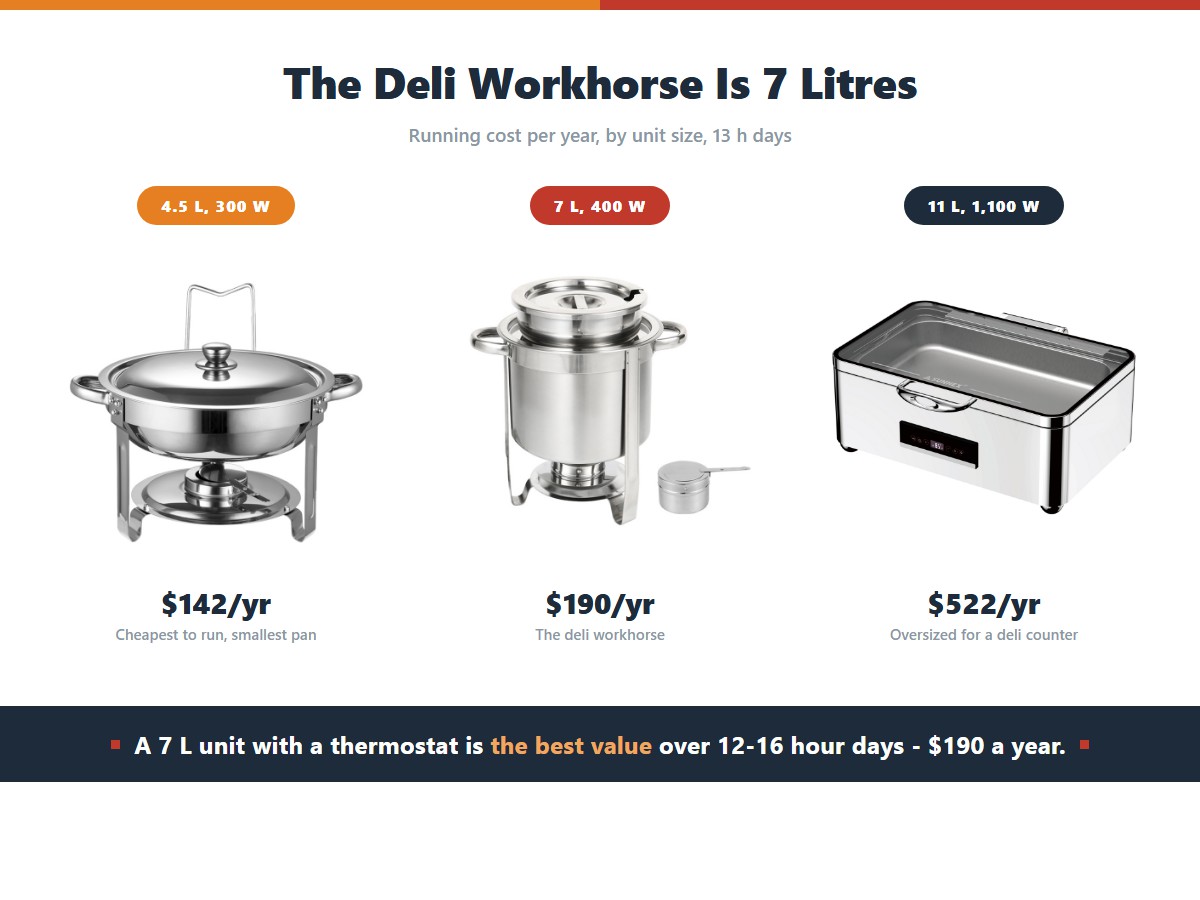
| 4.5 L, 300 W | 300 W | $0.03 | $0.39 | $142 | Cheapest to run, smallest capacity |
| 7 L, 400 W | 400 W | $0.04 | $0.52 | $190 | The deli workhorse |
| 9 QT, 700 W | 700 W | $0.07 | $0.91 | $332 | Only if the counter serves 200+ covers a day |
| 11 L, 1,100 W | 1,100 W | $0.11 | $1.43 | $522 | Oversized for a deli |
| 7 L with thermostat, 400 W | 400 W | $0.04 | $0.52 | $190 | Best value over 12–16 h days |
A deli running 13 hours a day on a 1,100 W full-size unit spends $522 a year on energy for one counter, against $190 for a 7 L unit with a thermostat. That $332 difference is close to the purchase price difference between the two, which is why a deli counter is the one place on this site where the smaller unit is clearly the better buy. The thermostat matters more here than anywhere else, because the unit sits at a low setpoint for hours and the element duty cycle is what the meter is actually measuring.
Cleaning and Sanitising Without Ruining the Unit
| Action | Frequency | Correct method | What damages the unit | Cost of the mistake |
|---|---|---|---|---|
| Pan wash | Every 2–4 h | Hot water and food-safe sanitiser, soft cloth | Chlorine on stainless, steel wool | Rust spotting within 6 months |
| Water pan | Daily | Remove, wash, dry, refill | Leaving it wet overnight | Scale, then pitting |
| Body and seams | Daily | Wipe with a damp cloth, dry immediately | Spraying directly into the seam | Water tracking to the element |
| Air intakes | Weekly | Vacuum or soft brush | Dust and grease in the element | Element overheating, shortened life |
| Lid glass or window | Every 2–4 h | Warm water, dry cloth | Sudden cold on hot glass | Cracking the window |
| Thermostat check | Monthly | Compare panel against a probe in the pan | Never checking at all | Drift discovered during a failed inspection |
| Deep descale | Monthly | Citric or vinegar solution, 20 min, rinse | Hydrochloric acid | Etching, permanent dull finish |
The chlorine line is the one that matters most in a deli, because deli counters are cleaned with sanitiser that is often chlorine-based, and stainless steel in the presence of chlorine and moisture will spot. Dilution and immediate drying are what protect the surface. A soft cloth and a measured solution are enough, and the alternative, a chlorine-diluted unit with visible spots across the front of the counter, is a cost that appears in the customer-facing area every day.
Frequently Asked Questions
What temperature should a supermarket deli hold food at?
58 to 60°C, measured at the pan rim every two hours. 57°C is the legal minimum with no margin, and the margin above it matters because a customer holding the door open on a cold morning can pull the temperature down faster than the unit recovers. Running a deli at 70 to 75°C is also wrong, because it drives 30 to 45% moisture loss over a twelve-hour day and the food looks dried out by evening.
Which chafing dish size suits a deli counter?
A 4 to 7 L unit. A deli tray is shallower than a banquet pan, and a deep pan cannot be refilled by staff without a ladle and a lot of time, or by a customer at all. The 7 L format is the workhorse: 400 W, about $0.04 an hour, and $190 a year over a 13-hour trading day against $522 for a 1,100 W full-size unit that is simply too big for a deli.
How often should a deli warmer be cleaned?
The pan every two to four hours, the water pan daily, the body and seams daily, and the air intakes weekly. The panel and the lid window need the same two-to-four-hour attention as the pan. A deli counter is cleaned continuously, so the cleaning method matters more than the frequency: use a food-safe sanitiser with a soft cloth, and never leave the unit wet overnight.
Can I use chlorine sanitiser on a stainless steel deli warmer?
Dilute it, and dry the surface immediately, or use a different sanitiser. Stainless steel in the presence of chlorine and moisture will spot, and deli counters are cleaned with chlorine-based products as standard. Visible spotting across the front of a customer-facing counter is a cost that appears every day, and a soft cloth with a measured solution costs nothing extra.
Why does food in a deli warmer dry out?
Almost always the setpoint rather than the equipment. A 70°C setpoint over a twelve-hour day costs 30 to 45% of surface moisture, and a lid-less counter makes it worse. Drop to 58 to 60°C, add a lid, and load the food at 85°C rather than straight off the range. A unit running at 60°C with a lid holds visibly fresh food at 19:00 where a unit running hot and open does not.

Electric Chafing Dish Food Warmer
Commercial Hotel Electric Visual Buffet Chafing Dish with 400W fast heating, stainless steel body and digital temperature control. A visible window lets staff check level and colour without lifting the lid, which in a deli counter means the food stays in the safe band and the surface does not dry out from constant exposure. 400W suits a shared counter circuit and a 13-hour trading day.

7L Stainless Steel Soup Pot
Stainless Steel Breakfast Porridge Warmer, commercial grade, in multiple sizes for buffet and restaurant use. The 7 L format matches a deli tray depth rather than a banquet pan, and the 304 stainless steel body takes the repeated hot water and sanitiser cleaning a deli counter puts through it, provided it is dried rather than left wet overnight.
Browse the full chafing dish range for current models and configurations.
Related reading
- How to Clean and Maintain a Stainless Steel Chafing Dish
- 304 vs 201 Stainless Steel: Which Alloy for Buffet Equipment?
- 201 vs 304 Stainless Steel: Chafer Durability Test
- Rust Spots on Stainless Steel Buffet Equipment: Causes and Removal
- Why Stainless Buffet Gear Gets Rust Spots (And Fixes)
- Supermarket Deli & Prepared Food Equipment Guide
- Stainless Steel Food Heat Lamps: Durable for Kitchen Surfaces