




Mini Chafing Dish: Perfect for Breakfast Buffets
Short answer: A mini chafing dish serves 25–35 guests and its job is to hold a small amount of one thing hot for a long time, which is a different requirement from serving a main, and the four numbers are 3.8 L of capacity, 300–400 W of element power, a 330 × 250 mm footprint and an insulated or lidded body that keeps a low volume at temperature without cooking it. See chafing dish sizes.

Condiment and side stations are the part of a breakfast buffet that most operators under-equip, because the number of guests is large and the amount of food per guest is small. A toast station, a preserves station, a yogurt and topping bar, a bread warmer, a hot syrup and fruit station: each of these holds 3 to 4 litres, each is on the line for four hours, and each one needs to be at 60 to 70°C for the whole service rather than for a fifteen-minute rush.
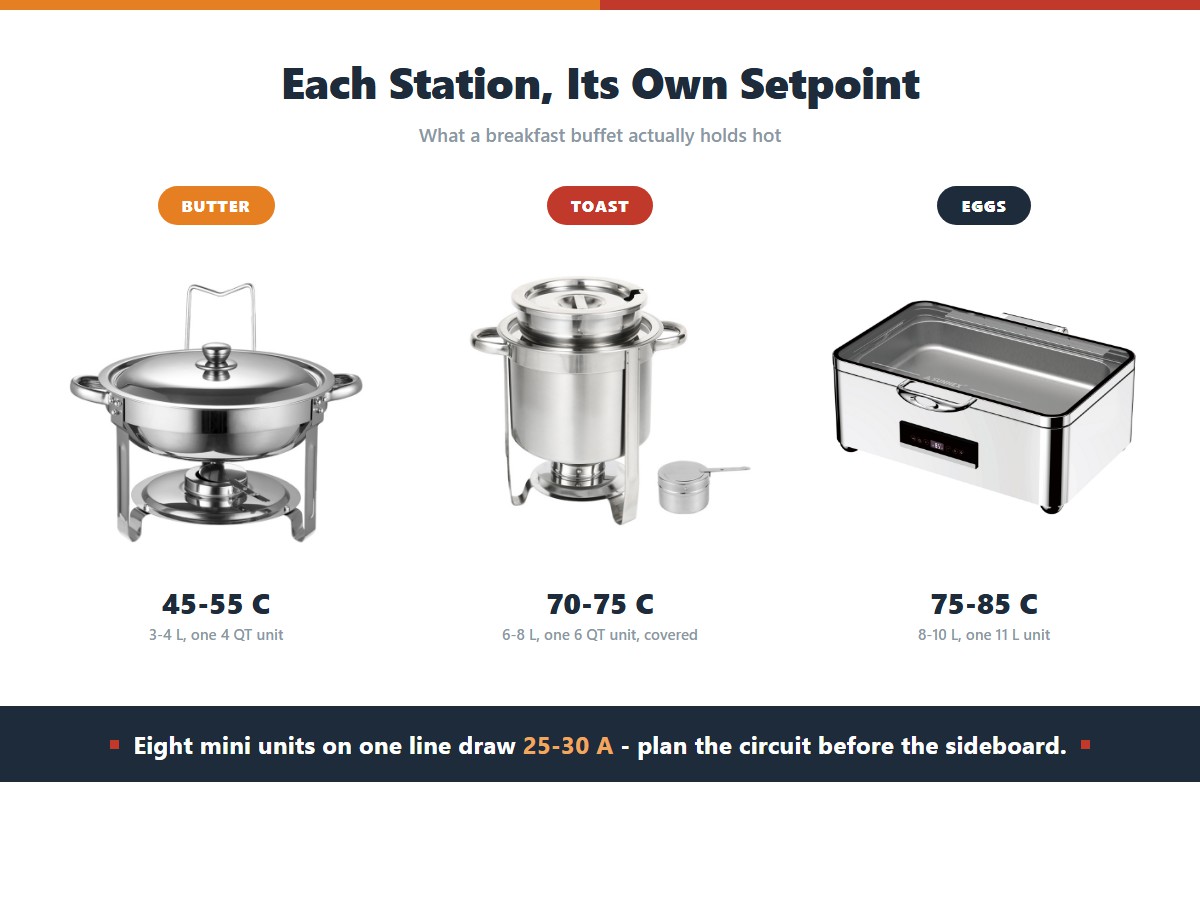
Mini Stations and What They Serve
| Station | Typical load | Volume needed | Setpoint | Units per 100 guests | Notes |
|---|---|---|---|---|---|
| Toast and bread | 4–6 slices per person | 6–8 L | 70–75°C | 1 × 6 QT | Dries out fast, needs a lid |
| Preserves and butter | 15–25 g per person | 3–4 L | 45–55°C | 1 × 4 QT | Butter needs a lower setpoint |
| Yoghurt and toppings | 60–100 g per person | 4–6 L | 8–12°C, chilled | Not a chafing dish | Needs refrigeration, not heat |
| Hot fruit and compote | 40–60 g per person | 4–6 L | 70–80°C | 1 × 6 QT | Acidic, watch the steel grade |
| Syrup and warm toppings | 20–30 ml per person | 2–3 L | 60–70°C | 1 × 4 QT | Thick, clogs the spout |
| Eggs and bacon | 2 items per person | 8–10 L | 75–85°C | 1 × 11 L | Not a mini job |
| Cold cereals and granola | Dry | Not applicable | Ambient | A cereal dispenser | See the dispenser range |
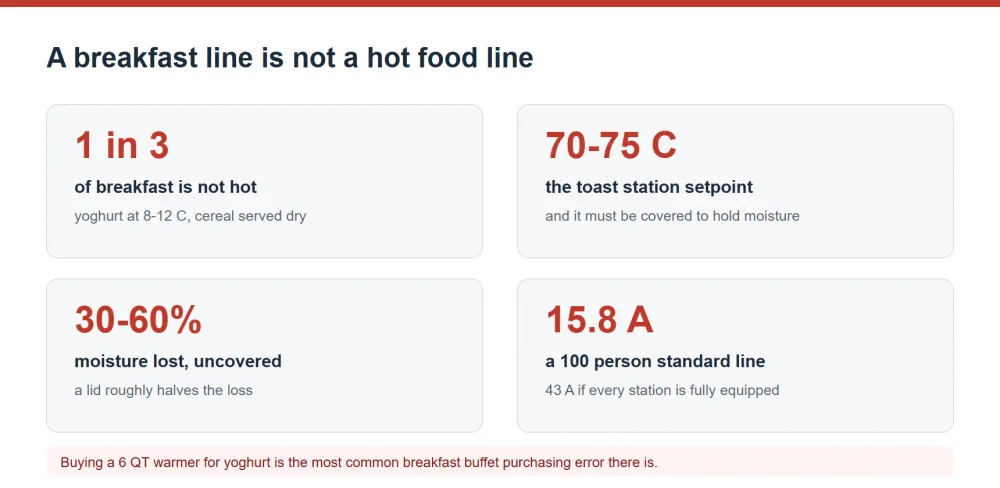
Two of these rows are not chafing dish work at all. Yoghurt has to be held at 8 to 12°C, which is a refrigerated unit, and cereals are a dry good in an acrylic hopper. Forcing either into a hot unit destroys the product and wastes energy. A mini chafing dish is the wrong answer for about a third of what a breakfast buffet line contains, and recognising which third is the useful part of specifying one.
Mini Unit Specifications
| Specification | 4 QT mini | 6 QT mini | Why it matters |
|---|---|---|---|
| Capacity | 3.8 L | 5.7 L | Match the volume to the portion, not to the guest count |
| Footprint | 330 × 250 mm | 360 × 280 mm | Four units across a 1.5 m sideboard |
| Element power | 300 W | 400–500 W | Six units still fit one 10 A circuit |
| Current at 120 V | 2.5 A | 3.3–4.2 A | A breakfast line with eight units is 25–30 A |
| Preheat | 12–15 min | 12–15 min | Eight stations preheat in one shift |
| Setpoint range | 45–85°C | 45–89°C | Butter at 50°C, fruit at 80°C |
| Body thickness | 0.6–0.8 mm | 0.6–0.8 mm | Below 0.5 mm the body warps |
| Price | $35–$60 | $45–$90 | Eight units is $360–$720 |
Hold Quality Over a Four-Hour Breakfast
| Setpoint | Safe for 4 h | Toast quality | Butter quality | Condensation on lid | Verdict | |
|---|---|---|---|---|---|---|
| 45°C | Yes | Soft, dries at the edges | Soft, usable | Heavy | Butter only | |
| 55°C | Yes | Acceptable | Very soft | Heavy | Preserves | |
| 65°C | Yes | Good | Melts | Moderate | Syrup, general use | |
| 70–75°C | Yes | Good, dries without a lid | Melted | Light | Toast and fruit | |
| 80–85°C | Yes | Too dry | Melted | Minimal | Eggs, not bread | |
| 90°C or above | Yes | Ruined | Melted | None | Wrong for a condiment |
The toast row is the one that decides the lids. At 70 to 75°C, toast loses 30 to 60% of its surface moisture over four hours without a lid, and a lid roughly halves that. With a lid, good toast at 70°C is achievable; without one, the same toast is acceptable at 60°C but then it is not really toast. This is the cheapest quality win on a breakfast line, and it is an accessory rather than an appliance.
Line Planning for a 100-Guest Breakfast
| Line | Stations | Units | Total power at 120 V | Counter length | Labour to set |
|---|---|---|---|---|---|
| Minimal | 2 hot, 1 cold | 2 × 6 QT + 1 dispenser | 8.4 A | 1.2 m | 15 min |
| Standard | 4 hot, 2 cold | 3 × 6 QT + 1 × 4 QT + 2 dispensers | 15.8 A | 2.4 m | 25 min |
| Full | 6 hot, 3 cold | 5 × 6 QT + 1 × 11 L + 3 dispensers | 30.0 A | 3.6 m | 40 min |
| Hotel, 300 guests | 8 hot, 4 cold | 6 × 6 QT + 2 × 11 L + 4 dispensers | 43.3 A | 5.4 m | 1 h 15 min |
The labour column is the one that gets missed. A full line for 300 guests takes over an hour to set, and that hour is either paid labour at the start of a shift or, more often, unaccounted time at the start of a service. The way to compress it is pre-heating everything at once, which needs a 30 A circuit and a staging area, and the way to reduce the number of stations is to accept a longer queue at two of them.
Frequently Asked Questions
How many guests does a mini chafing dish serve?
25 to 35 guests as a single station, and it is the station rather than the guest that matters. A mini unit works because it holds one small thing hot for four hours, so a breakfast for 100 guests might need four to six separate stations rather than four larger units serving different dishes.
What temperature should a toast and bread station run at?
70 to 75°C with a lid, and 60°C without one. Toast loses 30 to 60% of its surface moisture over a four-hour service without a lid, and a lid roughly halves that. At 90°C or above the toast is ruined within the hour, and at 45°C the butter is the only thing that is properly served.
Can a chafing dish hold yoghurt?
No. Yoghurt has to be held at 8 to 12°C, which requires a refrigerated unit, and a chafing dish applied to it will destroy the product and waste energy doing it. The same applies to cereals and granola, which are dry goods in a dispenser. A good breakfast line is roughly two-thirds hot stations and one-third cold or dry, and specifying the hot part as chafing dishes all the way is a common and expensive mistake.
How much power does a breakfast buffet line need?
A standard line for 100 guests with six hot stations runs about 16 A at 120 V and fits a 20 A circuit. A full line for 300 guests reaches 43 A and needs two circuits, which is also a useful number for the setting-up labour, because a line that needs two circuits needs a staged preheat and a place to stage it.
How long does it take to set up a breakfast buffet line?
About 40 minutes for a six-station line serving 100 to 150 guests, and over an hour for a full eight-station line serving 300. Most of that is preheat and staging, not carrying. Pre-heating everything at once on a single 30 A supply compresses it, and cutting two stations is faster than working faster at setting them.

Electric Chafing Dish Food Warmer
Commercial Hotel Electric Visual Buffet Chafing Dish with 400W fast heating, stainless steel body and digital temperature control. For a condiment station the visible window matters more than the capacity, because staff check and top up the pan every twenty minutes and lifting a lid on a small unit is what cools it. A digital setpoint also lets one unit cover butter at 50°C and fruit at 80°C.

Electric Chafing Dish-W07
900W rapid heating chafing dish with intelligent temperature control, multi-safety protection and an anti-dry-heat alarm, adjustable 45 to 89°C. The dry-heat alarm is the safety feature that matters on a condiment line, where a small pan of butter or syrup can run dry without anyone noticing for twenty minutes, and a dry element is a scrapped unit.
Browse the full chafing dish range for current models and configurations.
Related reading
- Hotel Breakfast Buffet Equipment: What 100 Rooms Really Need
- Multiple Buffet Stations: One Attendant, How?
- Hotel Breakfast Buffet on a $5,000 Budget: Exact List
- Return on Investment of a Hotel Breakfast Buffet
- Portable vs Built-In Buffet Stations: Which Suits Your Venue
- Triple Cereal Dispensers & Dry Food Stations for Hotel Buffets
- Best Buffet Chafing Dish: What Holds Heat Longest