


Electric Buffet Warmer: Why Adjustable Thermostat Matters
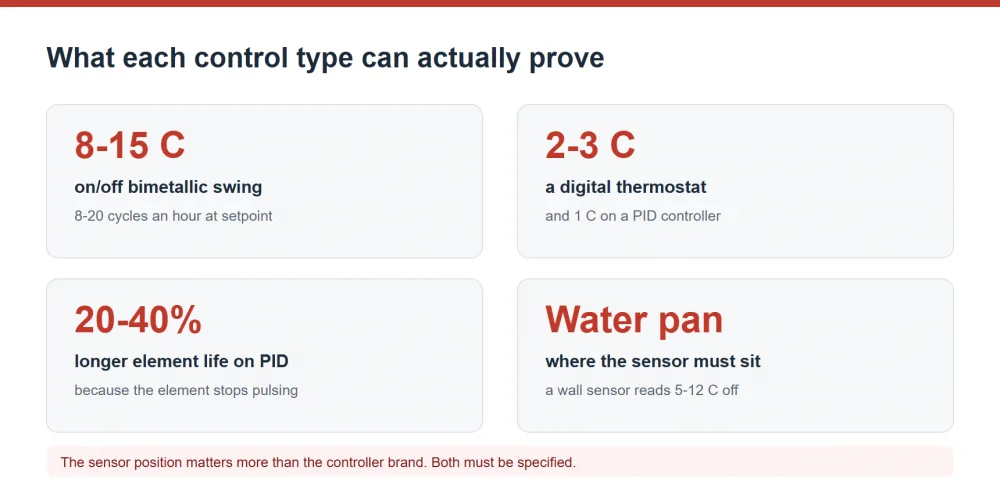
Short answer: An adjustable thermostat is worth $25–$60 on any unit, and the four numbers that decide which type to buy are the setpoint range in degrees Celsius, the tolerance at setpoint, the sensor position, and the element duty cycle it produces. A bimetallic switch cycles the element hard and drifts; a PID controller holds within 1°C and cycles it gently, which is what makes a documentable temperature record possible. See chafing dish temperature control options.

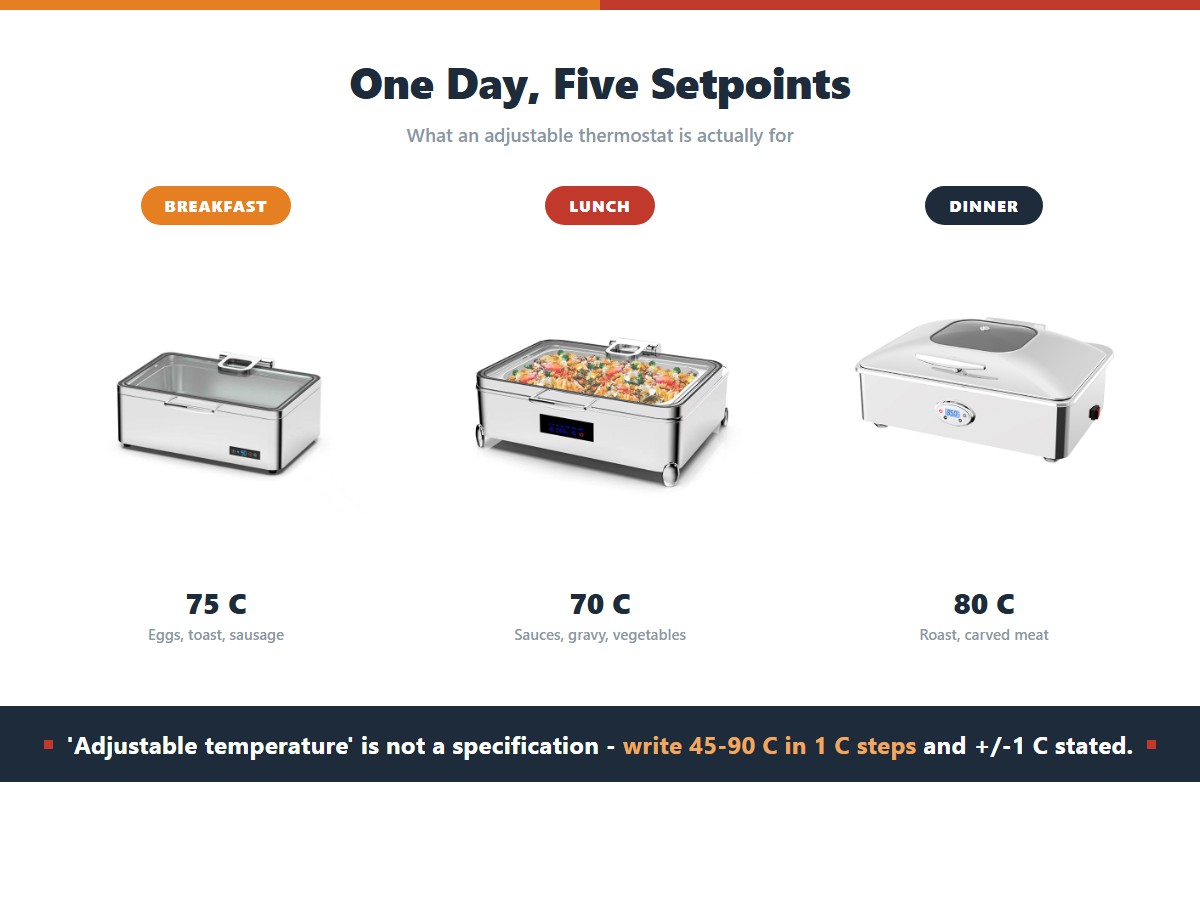
A restaurant cannot run one temperature across a whole day, and this is the argument for an adjustable thermostat in a single sentence. Breakfast at 75°C to keep toast and eggs workable, lunch at 70°C for a sauce that dries if it gets hotter, an afternoon coffee and pastry hold at 45°C, dinner at 80°C for a roast. A fixed bimetallic switch gives you one of those and a compromise on the rest. The cost of the compromise shows up as waste, and it is not visible on the invoice.
Control Types Side by Side
| Control | Tolerance | Setpoint range | Element cycling | Element life | Price premium |
|---|---|---|---|---|---|
| On/off bimetallic | ±8–15°C | Fixed or 2–3 steps | Hard, 8–20 cycles an hour | Shortened | Baseline |
| Two-stage bimetallic | ±5–8°C | Two setpoints | Moderate | Fair | $10–$25 |
| Digital thermostat | ±2–3°C | 30–90°C in 1°C steps | Moderate | Fair to good | $25–$60 |
| PID controller | ±1°C | 45–90°C, programmable | Even | Extended 20–40% | $60–$140 |
| PID with probe and logging | ±1°C | 45–90°C, programmable | Even | Extended | $120–$260 |
What Each Service Period Needs
| Service | Setpoint | Why | With a fixed switch | Food waste effect |
|---|---|---|---|---|
| Breakfast, 06:00–10:00 | 75°C | Eggs, toast, sausage | Either too cold or the eggs dry out | 8–14% |
| Lunch, 12:00–14:00 | 70°C | Sauces, gravy, vegetables | Too hot, the sauce reduces and skins | 10–18% |
| Afternoon, 15:00–17:00 | 45°C | Coffee, pastry, sauce station | Full power all afternoon | Energy, not waste |
| Dinner, 18:00–22:00 | 80°C | Roast, carved meat | Too low to hold safely | Safety risk |
| Late, 22:00–00:00 | 60–65°C | Small volumes, a la carte | Either off, or full power for two covers | 8–12% |
The afternoon row is the one that is pure energy, and it is where a fixed switch is most wasteful. A unit holding 75°C through two hours of almost no covers costs about as much as running it at full power for 30 minutes. Dropping it to 45°C costs nothing in quality because there is almost no food in the pan, and it takes a thermostat with a wide range to make that switch possible.
Where the Sensor Sits Decides What the Display Means
| Sensor position | What the display reads | What the pan rim actually is | Gap | Verdict |
|---|---|---|---|---|
| In the water pan, immersed | The water temperature | Within 2–3°C of the water | 2–3°C | Correct |
| On the pan base, contact | Close to the food | Within 1–2°C | 1–2°C | Acceptable |
| Clamped to the outer wall | The element housing | 5–12°C cooler | 5–12°C | Not acceptable |
| Air gap sensor, above the pan | Air temperature | Very variable | 10–20°C | Not acceptable |
This is the detail that product pages omit, and it is the difference between a display you can record and a display you cannot. A wall sensor reads the element housing, which is the hottest surface in the appliance, so it will display exactly 70°C while the food at the pan rim sits at 58°C. The operator trusts the panel, the record says 70°C, and the food was below 57°C. No one is lying and the record is still wrong. Ask where the sensor sits, and check with a probe in the pan rather than trusting the display.
Element Life, by Control Type
| Control type | Cycles per hour | Element temperature swing | Life at 8 h/day | Life at 18 h/day | Extra cost over 5 years |
|---|---|---|---|---|---|
| On/off bimetallic | 8–20 | Large | 3–5 years | 1.5–2 years | Baseline |
| Digital thermostat | 4–8 | Moderate | 4–6 years | 2–3 years | $15–$40 saved |
| PID controller | 1–3 | Small | 5–7 years | 2.5–3.5 years | $30–$80 saved |
The saving comes from the element spending less time at extreme temperature, not from the controller using less power. An on/off switch drives the element to full temperature and then lets it cool completely, twenty times an hour, and every one of those cycles is a thermal shock. A PID controller keeps the element close to steady, which extends element life by 20 to 40% and, over five years, is worth more than the controller cost in most cases. The saving is bigger on a unit that runs 18 hours a day, which is exactly the case where the controller matters most.
What to Specify in a Purchase Order
| Line to write into the order | Acceptable | Unacceptable | Why it matters |
|---|---|---|---|
| Setpoint range | 45–90°C in 1°C steps | Adjustable temperature | A range you can actually use across a service day |
| Tolerance at setpoint | ±1°C stated | Precise control | Decides whether the record is defensible |
| Sensor position | In the water pan, immersed | Built-in sensor | Decides whether the display means anything |
| Dry-heat protection | Alarm and cut-out | — | Best value feature on the list |
| Probe port | External probe port | — | Turns the panel reading into a food measurement |
| Element replacement price | Published, $28–$45 | — | Lead time of 5–14 days makes this a real number |
| Spare part availability | 5 years | — | Determines the life of the unit, not the warranty |
None of these lines costs anything extra to write and every one of them removes an argument later. A thermostat that cannot be probed cannot be verified, and an unverifiable thermostat is a thermostat that eventually gets replaced rather than calibrated, which is how a restaurant ends up with a new appliance it did not need.

Frequently Asked Questions
Is an adjustable thermostat worth the extra cost?
Yes, and it is the best value upgrade on any warmer. A digital thermostat costs $25 to $60 over a bimetallic switch and gives a 45 to 90°C setpoint range, which is what lets one unit cover breakfast at 75°C, lunch at 70°C and an afternoon hold at 45°C. A PID controller at $60 to $140 adds tolerance and extends element life by 20 to 40%, which pays back over five years on a unit running 18 hours a day.
What is the difference between a thermostat and a thermometer?
A thermostat controls the element, a thermometer measures the food. A panel that displays 70°C is a thermostat reading its own sensor, not a thermometer reading the pan. That distinction matters because the two can differ by 5 to 12°C if the sensor is on the outer wall rather than in the water pan, and only an external probe tells you the difference.
Where should the temperature sensor be located?
In the water pan, immersed, in contact with the heating water. A sensor clamped to the outer wall reads the element housing, which is the hottest surface in the appliance, so it will display 70°C while the food at the pan rim sits at 58°C. Always verify with a probe in the pan rather than trusting the display.
Does a thermostat reduce energy use?
Less than people expect, and not through the thermostat itself. A PID controller draws marginally more power because it cycles the element more evenly, and it saves money through longer element life and through the ability to hold a low setpoint during quiet hours. The real energy saving comes from switching the unit off between services, which is worth about $1,000 a year across twenty units.
How do I know if my existing warmer has a faulting thermostat?
Compare the panel reading against a probe in the pan at the rim. If the panel reads 70°C and the probe reads 58°C, the sensor is misplaced or the controller has drifted. If the panel reads 70°C and the probe reads 68°C but the food is still cold, the problem is at the pan rather than the thermostat. Ten seconds with a probe separates the two cases and saves a unit replacement.

Full Size 11L Electric Chafer
BAVA Full Size 11 L Electric Chafer, 1,100W with 12-minute rapid heat-up, 80% or better thermal efficiency, digital temperature display and Smart Mode, in polished stainless steel. The digital setpoint is what makes a restaurant service day work, since the same unit can run breakfast at 75°C, lunch at 70°C and an afternoon pastry hold at 45°C without any change to the appliance.

Electric Chafing Dish Food Warmer
Commercial Hotel Electric Visual Buffet Chafing Dish with 400W fast heating, stainless steel body and digital temperature control. 400 W suits a smaller line and a normal 10 A circuit, and the visible window lets staff check food level without lifting the lid, which keeps a small pan at temperature through a service where it is checked every twenty minutes.
Browse the full chafing dish range for current models and configurations.
Related reading
- Countertop Electric Food Warmer for Restaurant Buffet Lines
- Induction vs Electric vs Fuel: Which Warmer Heats Fastest?
- The Future of Chafing Dishes: Electric & Smart Food Warmers
- Electric Chafing Dish Thermostat Not Working: Diagnosis and Fixes
- Fuel vs Electric: The 5-Year Cost Nobody Calculates
- Commercial Electric Chafing Dish: What Restaurants Get Wrong