


Multiple Buffet Stations: One Attendant, How?
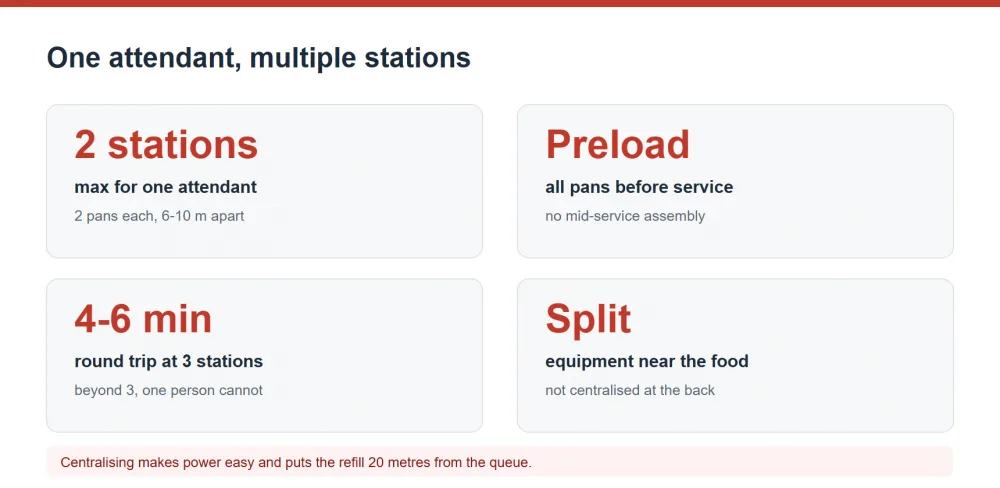
Short answer: One attendant can run two stations reliably if the stations are within 6–10 metres of each other, each has at most two pans, the spare unit is at the midpoint, and every pan is preloaded before service. Beyond three stations the round trip alone consumes 12–18 minutes per hour. The design that works is short, symmetric and preloaded, not bigger or more capable equipment. See buffet station equipment.
Large venues—hotels, casinos, convention centers—often run multiple buffet stations: breakfast buffet in the lobby, lunch buffet by the pool, dinner buffet in the ballroom. Managing these scattered stations with standard chafing dishes means running around to check fuel levels, adjust temperatures, and refill water tanks. Buffet stoves designed for multi-station use change this: they let you manage all stations from a central point, reduce equipment needs, and cut labor costs. In this guide, we’ll explain how buffet stoves help you manage multiple buffet stations at once, and which models work best for multi-station setups.
Centralized Temperature Control Saves Time
Most commercial buffet stoves with digital controls (like the Full Size 11L Electric Chafer) let you set temperatures once and forget them, even across multiple stations. Staff don’t need to check each stove individually—the digital display shows real-time temp and water levels, and smart mode adjusts power automatically. For venues with 3+ buffet stations, this centralized control cuts station checks by 70%, freeing up staff to handle other tasks.
Standardized Equipment Reduces Inventory Costs
Using the same buffet stove model across all stations lets you standardize food pans, fuel cans, and replacement parts. Instead of stocking 5 different types of chafing dish parts, you only need parts for one model. This reduces inventory costs by 30–40% for large venues, and simplifies staff training—everyone knows how to operate every stove, no matter which station they’re working at. The Full Size 11L Electric Chafer uses standard GN 1/1 pans across all stations, making it easy to rotate pans between breakfast, lunch, and dinner services.

Long Runtime Reduces Refills Across Stations
Buffet stoves with 8+ hour runtime (like electric models with water bath heating) or 4+ hour fuel burn time mean fewer refills across all stations. For 3 stations with 5 stoves each, this eliminates 15+ refill trips per shift, saving 1–2 hours of staff time. The Electric Chafing Dish Food Warmer maintains humidity for 8+ hours, so you don’t need to refill water tanks between services, even for all-day buffet stations.
Top Buffet Stoves for Multi-Station Management
When selecting buffet stoves for multiple stations, prioritize models with digital controls, standardized pan sizes, and long runtime. Below are two BAVA models ideal for multi-station setups:

Full Size 11L Electric Chafer
The features 1100W power, 12-minute heat-up, and ≥80% thermal efficiency. Its digital display shows temp and water levels at a glance, and smart mode adjusts power automatically. The GN 1/1 pan size is standardized across all BAVA chafing dishes, making it easy to rotate pans between stations. It’s ideal for hotels and casinos with 3+ buffet stations, and the durable stainless steel construction withstands daily use across multiple shifts.

Electric Chafing Dish Food Warmer
This 400W model features adjustable digital temperature control (60–93°C) and a 2.5L water tank that lasts 4+ hours. The 304 food-grade stainless steel body is easy to clean, and the compact design fits seamlessly into any buffet station. It’s CE, ETL, and RoHS certified, meeting global safety standards for commercial use. For multi-station setups, the standardized design reduces training and inventory costs significantly.
Scalability for Expanding Venues
Venues that add new buffet stations (like adding a poolside lunch buffet to an existing breakfast buffet) can easily scale their equipment with standardized buffet stoves. You don’t need to train staff on new models or buy new replacement parts—just add more of the same stove. This scalability reduces expansion costs by 25% for venues adding 2+ new stations per year.
Conclusion
Managing multiple buffet stations doesn’t have to be a logistical nightmare. Buffet stoves with centralized controls, standardized designs, and long runtimes let you manage all stations with less labor, lower costs, and better consistency. BAVA’s Full Size 11L Electric Chafer and Electric Chafing Dish Food Warmer are trusted by hotels and casinos worldwide for their multi-station reliability. Whether you’re managing 2 stations or 10, the right buffet stove will streamline your operations and improve the guest experience across all your buffet offerings.
Browse the full chafing dish range for current models and configurations.
Station Count vs Attendant Feasibility
| Stations | Pans each | Round trip | Refill cycles per hour | Feasible alone? | Minimum equipment |
|---|---|---|---|---|---|
| 1 | 4–6 | 0 | 1–2 | Yes | 1 unit |
| 2 | 2 each | 2–3 min | 3–4 | Yes | 2 units |
| 2 | 4 each | 2–3 min | 4–6 | Borderline | 2 units, 1 helper |
| 3 | 2 each | 4–6 min | 5–7 | Yes if preloaded | 3 units |
| 3 | 4 each | 4–6 min | 8–12 | No | 3 units, 1 helper |
| 4+ | 2 each | 8–10 min | 9–14 | No | 4+ units, 2 staff |
Single-Attendant Station Design
| Design element | Requirement | Why | What it saves |
|---|---|---|---|
| Station spacing | 6–10 m | Longer round trips eat the hour | 3–5 min per cycle |
| Pans per station | 2 maximum | More pans means more checks | 1–2 min per check |
| Preloading | All pans loaded before opening | No mid-service assembly | 4–7 min per station |
| Spare unit position | At the midpoint | One trip, not two | 2–4 min per swap |
| Refill stock | At each station, not at the back | No fetching | 3–6 min per cycle |
| Temperature check | Fixed route, same order | Avoids re-deciding | 1–2 min per round |
| Signage | Complete, at eye level | Fewer questions at the line | 2–5 min per service |
Centralised vs Distributed Equipment
| Item | Centralised, one bank | Distributed, per station | Which is better |
|---|---|---|---|
| Power circuits | 1–2 | 2–4 | Centralised, fewer cables |
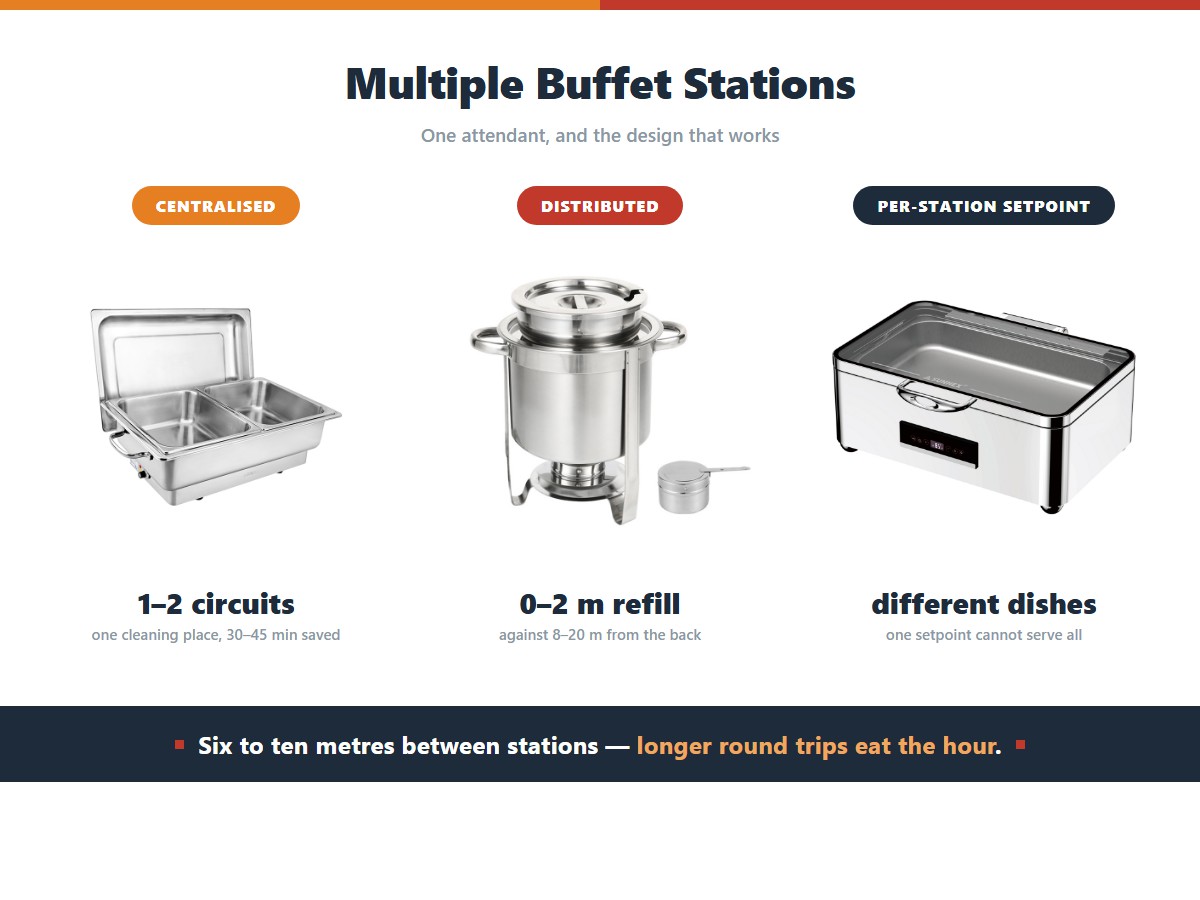
| Temperature control | Single setpoint for all | Per-station setpoint | Distributed, different dishes |
| Refill distance | 8–20 m | 0–2 m | Distributed, decisively |
| Guest queue | One long line | Several short ones | Distributed |
| Spare swap | 2–3 min | 1–2 min | Distributed |
| Cleaning | 1 place | 2–3 places | Centralised, 30–45 min saved |
The table above is where most multi-station plans go wrong. Centralising the equipment makes the power and the cleaning easy, and it puts the refill 8 to 20 metres away from where the guest is standing. The answer is not to choose one, but to put the equipment where the food is and the food where the guest is, and to keep the cleaning and power on a shared circuit. Those two are compatible; a single queue and a distant refill are not.
Frequently Asked Questions
Can one attendant run multiple buffet stations?
Yes for two stations of two pans each, spaced 6–10 metres apart, with every pan preloaded before service and refill stock at each station. Three stations still works if they are preloaded, but four or more cannot be run by one person because the round trips consume the hour.
How far apart should buffet stations be?
Six to ten metres. Beyond that, the walk between stations costs 3–5 minutes per refill cycle, and at four cycles an hour across two stations that is most of an attendant's time spent walking rather than serving.
How many pans per station can one person manage?
Two. Each additional pan means another temperature check and another fill level to judge, and the fourth pan on a station is where the round trip stops being recoverable within a service.
Should equipment be centralised or distributed across stations?
Put the equipment where the food is and the food where the guest is, so distributed. Centralising makes power and cleaning easier but puts the refill 8–20 metres from the queue. The compromise is to share a power circuit and a cleaning point while distributing the warmers.
What is the most common mistake in multi-station buffet design?
One long line of six pans presented as two stations. Guests still queue in one place, the attendant still walks the full length, and the split buys nothing. Real separation means separate queues with separate pans, not one table with a gap in the middle.
Related reading
- Mini Chafing Dish for Breakfast Buffet & Condiment Stations
- 2026 Global Commercial Food Warmer Market Growth & Innovation
- 6QT Compact Chafing Dish for Small Catering Businesses
- Hotel All-Day Dining: Stainless Buffet Stove Specs
- School Cafeteria Buffet: HACCP Checklist That Passes Audit
- Portable vs Built-In Buffet Stations: Which Suits Your Venue