




How to Choose a Buffet Stove: Size, Heat Source, Budget
Short answer: A buffet stove is a tabletop cooker with a thermostat and often a water well, so it differs from a chafing dish in one decisive way: it heats cold food from about 20°C to 70°C in 25–40 minutes. Choose electric at 1,200–1,800 W for permanent lines and propane for off-site work, budget $120–320 per unit, and size one well per 30–40 guests. Our buffet station equipment range lists current models.
Most buffet stove buying guides start with a list of features and end with a recommendation, which is the wrong order. The features only matter once you know what your service actually has to do, and the recommendation is worthless if it was chosen before anyone counted the food. This guide works in the opposite sequence: it fixes the volume first, then the heat source, then the budget, and only then looks at models.
A buffet stove is a tabletop cooker with a thermostat and usually a recessed water well. That makes it a different machine from a chafing dish, and the difference decides the purchase: a chafing dish holds food that is already hot, while a stove brings cold food from roughly 20°C up to 70°C in 25–40 minutes. If your kitchen reheats everything before service and your line only holds, a chafing dish is the correct purchase and a stove is money spent on a problem you do not have.
Step One: Fix the Volume, Not the Guest Count
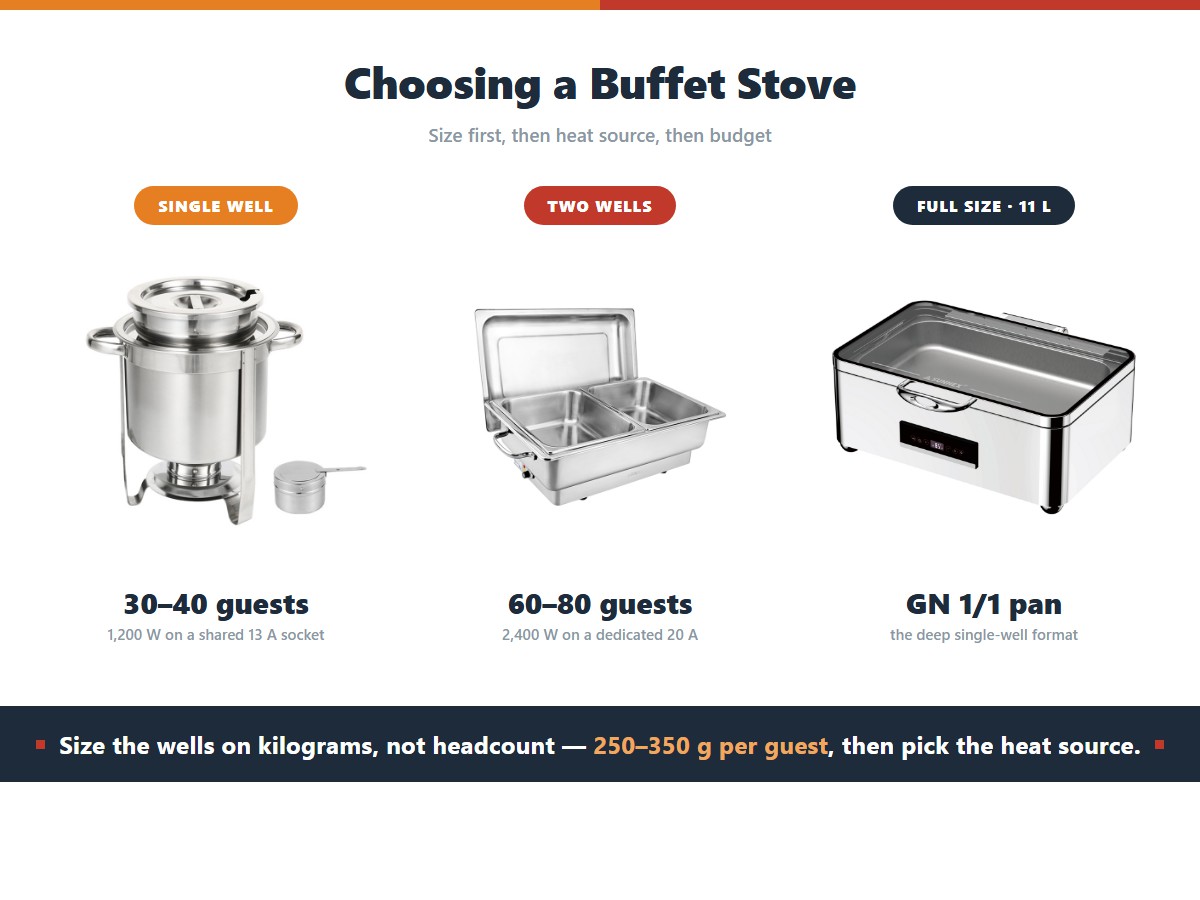
Guest counts are the most common sizing input and the least reliable one, because guests do not all eat the same amount. One plated cover of buffet food typically lands between 250 g and 350 g of cooked weight, and that figure moves with the menu. A 120-cover service needs somewhere between 30 kg and 42 kg of cooked food on the line at any one time, and a 4 L well holds roughly 4 kg of food. Size the wells against the kilograms, then check the kilograms against the guest count.
| Plated volume per cover | Cooked weight for 100 covers | 4 L wells needed | 6 L wells needed |
|---|---|---|---|
| 250 g (light menu, salads, one main) | 25 kg | 7 | 5 |
| 300 g (standard buffet) | 30 kg | 8 | 5 |
| 350 g (heavy menu, two mains) | 35 kg | 9 | 6 |
Two practical consequences follow. First, a single-well unit almost never covers a service on its own, whatever the marketing says about “10 to 30 guests”; that figure assumes 250 g per cover and a single dish, and it ignores replenishment. Second, if you are running a fixed line every morning, buying one extra well is usually cheaper than replacing the whole line later, because the wells are the part that has to match the pans you already own.
Measure the Line Before You Order
Three numbers settle the sizing question in ten minutes. Measure the counter length available for the hot line in millimetres. Count the GN pans you already own, because the wells must accept those, not a generic “full size”. Then write down the peak service window in minutes, since a 45-minute breakfast service and a three-hour banquet need different recovery behaviour from the same equipment.
Step Two: Choose the Heat Source Before the Model
The heat source decides your running cost, your electrical planning and where the unit is allowed to sit. It is a bigger decision than any feature on the spec sheet, and it should be made before you start comparing thermostats.
| Factor | Electric | Propane | Butane canister |
|---|---|---|---|
| Heat-up to 60°C | 10–15 min | 15–20 min | 15–20 min |
| Running cost per hour | $0.22–0.40 | $0.90–1.50 | $1.20–1.80 |
| Ventilation required | None | Yes | Yes |
| Control | Thermostatic, 30–100°C | Manual valve | Manual valve |
| Unit price | $120–320 | $280–600 | $70–140 |
| Staff attention | Occasional check | Fuel change every 2 h | Fuel change every 1–2 h |
For a fixed indoor line, electric is the default: no open flame, no ventilation requirement, thermostatic control and a running cost that is a fraction of fuel. Propane earns its place where there is no mains supply at all, or where the line is temporary. The trap is the labour figure rather than the fuel figure, because changing a canister and watching a flame for three hours is a half hour of staff time that never appears on a fuel invoice.
Check the Electrical Ceiling Before the Model
Electric stoves draw more than most people expect. A four-well electric line at 1,500 W per well pulls 6,000 W, which needs a dedicated 20–30 A circuit rather than a shared wall outlet behind the coffee machine. Two electric stoves on the same 13 A socket will trip it, and a venue that discovers this during a service has learned it expensively.
Step Three: Set the Budget From the Running Cost
The capital cost is the part everyone quotes, and it is the part that usually matters least. A $240 electric stove with a three-year element warranty will still be running in year six, while a $140 unit with a one-year warranty is often disposable in year three, and the difference between those two outcomes is larger than the $100 gap in price. Budget for the whole ownership period, not the invoice.
| Budget tier | Price | Element warranty | Expected ownership | Five-year cost |
|---|---|---|---|---|
| Entry | $70–140 | None or 1 yr | Disposable at year three | $210–420 |
| Value | $140–260 | 1–2 yr | One element change | $420–780 |
| Standard | $260–450 | 3 yr | Two element changes | $675–1,050 |
| Premium | $450–900 | 3–5 yr | Three or more changes | $1,050–1,900 |
Ask for the element part number in writing before you pay. If a supplier cannot name it, the unit becomes disposable when the element fails, and no amount of warranty paperwork changes that. This single question separates suppliers who will still exist in year five from those who will not.
Step Four: Only Now Look at Models
With volume, heat source and budget settled, model selection becomes a short comparison on published specifications rather than an open-ended search. Three models cover most commercial lines, and each earns its place for a different reason.

Full Size 11L Electric Chafer (1,100 W)
This 1,100 W full-size electric chafer is built for high-volume hotel and catering lines. It reaches operating temperature in about 12 minutes, publishes a thermal efficiency of 80% or better, and holds an 11 L capacity that accepts standard GN 1/1 pans. The digital display and smart mode let staff adjust settings without opening the lid, and the tempered glass window means the food can be checked without losing heat. It is the right pick when a single well has to cover 40 or more covers.

Electric Chafing Dish Food Warmer (400 W)
This 400 W unit is the compact option for a smaller line, a breakfast counter or a single-dish station. The temperature range adjusts from 60°C to 93°C, which is enough to hold soups, stews and sauces for hours without drying them out, and the 2.5 L tank is small enough to refill during service without a second person helping. It is CE, ETL, RoHS and FDA certified, which matters if your venue is inspected. It is not the right pick for a main hot line above 40 covers.

Electric Chafing Dish W07 (900 W)
The 900 W W07 sits between the two above and is often the best value on a busy line. It reaches 60°C in about 8 minutes, the fastest of the three, and its thermostat spans 45°C to 89°C, which lets one unit hold a delicate sauce at one end of the range and a curry at the other. The anti-dry heat alarm and auto shut-off protect both the food and the element, and the 304 stainless steel body resists the corrosion that comes with daily washing.
What Changes After Delivery
Two things decide how a stove performs in year two, and neither is on the spec sheet. The first is the water well, which most operators ignore and then regret: empty and scrub it daily, because a scaled well is both a heat sink and a bacterial risk. The second is staff habit, which is why a written setting per dish matters more than a digital display. A unit set to 90°C for a curry and 70°C for a cream sauce does the same job as two different machines, as long as someone wrote those numbers down where the line team can see them.
Buy the volume you measured, on the heat source your site allows, at the warranty level your service hours justify. That sequence removes almost every expensive mistake before it happens, and the model comparison that follows is a formality rather than a search.
Buffet Stove Sizing by Food Volume
| Guests | Wells needed | Well capacity | Recovery to 70°C | Total power, electric | Line cost |
|---|---|---|---|---|---|
| 30–40 | 1 | 4–6 L | 25–30 min | 1,200 W | $120–200 |
| 60–80 | 2 | 4–6 L each | 30–35 min | 2,400 W | $240–400 |
| 120–160 | 4 | 6–8 L each | 30–40 min | 4,800 W | $480–800 |
| 250–300 | 6 | 6–8 L each | 35–40 min | 7,200 W | $720–1,200 |
Heat Source Comparison
| Factor | Electric | Propane | Butane canister |
|---|---|---|---|
| Heat-up time | Fastest, 10 min | 15–20 min | 15–20 min |
| Running cost per hour | $0.22–0.40 | $0.90–1.50 | $1.20–1.80 |
| Portability | Low | High | Medium |
| Indoor use | Unrestricted | Needs ventilation | Needs ventilation |
| Control range | Thermostatic, 30–100°C | Manual valve | Manual valve |
| Typical unit price | $120–320 | $280–600 | $70–140 |
One practical distinction gets lost in most comparisons. A chafing dish holds food that is already hot; a buffet stove is designed to bring cold or chilled food up to service temperature and to keep it there. If your operation only ever reheats in a kitchen and then transports, you do not need buffet stoves at all, and buying them solves a problem you do not have.
Frequently Asked Questions
Do I need a buffet stove or a chafing dish?
A buffet stove if food arrives cold or chilled and must be heated on site. A chafing dish if the food is cooked in a kitchen and only needs to stay hot. Buying stoves when you only hold food adds cost and introduces an unnecessary power and fuel requirement.
How large a buffet stove do I need for 100 guests?
Two wells, one per 60–80 guests of cooked volume. For a 100-cover event with three main dishes, plan for three wells of 6L, which is about $360–500 of equipment and 3,600 W of connected load.
Are propane buffet stoves safe indoors?
Only with proper ventilation. Carbon monoxide accumulates at floor level in a closed room, which is why propane stoves are specified for outdoor or well-ventilated service only. Electric stoves have no such restriction and are the default indoors.
How much does it cost to run a buffet stove?
Roughly $0.22–0.40 an hour for a 1,500 W electric unit at commercial tariffs, and $0.90–1.50 an hour for propane. Over a four-hour service an electric stove adds around $1.30 to your costs, which is rarely the deciding factor.
What is a water well on a buffet stove?
A recessed well in the top that holds water for steaming or gentle simmering, distinct from the flat cooking surface. It lets one unit boil pasta and simmer sauce simultaneously, and it is the reason many caterers prefer stoves to plain hot plates.
Related reading
- Buffet Stoves for Small Restaurants: What Actually Fits
- Catering Buffet Stoves: 5 Specs That Matter on the Road
- Buffet Stoves and Food Waste: What Actually Helps
- Commercial Buffet Stove Types Compared: Which Fits Your Menu
- Opening a Buffet? The 2026 Equipment Checklist
- How to Choose the Best Heat Lamp for Your Buffet Restaurant