




Buffet Stoves and Food Waste: What Actually Helps
Short answer: A buffet stove reduces food waste by holding food at 70–75°C without a cook monitoring it, which is worth 8–18% of food cost at a banquet venue. It does not reduce waste from over-production, which is 60–75% of buffet waste. Expect the equipment to fix 8–18% of the problem and a menu and forecasting decision to fix the rest. See buffet station equipment.
Food waste is a massive challenge for restaurants worldwide, with the average establishment throwing away 4-10% of the food they purchase before it even reaches a customer’s plate. For buffet-style restaurants, catering businesses, and hotels with self-service sections, this problem is even more acute: keeping food at safe, appealing temperatures for hours on end often leads to overcooking, drying out, or spoilage that forces staff to discard large portions of uneaten dishes. Enter the commercial buffet stove—a purpose-built solution that not only keeps food hot and fresh but also plays a critical role in slashing food waste, cutting operational costs, and boosting your restaurant’s sustainability profile. In this guide, we’ll explore exactly how these innovative appliances help reduce waste, the key features to look for, and our top product recommendations for restaurants of every size.
How Buffet Stoves Minimize Food Waste
The core reason buffet stoves reduce food waste lies in their ability to maintain consistent, optimal temperatures for extended periods. Unlike makeshift heating solutions like slow cookers or warming trays, commercial buffet stoves are engineered to hold food at safe serving temperatures (usually between 60°C and 90°C) without fluctuating, which prevents two major causes of waste: overcooking and bacterial spoilage. Let’s break down the specific ways they help:
- Precision Temperature Control: Modern electric buffet stoves come with adjustable thermostats and digital displays that let staff set exact temperatures for different dishes. Soups and stews can stay at a gentle simmer, while delicate pastries and proteins stay warm without drying out. This eliminates the guesswork that leads to overcooked, inedible food.
- Rapid Heat Recovery: When guests serve themselves, the temperature of the food pan drops temporarily. High-quality buffet stoves with 900W+ power and rapid heat recovery (like 8-minute warm-up times) quickly bring the temperature back to safe levels, preventing the growth of harmful bacteria that would force you to discard the entire pan.
- Smart Operating Modes: Many newer models include smart modes that automatically adjust power output based on the food’s temperature, reducing energy waste and preventing overheating during slow periods. This not only cuts utility costs but also keeps food in prime condition for longer.
- Visual Monitoring: Tempered glass lids and viewing windows let staff check food levels and doneness without lifting the lid, which retains heat and moisture. This reduces the temptation to overcook dishes "just to be safe" and lets you replenish pans only when needed, cutting down on unused portions.
Additional Benefits for Restaurants
Beyond direct food waste reduction, commercial buffet stoves offer a range of operational benefits that improve your bottom line: they reduce labor costs by minimizing the need for constant temperature checks, cut energy bills with high thermal efficiency (80%+ for top models), and improve customer satisfaction by serving consistently hot, high-quality food. For catering businesses handling off-site events, portable electric or fuel-powered models ensure food stays safe and appealing even in remote locations, reducing waste from transport-related spoilage.

Top Buffet Stoves for Reducing Food Waste

Electric Chafing Dish-W07
This 900W commercial buffet stove is a standout choice for restaurants looking to cut food waste. It features intelligent temperature control with a 45-89°C adjustable range, reaching 60°C in just 8 minutes for rapid heat recovery. Anti-dry heat flash alarms and overheat protection prevent accidents, while the 304 food-grade stainless steel construction is durable and easy to clean. Its GN 1/1 size fits standard buffet pans, making it a versatile addition to any self-service setup.

Electric Chafing Dishes-W20
With a sleek OLED touchscreen and 3-layer base for superior heat retention, this 900W electric chafing dish is designed for high-efficiency operation. It maintains consistent temperatures between 45-90°C, with CE, ETL, and RoHS certifications for safety and reliability. The polished 304 stainless steel build resists rust and corrosion, while the GN 1/1 pan size works with all standard buffet inserts. Its energy-efficient design reduces both food and utility waste over time.
Final Tips for Maximizing Waste Reduction
To get the most out of your buffet stove, pair it with proper food handling practices: label pans with cooking times, rotate dishes regularly to ensure even heating, and train staff to monitor temperatures during peak hours. Combine your stove with airtight food storage containers and portion control tools to cut waste at every stage of your buffet operation. Remember, even the best equipment works best when paired with smart operational habits.
Investing in a high-quality commercial buffet stove is one of the most effective steps you can take to reduce food waste, lower costs, and improve sustainability in your restaurant. By maintaining consistent temperatures, preventing overcooking, and cutting energy waste, these appliances pay for themselves over time through reduced food costs and higher customer satisfaction. Explore our recommended models above to find the perfect fit for your establishment, and start seeing the difference in your waste reduction metrics today.
Browse the full chafing dish range for current models and configurations.
Where Buffet Waste Actually Comes From
| Waste source | Share of waste | Cost impact | Does a buffet stove help? | What actually helps |
|---|---|---|---|---|
| Over-production | 60–75% | Biggest single line | No | Forecast and count |
| Guests taking too much | 10–20% | Second largest | No | Smaller pans, more frequent refills |
| Food falling below 60°C | 5–12% | Discarded entirely | Yes, mostly | Steady 70–75°C hold |
| Overheating and drying | 3–8% | Quality loss, not waste | Yes | Thermostat instead of full power |
| Leftovers after service | 2–5% | Usually reused | No | Cook-chill policy |
| Spillage and mishandling | 1–3% | Minor | No | Training |
Waste Reduction by Service Length
| Service length | Waste without control | Waste with thermostat | Reduction | Annual saving, 200 guests |
|---|---|---|---|---|
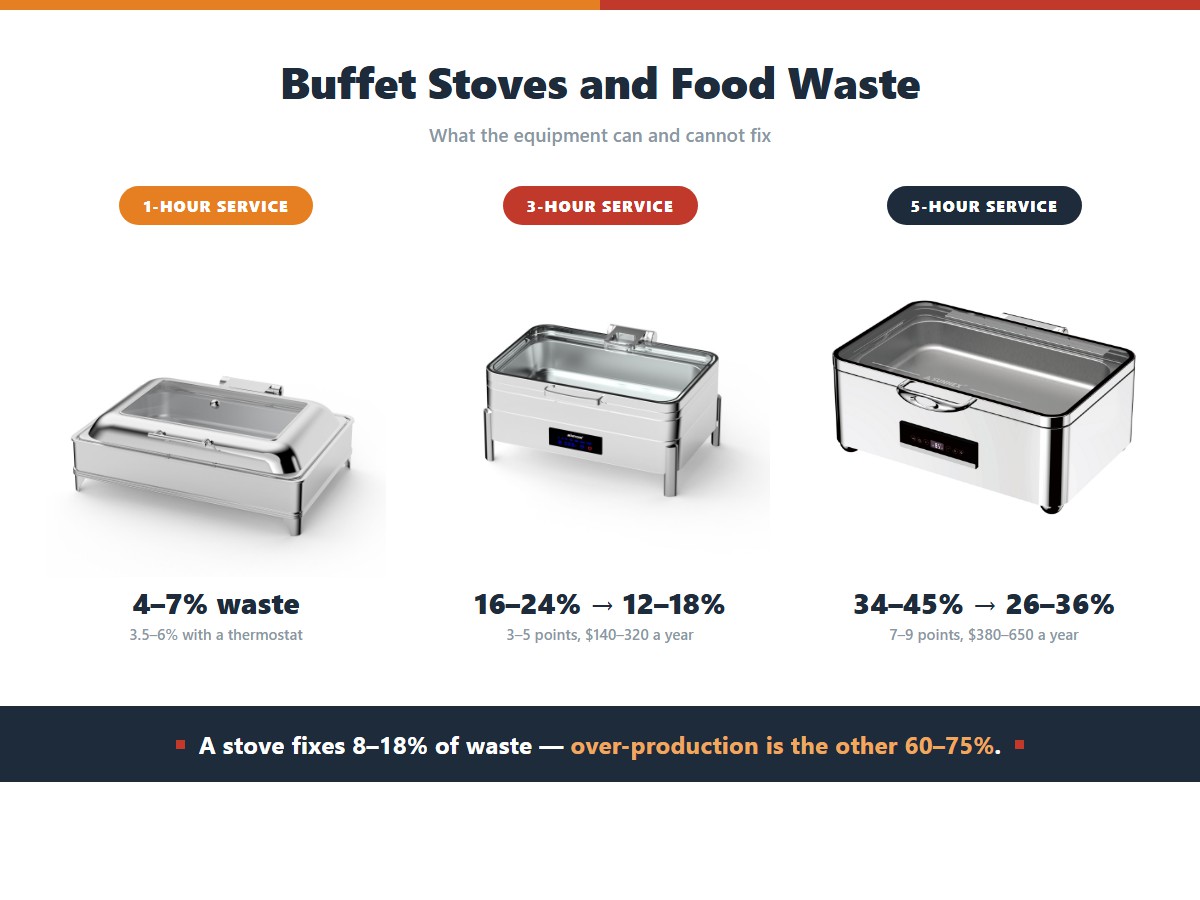
| 1 hour | 4–7% | 3.5–6% | 0.5–1 pt | $40–90 |
| 2 hours | 9–14% | 7–11% | 1–2 pts | $90–180 |
| 3 hours | 16–24% | 12–18% | 3–5 pts | $140–320 |
| 4 hours | 24–34% | 17–25% | 6–8 pts | $260–480 |
| 5+ hours | 34–45% | 26–36% | 7–9 pts | $380–650 |
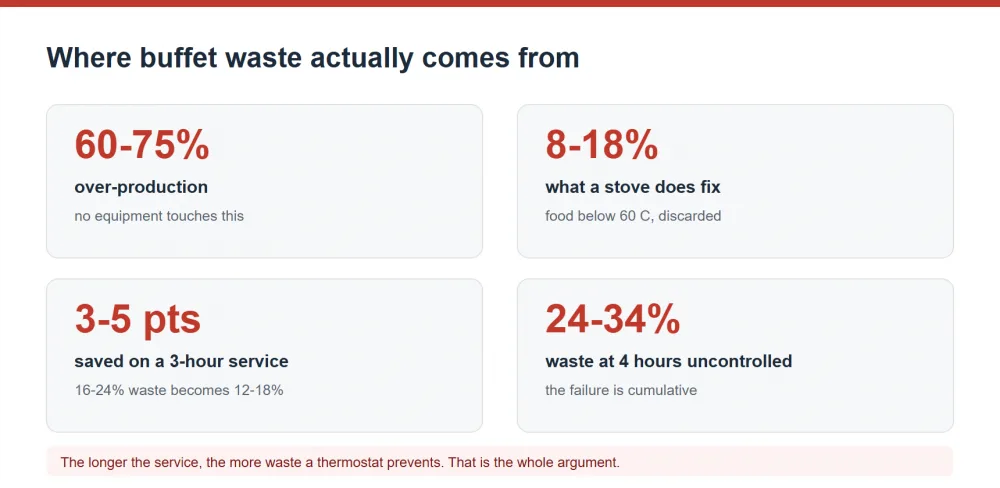
The pattern in that table is the whole argument. The longer the service, the more waste a thermostat prevents, because the failure mode is cumulative: food that sits at 55°C for an hour is already committed, and a later probe does not recover it. A three-hour service is where equipment starts to matter, and a five-hour service is where it is the difference between 40% waste and 30%.
Frequently Asked Questions
How much food waste do buffet stoves reduce?
8–18% at a banquet venue, and almost all of that comes from food that would have fallen below 60°C and been discarded. Over-production is 60–75% of buffet waste and no piece of equipment touches it.
Does a buffet stove reduce food waste?
Partly. It stops the temperature failures that force discard, which is 5–12% of waste, and it prevents overdrying, which is 3–8%. The larger waste sources, over-production and guests taking too much, need a forecast and a pan-size decision rather than a heater.
Why does waste increase so much on longer services?
Because the failure is cumulative. Food that sits at 55°C for an hour has already passed the point where a later probe helps, so waste goes from 9–14% at two hours to 24–34% at four hours. A thermostat is worth most in exactly the long services where the waste is worst.
Does a thermostat on a buffet stove reduce food waste?
Yes, it is the main equipment contribution. Holding at a steady 70–75°C instead of running full power prevents both the safety discard and the drying that makes food unpalatable. Expect 3–5 percentage points of reduction on a three-hour service.
What is the best way to reduce buffet food waste?
Count covers accurately and forecast from that, use smaller pans with more frequent refills, and hold at 70–75°C with a thermostat. Equipment handles the temperature failures, but the money is in the forecast, which is why forecasting tools and buffet equipment appear in the same conversation.
Related reading
- Buffet Stoves for Small Restaurants: What Actually Fits
- Automatic Heating on Buffet Stoves: How It Works
- Large Buffet Lines: How Many Stoves per 100 Guests?
- Buffet Stoves and Menu Design: 4 Ways to Sell More Covers
- 7 Buffet Layout Mistakes That Waste 30% of Your Space
- How to Reduce Food Waste & Cost at a Buffet