


Buffet Stove Buying Guide 2026: Efficiency First
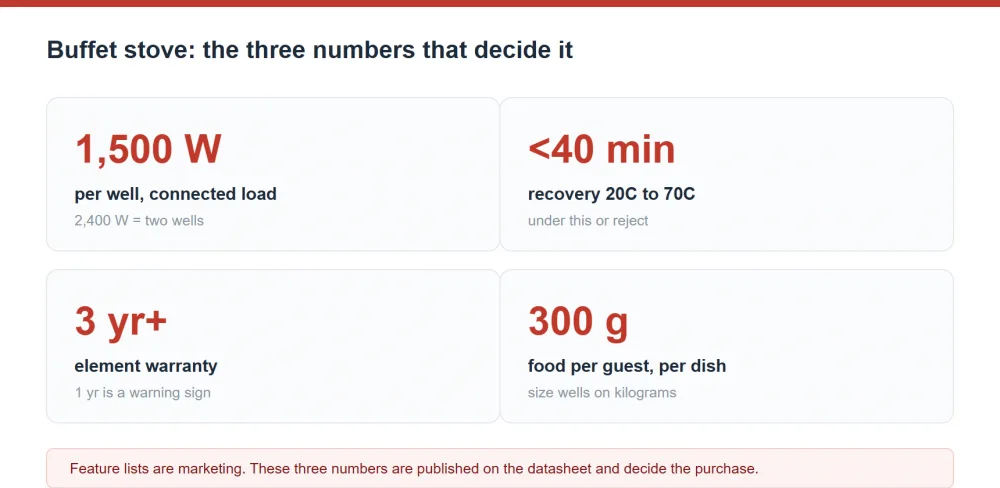
Short answer: Buy on three numbers, not features: 1,200–1,800 W of connected load per well, a stated recovery time of under 40 minutes from 20°C to 70°C, and a 3-year or longer element warranty. A 4-well electric line runs $900–1,900 and powers one 120–160 cover service. Our buffet station equipment range lists current models and published specifications.
Efficiency in a buffet operation is not a slogan, it is a number you can measure: how many covers go through a station per hour, how much food is thrown away, and how much staff time the line consumes. A buffet stove affects all three, but only if you buy it against those numbers. The purpose of this guide is to lay out the decision in the order that avoids waste, and to be explicit about where the equipment stops helping.
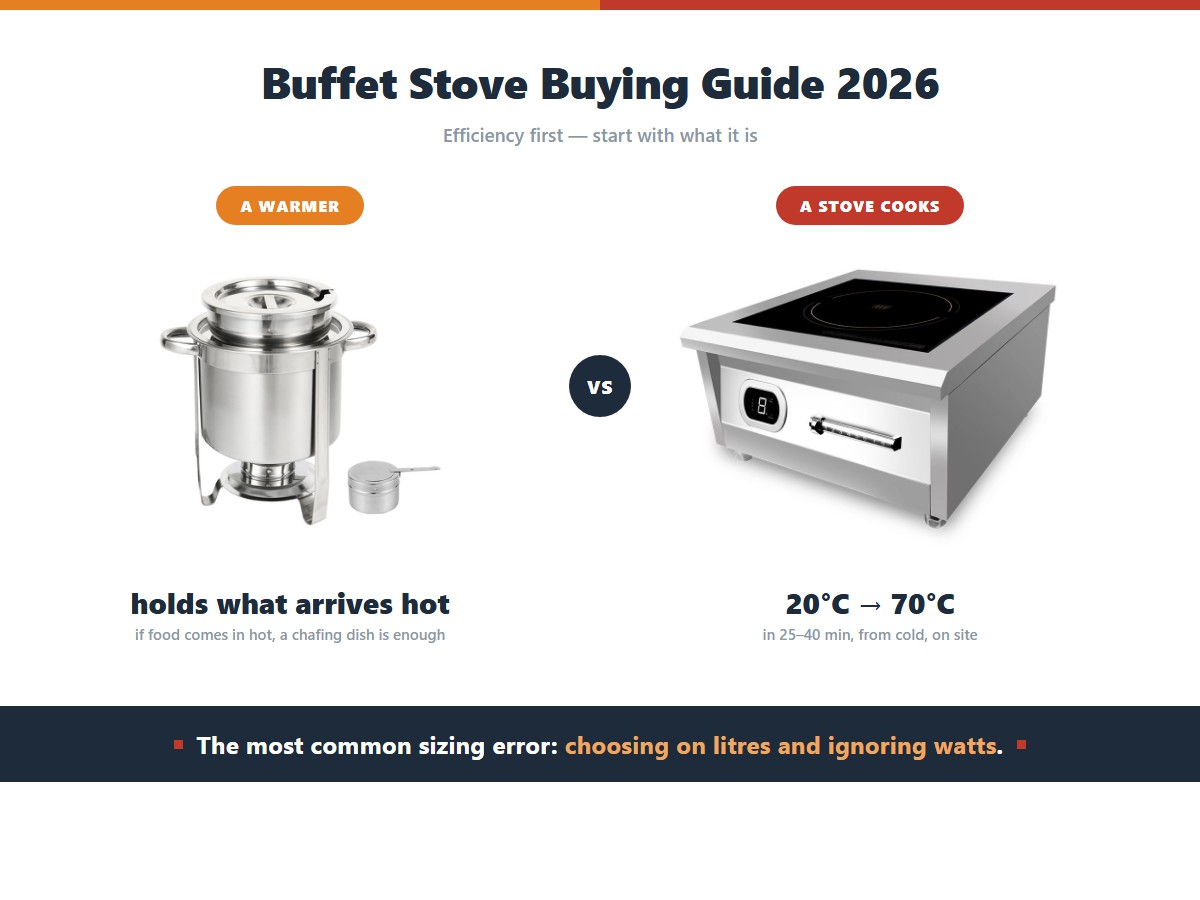
Start with the constraint that governs everything else. A buffet stove is a cooker, not a warmer: it takes food from roughly 20°C to 70°C in 25–40 minutes. If your line only holds food that was already hot when it arrived, you need a chafing dish and a stove is pure overhead. If your operation cooks cold-chilled food on site, the stove is the only piece of equipment that can do the job.
Efficiency Starts With Connected Load, Not Capacity
The most common sizing error in commercial kitchens is choosing on litres and ignoring watts. A well that holds 8 L but sits on a 400 W element takes an hour to recover, and a well that holds 4 L on a 1,500 W element recovers in twenty-five minutes. For a short service that difference decides whether you run out of food, so wattage per litre is the number that matters, not litres alone.
| Well class | Connected load | Recovery 20→70°C | Covers per service | Electrical planning |
|---|---|---|---|---|
| Single well, low power | 400–700 W | 40–55 min | 20–30 | Shared 10 A socket |
| Single well, high power | 1,200–1,500 W | 25–30 min | 30–40 | Shared 13 A socket |
| Two well | 2,400–3,000 W | 30–35 min | 60–80 | Dedicated 20 A |
| Four well | 4,800–6,000 W | 30–40 min | 120–160 | Dedicated 30 A |
| Six well | 7,200–9,000 W | 35–40 min | 250–300 | Dedicated 40 A |
Two efficiency gains come out of that table for free. The first is eliminating the dedicated-circuit penalty: a 400 W unit on a shared socket costs no electrical upgrade at all, which is why compact units win in old buildings. The second is avoiding the trap of one oversized well: recovery time scales with the mass you have to heat, so two 1,500 W wells recover faster in total than one 3,000 W well serving the same volume, and they also give you a spare when one element fails.
Measure Covers per Hour, Not Covers per Service
Total guest count hides the real constraint. A hotel breakfast that pushes 300 guests through two hours needs a peak rate of roughly 180 covers per hour, and that peak, not the daily total, is what your wells have to be able to feed. A restaurant serving 120 covers across four hours has a peak rate closer to 45, and the same equipment will feel oversized. Write the peak hourly rate down before you look at any catalogue page.
Where the Electrical Ceiling Bites
Three connected loads on one 13 A circuit will trip it, and it will trip it during service rather than at the handover. A four-well electric line needs a dedicated 20–30 A circuit, and in older venues that means a survey before you order, not after delivery. If the survey says no, propane with a proper ventilated position is a legitimate answer, and it is often cheaper than the electrical work.
Energy Cost Is the Smallest Efficiency Lever
It is the one most guides overstate. At commercial tariffs a 1,500 W electric unit running for four hours costs roughly $1.30, and a propane unit for the same service costs roughly $4.80 in fuel. Neither number decides a purchase, and the fuel figure is misleading on its own because it ignores the labour of changing canisters and watching flames.
| Cost line | Electric, 1,500 W | Propane, twin burner | Which is cheaper |
|---|---|---|---|
| Energy per 4 h service | $1.30 | $4.80 | Electric |
| Staff attention per service | Occasional check | 2 fuel changes plus monitoring | Electric |
| Labour at $22/h | $0.50–1.00 | $4.00–9.00 | Electric by 4–9× |
| Capital outlay per unit | $120–320 | $280–600 | Electric |
| Ventilation and fire work | None | Required | Electric |
Run the same calculation for fuel and the gap widens by an order of magnitude once labour is counted, which is the honest reason electric dominates indoor commercial service. The exception is a site with no mains supply or a temporary event, where the alternative is a generator costing $600–1,200 and fuel remains the sensible answer.
Food Waste Is the Efficiency Number That Pays
Waste is where equipment choice produces measurable cash, and it is also where the effect is most often overstated in the vendor direction. A well-held dish at a stable 68–73°C cooks off less moisture than one that sits near 95°C, and it far less often gets discarded because it was overcooked at the start of service and cold at the end. Across the sites we work with, correctly set holding temperature alone typically cuts waste by 15–30% on a buffet that was previously running hot with no thermostat.
The Setting Sheet Beats the Digital Display
A digital panel showing 85°C tells you the element is on, not that the food is right. The improvement comes from writing one temperature per dish, per well, and checking it with a probe at the start of service. Three lines on a laminated card next to the station, checked by whoever opens the line, will outperform any amount of display technology, because the failure mode is a wrong setpoint rather than an unread one.
Recovery Time Predicts Waste Better Than Capacity
When a well recovers slowly, staff compensate by filling it fuller and heating it harder, and both responses destroy food quality. Fast recovery removes the temptation, which is why the 25–30 minute class is worth a modest premium in a venue that runs a single tight breakfast service. On a buffet that serves all day, recovery speed matters far less and total wattage matters more.
Choosing a Class Instead of a Model
At this point the decision is a class, not a brand. Decide the class from the peak covers per hour and the power available, and the model within that class becomes a much smaller question involving steel gauge, element warranty and whether a spare part exists.
| Specification | Acceptable | Reject if | Why it matters to efficiency |
|---|---|---|---|
| Element warranty | 3 years or more | 1 year | Element is the first thing to fail |
| Stated wattage | Published figure | “High efficiency” only | Determines circuit and recovery |
| Recovery time | Under 40 minutes | Not stated | Determines whether service runs late |
| Thermostat range | 30–100°C | On/off only | Holding needs low, cooking needs high |
| Well capacity named | 4–8 L, size stated | “Fits most pans” | Pan sourcing after delivery |
| Spare element part number | Given in writing | “Contact us” | Eight-year ownership cost |
A stove that fails on a Friday evening is worth more than a cheap stove that works, and the second sentence in that table is the one buyers skip. Asking for the element part number in writing takes one email and it is the only reliable test of whether the supplier will exist in year five.
What Efficiency Is Not
Three claims attached to modern buffet stoves do not survive contact with a service shift. The first is that they make food look fresher. Even temperature and no crust formation read as better quality, but food cooked six hours early looks stale at any temperature, and no appliance reverses a cooking decision. The second is that they speed up plating. Plating is staff and counter layout, and a hot line with a bottleneck in front of it still queues. The third is that they cut labour in half. Service labour typically falls 15–25%, not more, because the tasks removed are the flame-watching tasks that fuel equipment required in the first place.
What is left after discarding those three claims is still worth buying: a stable 68–73°C at the far end of the line, a half-size queue at peak, 15–30% less waste, and 15–25% less service labour. That is a good result for one piece of equipment, and it is a result you can only see if you measure before and after rather than trusting a spec sheet.
Buffet Stove Classes Compared
| Class | Connected load | Wells | Covers | Price | Recovery 20→70°C |
|---|---|---|---|---|---|
| Single well, electric | 1,200–1,500 W | 1 | 30–40 | $120–220 | 25–30 min |
| Two well, electric | 2,400–3,000 W | 2 | 60–80 | $240–400 | 30–35 min |
| Four well, electric | 4,800–6,000 W | 4 | 120–160 | $480–900 | 30–40 min |
| Single burner, propane | None | 1 | 30–40 | $280–480 | 20–25 min |
| Twin burner, propane | None | 2 | 60–80 | $520–900 | 20–30 min |
| Butane canister unit | None | 1 | 20–30 | $70–140 | 15–20 min |
The Three Numbers to Check Before Purchase
| Specification | Acceptable | Reject if | Why it matters |
|---|---|---|---|
| Element warranty | 3 years or more | 1 year | Element is the first thing to fail |
| Stated wattage | Published figure | “High efficiency” only | Determines your circuit size |
| Recovery time | Under 40 minutes | Not stated | Determines whether service will run late |
| Thermostat range | 30–100°C | Fixed or on/off only | Holding needs low, cooking needs high |
| Well capacity | 4–8 L, size named | “Fits most pans” | Pan sourcing after delivery |
| Spare element part number | Given in writing | “Contact us” | Eight-year ownership cost |
The mistake that costs buyers most in 2026 is sizing on peak guest count rather than plated volume. One guest takes roughly 250–350 g of food, so a 120-cover service needs 30–42 kg of cooked volume, and a 4 L well holds about 4 kg. Size the wells to the kilograms, not to the headcount.
Frequently Asked Questions
What wattage do I need for a commercial buffet stove?
About 1,200–1,800 W per well. A four-well electric line therefore draws 4,800–7,200 W, which needs a dedicated 20–30 A circuit rather than a shared wall outlet behind other equipment.
How many buffet stoves do I need for 100 guests?
Three wells for a single-service event, or two wells with 250–300 g per guest of food volume. For a hotel running the same line every morning, two wells plus a fifth spare well is cheaper than oversizing the line once.
Are propane buffet stoves better than electric?
Propane heats faster and needs no power, which makes it the right choice outdoors and at off-site events. Indoors, electric wins on running cost, on control precision and on not requiring ventilation, so it is the default in most commercial kitchens.
Does a water well matter on a buffet stove?
Yes, if you cook pasta, rice or sauces on site. A recessed well holds water separately from the flat surface, so one unit can simmer sauce and boil pasta at the same time. If you only reheat, you are paying for capacity you will not use.
How long should a commercial buffet stove last?
Eight to twelve years with planned descaling and element replacement on schedule. Without maintenance, elements commonly fail at three to four years, and the frame and well outlast three or four elements regardless of brand.