




Buffet Stove Brands 2026: Who's Worth the Premium?
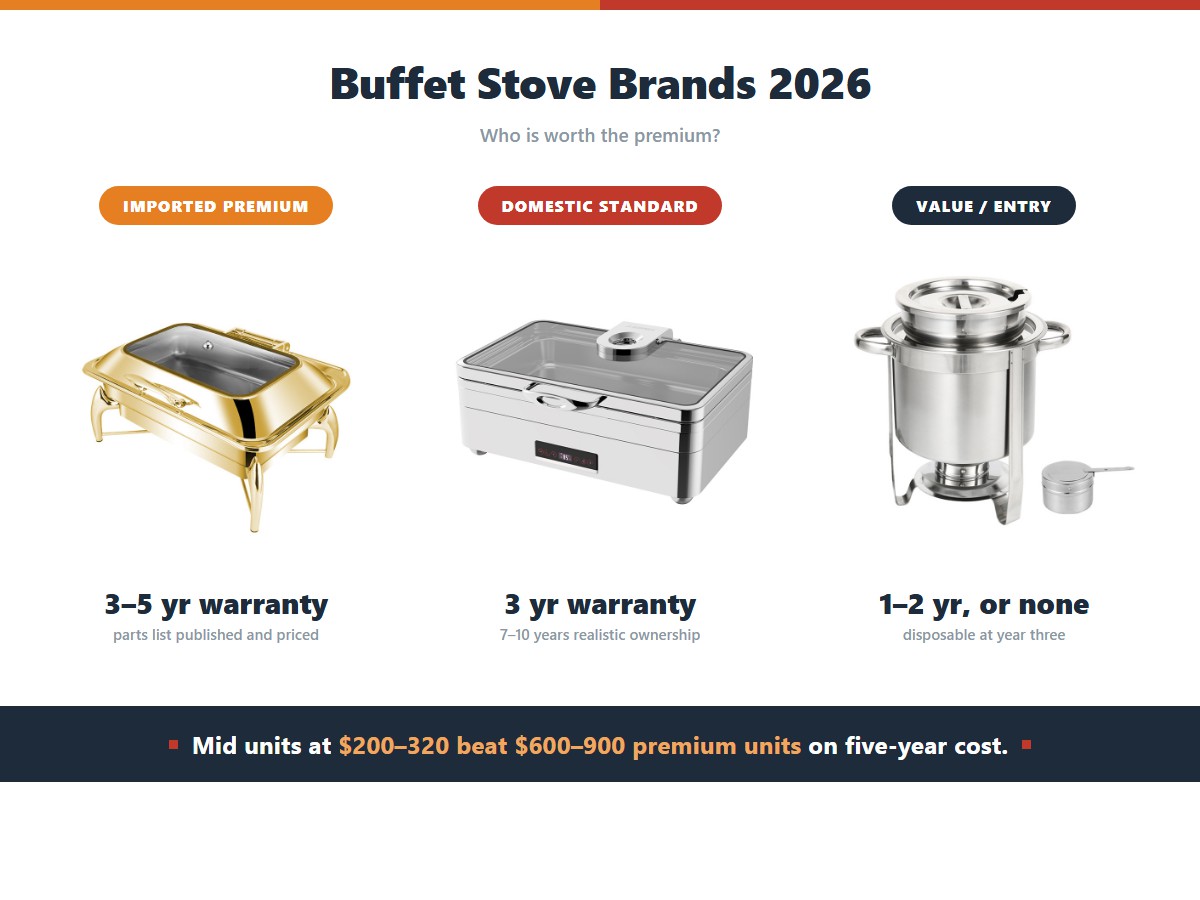
Short answer: No brand premium is worth paying on reputation alone. Judge on four published facts: element part number, element warranty of 3 years or more, stated wattage and steel gauge. Across the price range, mid units at $200–320 outperform premium units at $600–900 over five years on total cost. See buffet station equipment for the models we supply.
Brand is the least useful input to a buffet stove purchase and the one most often used. Reputation tells you where a company was ten years ago, not whether it will ship you an element in year four. The brands that look expensive and the brands that look cheap frequently fail at the same point, because the failure point is the same: the element, and whether anyone still makes it.
So the honest way to compare brands is not to rank them, but to grade them on published facts. Four numbers decide the outcome: element part number, element warranty length, stated wattage, and steel gauge. A supplier who will give you all four, in writing, before payment is a supplier you can buy from. A supplier who answers with adjectives is not, however familiar the name is.

Grade 1: Does a Spare Part Exist?
This is the only question that matters over an eight-year ownership period. Every buffet stove sold today will eventually lose its element, and the ones that are still running in year six are the ones whose element could be replaced rather than the whole unit discarded. The test is simple: ask for the element part number in writing, then check whether a distributor stocks it. If the part cannot be found today, the frame is irrelevant, because the unit becomes disposable when the element fails, however good the stainless steel was.
| Brand tier | Element warranty | Spare parts list published | What happens at year four | Realistic ownership |
|---|---|---|---|---|
| Imported premium | 3–5 years | Yes, priced | Element replaced, unit continues | 8–12 years |
| Domestic standard | 3 years | Yes | Element replaced, unit continues | 7–10 years |
| Value tier | 1–2 years | Partial | Element replaced, but warranty expired | 4–7 years |
| Entry tier | None or 1 year | No | Whole unit discarded | Disposable at year three |
Notice what the table actually says. The premium tier does not perform differently at service; it simply survives service. That is the whole argument for spending more, and it is a much smaller argument than the marketing suggests, because the benefit accrues at year four rather than at the first service.
Grade 2: Wattage Published or Not
Stated wattage is a proxy for two things that matter: recovery speed, and whether the unit can be sited on your existing circuit. A supplier who publishes 900 W is telling you the electrical footprint and, by implication, that the element is a real 900 W element. A supplier who writes “high efficiency” is telling you nothing, and you will find out at the socket.
Why Published Wattage Separates Real Brands
A 900 W element and a 900 W marketing claim are easy to confuse, and the gap between them is usually where the price difference hides. An entry-tier unit with a genuine 900 W element and a 1-year warranty costs $140. A mid unit with a genuine 900 W element and a 3-year warranty costs $320. The element performance is close; the difference is the third year, and it is worth about $180 only if you will actually be there in year three.
Check Against Your Own Circuit
Published wattage is also a siting constraint. Three 900 W units on one 13 A socket will trip, and the fix is not a bigger socket but a dedicated circuit. Any brand that cannot tell you its wattage is also unable to tell you whether it fits your kitchen, which is a reasonable proxy for how much of the spec sheet was written by a marketing department.
Grade 3: Steel Gauge and Welds
Steel gauge is the third published fact worth demanding, and it explains a surprising share of the price spread. A 0.6 mm body is what you get at $140, 0.7–0.8 mm in the $260–450 range, and 0.8 mm or thicker above $450. The difference shows up as warping around a burner under a heavy stockpot, and as the reason a cheap unit eventually has a dished top that will not hold a pan level.
| Steel gauge | Price band | Typical price | Expected warp under a full pot | Weld and seam quality |
|---|---|---|---|---|
| Not stated | Entry | $70–140 | Within two years | Often a single folded seam |
| 0.6 mm | Value | $140–260 | Three to five years | Folded, spot-welded corners |
| 0.7–0.8 mm | Standard | $260–450 | Rare | TIG-welded and dressed |
| 0.8 mm and up | Premium | $450–900 | Not in normal service life | Full-penetration welds |
The gauge also decides the weight, which matters more than buyers expect. A heavier unit is not a premium feature in itself, but weight is a usable proxy for whether a manufacturer has used thicker material, and it is something you can verify with two hands at a trade show or in a showroom without a caliper.
Grade 4: What the Premium Actually Buys
Once the four facts are in hand, the premium tier can be examined honestly. It is not all marketing, but most of it is.
| Premium feature | Typical cost | Real benefit | Verdict for most operators |
|---|---|---|---|
| Heavier element | $40–80 | Longer element life | Worth it above 600 service hours a year |
| Probe logging | $120–260 | Audit evidence | Worth it if multi-site or audited |
| Branded finish | $30–70 | Appearance only | Not worth it |
| Extended warranty | $40–90 | Paper cover | Only if you self-repair |
| Digital panel | $80–180 | Readout you set yourself | Avoid, adds a failure point |
| App and Wi-Fi | $150–320 | Nothing in a kitchen | Avoid entirely |
Two features in that table can be justified and the rest are transfers of money from the buyer to the manufacturer. Probe logging earns its cost if you are running a multi-site operation under a food safety audit, because it produces evidence rather than assurance. A heavier element earns its cost if you run more than about 600 service hours a year, because that is roughly where annual element failures cross the cost of a heavier element. Everything else is a feature that has to be carried, cleaned and eventually replaced.
The Uncomfortable Finding
Price does not predict reliability. What predicts reliability is whether a spare element exists and whether the supplier answers the phone in year four. A $240 unit from an unresponsive supplier is a worse purchase than a $320 unit from one that ships parts, and you can only tell the difference before you buy, not after the first failure.
Three Models That Meet the Bar
Within the standard tier, where the published facts are complete, three units cover most commercial lines. They are listed here as illustrations of what a correctly specified stove looks like, not as a ranking.

Full Size 11L Electric Chafer (1,100 W)
This 1,100 W full-size electric chafer publishes its wattage, its 80%-plus thermal efficiency and an 11 L capacity that accepts standard GN 1/1 pans. It reaches operating temperature in about 12 minutes, which suits a line carrying 40 or more covers per well, and the digital display with smart mode lets staff adjust settings without opening the lid. The tempered glass window means food can be checked without losing heat, and overheat protection covers the failure mode that matters most in a busy service.

Electric Chafing Dish Food Warmer (400 W)
This 400 W unit is the entry point that still meets the bar: stated wattage, a 60°C to 93°C thermostat range, 304 stainless steel construction, and CE, ETL, RoHS and FDA certification published rather than claimed. The 2.5 L tank is small enough to refill during service, which is a genuine efficiency point in a small venue. It suits a single-dish station or a breakfast counter rather than a main hot line.

Electric Chafing Dish W07 (900 W)
The 900 W W07 reaches 60°C in about 8 minutes, the fastest recovery of the three, and its thermostat spans 45°C to 89°C so one unit can hold a delicate sauce and a curry at different settings. The anti-dry heat alarm protects the element from the single most common cause of failure, which is a well allowed to run dry during a rush. For a high-turnover line, that alarm and that recovery time are worth more than any connectivity feature.

How to Buy From Any Brand
Put four questions in writing before you pay: the element part number, the element warranty in years, the stated wattage, and the steel gauge. A supplier who answers all four is buying from. A supplier who answers with adjectives is not, and no discount changes that. If the answers are good, the brand name stops being a factor, which is the correct outcome, because at that point the equipment really is a commodity with a service life you can calculate.
Price Tiers Judged on Published Facts
| Tier | Price | Element warranty | Wattage published | Steel gauge | Parts list | Five-year cost |
|---|---|---|---|---|---|---|
| Entry | $70–140 | None or 1 yr | Sometimes | Not stated | No | Disposable at year three |
| Value | $140–260 | 1–2 yr | Yes | 0.6 mm | Partial | $520–780 |
| Standard | $260–450 | 3 yr | Yes | 0.7–0.8 mm | Yes | $675–1,050 |
| Premium | $450–900 | 3–5 yr | Yes | 0.8 mm+ | Yes, priced | $1,050–1,900 |
What the Premium Actually Buys
| Premium feature | Typical cost | Real benefit | Verdict for most operators |
|---|---|---|---|
| Heavier element | $40–80 | Longer element life | Worth it above 600 h/year |
| Probe logging | $120–260 | Audit evidence | Worth it if multi-site or audited |
| Branded finish | $30–70 | Appearance only | Not worth it |
| Extended warranty | $40–90 | Paper cover | Only if you self-repair |
| Digital panel | $80–180 | Readout you set yourself | Avoid, adds a failure |
| App and Wi-Fi | $150–320 | Nothing in a kitchen | Avoid entirely |
The uncomfortable finding is that price does not predict reliability. What predicts reliability is whether a spare element exists and whether the supplier answers the phone in year four. A $240 unit from an unresponsive supplier is a worse purchase than a $320 unit from one that ships parts, and you can only tell the difference before you buy.
Frequently Asked Questions
Which buffet stove brands are worth paying a premium for?
Premium units are worth it when you run more than 600 service hours a year or need probe logging for audits. Below that, a standard unit at $260–450 gives the same holding performance for half the money.
How do I check if a brand will still exist in five years?
Ask for the element part number in writing and check whether a distributor stocks it. If the part is unavailable today, the unit becomes disposable when it fails, regardless of how good the frame is.
Is a 5-year warranty worth the premium?
Only if you would do the repair yourself. Warranty cover costs roughly $40–90 extra and pays out only when a component fails inside the period, which for the entry to standard tiers is the first two to three years.
Do premium buffet stoves use less energy?
No, not measurably. Any 30–50% saving is the difference between a thermostat and an on/off switch, and both premium and mid units ship with a thermostat.
Should I buy all my buffet stoves from one brand?
Mix at least two brands. A single supply chain problem can take an entire line out of service, and the diversity costs nothing if you keep a spare part for each model.
Related reading
- Top Brands for Buffet Warmers in the Market – how to judge a brand before you buy
- Buffet Stove Price Breakdown: What Drives the Cost – where the money in a $320 unit goes
- High-Traffic Buffets: Why Cheap Warmers Fail – which parts decide failure at high duty
- Buffet Stove Maintenance: The Monthly Checklist – the ten minutes that protect the element
- 5 Buffet Stove Features That Matter (and 3 That Don’t) – where to spend and where not to
- Commercial buffet station equipment – the current range with published specifications