




High-Volume Buffet Stoves: What Breaks First
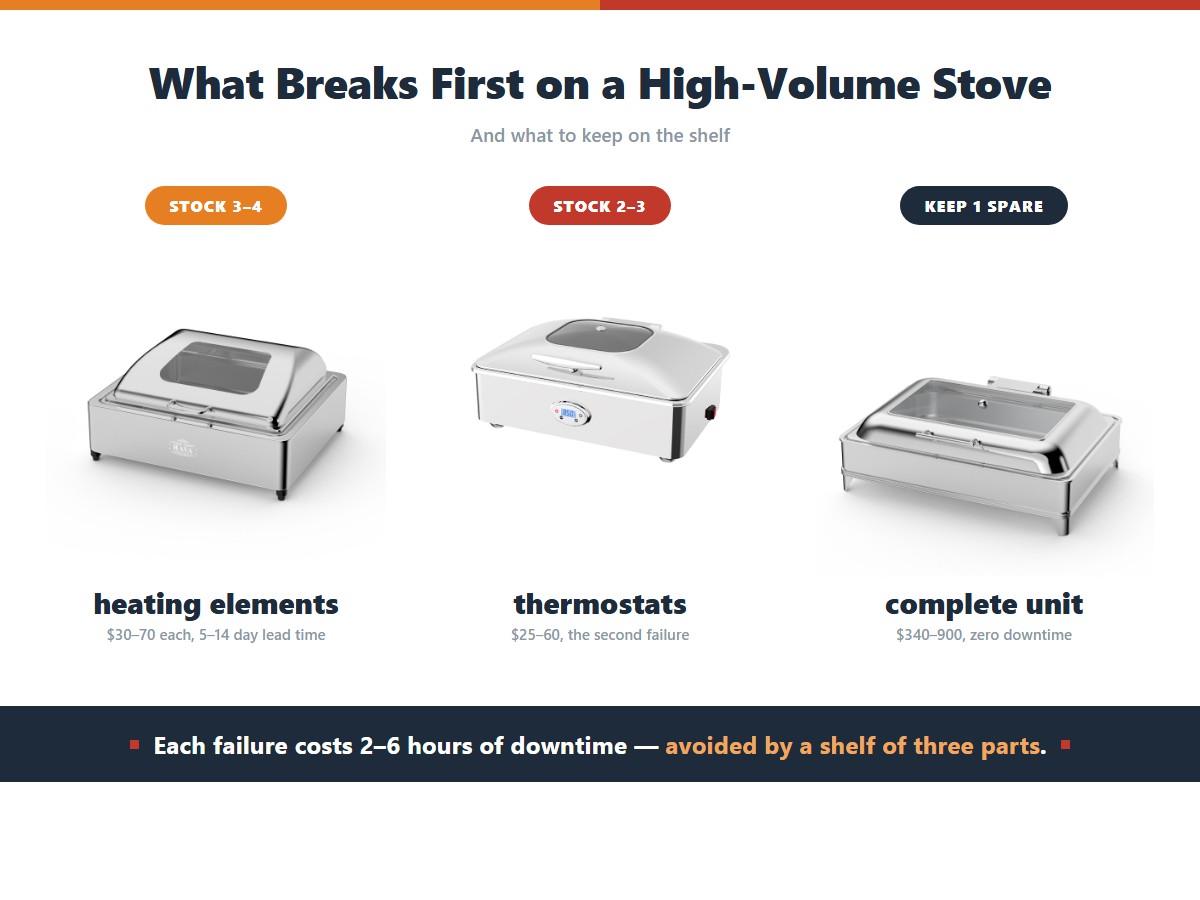
Short answer: On a high-volume buffet stove, the heating element fails first, then the thermostat, then the power cord and plug, then the hinges and lid, and the stainless body last. The element and thermostat together are about 20% of unit cost but roughly 74% of failures. Knowing that order tells you what to stock, what to budget, and which failures are actually worth repairing. See buffet station equipment.
The useful thing about a failure order is that it is predictable, which means a high-volume operation can treat it as a schedule rather than as a surprise. An element that is going to fail at 900 service hours will fail at 900 service hours, and a kitchen that knows the number can order the part before the failure rather than during the breakfast rush.
What Breaks First, in Order
| Rank | Component | Share of unit cost | Share of failures | Failure rate, 900 service hours | Repair or replace |
|---|---|---|---|---|---|
| 1 | Heating element | 10–16% | 46% | 0.9–1.4 per year | Repair if unit under 3 years |
| 2 | Thermostat | 5–9% | 28% | 0.5–0.9 per year | Repair if unit under 3 years |
| 3 | Power cord and plug | 2–4% | 9% | 0.2–0.4 per year | Repair, always cheap |
| 4 | Hinges and lid hardware | 2–3% | 7% | 0.1–0.3 per year | Repair |
| 5 | Control panel and display | 4–8% | 6% | 0.1–0.2 per year | Replace panel, not unit |
| 6 | Water tray and seals | 1–2% | 3% | 0.05–0.15 per year | Repair |
| 7 | Stainless body and frame | 35–45% | 1% | Rare | Replace the unit |
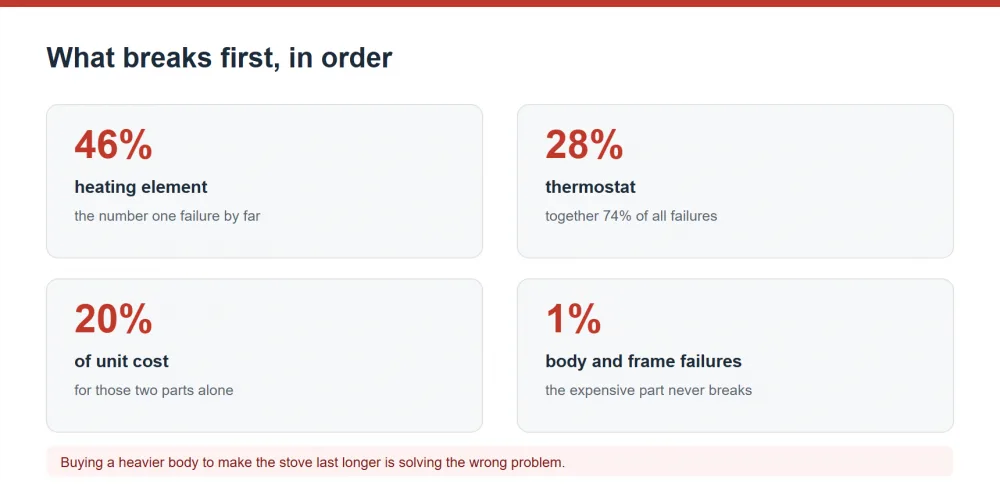
Read the two middle columns together and the argument is clear. The element, thermostat and cord together make up 17–29% of what you paid, and they cause 83% of all failures. The body and frame, which are most of the money, cause about 1%. This is why buying a heavier gauge body to make the stove last longer is solving the wrong problem: the body was never going to fail.
Element Failure by Duty Cycle
| Service hours per month | Annual element cycles | Element life | Cost per year, element | Units to keep as spare |
|---|---|---|---|---|
| Under 40 | Under 480 | 4–6 years | $0 | 0 |
| 40–100 | 480–1,200 | 3–4 years | $8–16 | 0 |
| 100–200 | 1,200–2,400 | 2–3 years | $12–24 | 1 |
| 200–400 | 2,400–4,800 | 1.5–2 years | $18–36 | 1–2 |
| Over 400 | Over 4,800 | Under 1.5 years | $25–48 | 2–3 |
A thermostat makes this worse, and it is worth being honest about that. A thermostat cycles the element more often than an on/off switch, which is exactly how it saves 30–43% of the electricity, and more cycles means a shorter element life. Below 40 service hours a month the switch wins on both counts. Above 100 hours a month the energy saving outweighs the shorter element life, and above 300 hours a month the element becomes a consumable you plan for rather than a repair you absorb.
Spare Parts for a High-Volume Line
| Part | Unit cost | Stock for 6 units | Lead time | Downtime avoided |
|---|---|---|---|---|
| Heating element | $30–70 | 3–4 | 5–14 days | 2–6 hours per failure |
| Thermostat | $25–60 | 2–3 | 5–14 days | 1–4 hours |
| Power cord and plug | $12–28 | 2–3 | 2–5 days | 1–3 hours |
| Hinge kit | $16–38 | 2–3 | 3–10 days | 30–60 min |
| Spare complete unit | $340–900 | 1 | 0 | A full service |
What Is Not Worth Repairing
| Component | Repair cost | Replacement cost | Decision |
|---|---|---|---|
| Element, unit under 3 years | $30–70 | $340–900 | Repair |
| Element, unit over 4 years | $30–70 | $340–900 | Repair if the body is good |
| Thermostat | $25–60 | $340–900 | Repair |
| Control panel | $40–95 | $340–900 | Replace panel, keep unit |
| Bent frame or leg | $55–120 | $340–900 | Replace the unit |
| Burnt body around the element | Not practical | $340–900 | Replace the unit |
There is a limit to how much any of this matters. At 400+ service hours a month, the honest answer is that you are running a small appliance repair business alongside your kitchen, and the arithmetic starts to favour a service contract or a unit designed for that duty. Buying a heavier body does not help. A published spare-parts list and a supplier who ships within 48 hours helps a great deal.
Frequently Asked Questions
What breaks first on a high-volume buffet stove?
The heating element, at about 46% of all failures, followed by the thermostat at 28%. The power cord and plug come third at 9%, and the stainless body and frame last at about 1%. The element and thermostat are only 17–29% of the purchase price but cause 74% of the failures.
How long does a heating element last in a busy restaurant?
Two to four years at 100–200 service hours a month, and under 1.5 years above 400 hours a month. At under 40 hours a month it lasts 4–6 years and is effectively a lifetime part. The number of thermostat cycles matters more than the hours, which is why a thermostat shortens element life.
Is it worth repairing a high-volume buffet stove?
Yes for the element, thermostat, cord and hinges, which together cost $12–28 to $30–70 each against a $340–900 replacement. No for a bent frame or a burnt body, where the repair is $55–120 and the value of the rest of the unit is already reduced.
Should I keep spare parts for a busy buffet line?
For a six-unit line, three to four elements, two to three thermostats and two to three cords cover most of the year for about $200–400 of shelf cost. Above 300 service hours a month, also keep one complete spare unit, because a five-day element lead time is five days of service you cannot deliver.
Does a thermostat make an element fail sooner?
Yes. A thermostat cycles the element more often than an on/off switch, which is how it saves 30–43% of the electricity and also how it shortens element life. Below 40 service hours a month the switch is better on both counts, and above 100 hours a month the energy saving wins.
Related reading
- Are Buffet Stoves Worth It? Payback by Event Volume
- Buffet Stoves for Small Restaurants: What Actually Fits
- All-You-Can-Eat: Why Buffet Stoves Pay Off Fast
- Chafing Dishes for Buffet Lines: High-Volume Commercial Solutions
- Buffet Equipment Maintenance Schedule: Don't Wait Until It Breaks
- High-Volume Events: Stove Count and Backup Plan