




Upgrading a Buffet Line: What to Replace First
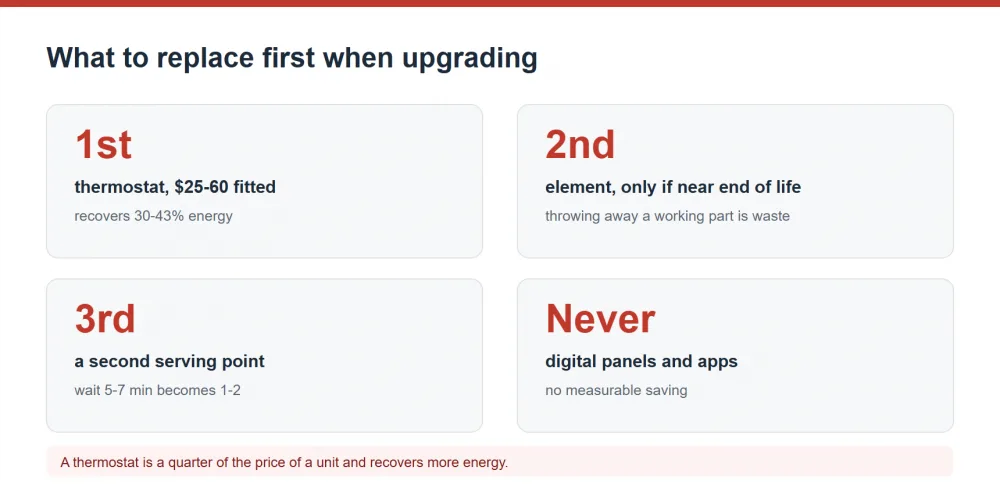
Short answer: Replace in this order: thermostats first, then the heating elements, then the units themselves, and leave the stainless frames alone. A thermostat retrofit is $25–60 per unit and recovers 30–43% of the energy bill; replacing a working element for no reason throws away the part that was about to fail anyway. Frames rarely need replacing. See buffet station equipment.
Upgrading your buffet setup from standard chafing dishes to professional buffet stoves can transform your operation: faster service, fresher food, lower labor costs, and happier guests. For many restaurants and caterers, the upgrade pays for itself in 3–6 months through efficiency gains alone. But with so many models on the market, it’s hard to know where to start. In this guide, we’ll walk you through how to upgrade your buffet setup with a professional buffet stove, step by step, and which models deliver the best ROI for your business.
Step 1: Assess Your Current Pain Points
Before buying new equipment, identify what’s not working with your current setup. Are you spending too much on fuel? Is food drying out after 2 hours? Do you need more staff to manage the buffet? For example, if your main pain point is food drying out, prioritize stoves with water bath heating (like the Electric Chafing Dish Food Warmer) that maintain 80%+ humidity. If labor costs are too high, choose stoves with digital controls that need less monitoring.
Step 2: Choose the Right Capacity
Match stove capacity to your guest count: 5L for 50-seat buffets, 11L for 100+ seat buffets, and double pan models for high-volume venues. Over-sizing wastes energy, while under-sizing leads to constant refills. The Full Size 11L Electric Chafer is a great middle-ground for most 100–200 seat restaurants, holding enough food for 50+ guests per pan.
Step 3: Prioritize Durability for Daily Use
Professional buffet stoves need to withstand daily use, spills, and transport. Look for 304 stainless steel construction (like all BAVA models) that resists dents, scratches, and corrosion. Avoid models with plastic parts that crack after a few months of use. For caterers who transport equipment, choose stoves with reinforced corners and non-slip bases to prevent damage during transit.
Top Professional Buffet Stoves for Upgrades
When upgrading your buffet setup, choose models with fast heat-up, precise temp control, and durable construction. Below are two BAVA models ideal for buffet upgrades:

Electric Chafing Dish Food Warmer
This 400W model features adjustable digital temperature control (60–93°C) and a 2.5L water tank that maintains humidity for 8+ hours. It’s CE, ETL, and RoHS certified, meeting global safety standards. The compact design fits into most existing buffet lines, so you don’t need to redesign your setup. It’s a cost-effective first upgrade for restaurants looking to improve food freshness.

Full Size 11L Electric Chafer
The reaches optimal temperatures in 12 minutes with 1100W power and ≥80% thermal efficiency. Its digital display and smart mode reduce staff monitoring needs, and the polished stainless steel construction withstands daily use. It’s ideal for 100+ seat buffets looking to reduce setup time and food waste. Most restaurants see ROI within 4 months of upgrading to this model.
Step 4: Train Staff on New Equipment
Even the best equipment won’t deliver results if staff don’t know how to use it. Choose stoves with intuitive controls (like digital touchscreens) that need minimal training. BAVA stoves come with free training videos and user manuals, cutting training time to 15 minutes per staff member. For restaurants with high turnover, this simplicity is key to maintaining efficiency after the upgrade.
Conclusion
Upgrading your buffet setup with a professional buffet stove is one of the highest-ROI investments you can make. It improves food freshness, reduces labor costs, and cuts energy/fuel bills—all while making your buffet line look more professional to guests. BAVA’s Electric Chafing Dish Food Warmer and Full Size 11L Electric Chafer are trusted by thousands of restaurants worldwide for their reliability and performance. Whether you’re upgrading a small café buffet or a large hotel banquet, the right professional buffet stove will take your operation to the next level.
Browse the full chafing dish range for current models and configurations.
Upgrade Priority by Component
| Order | Component | Cost per unit | What it recovers | Payback | Do this when |
|---|---|---|---|---|---|
| 1 | Thermostat retrofit | $25–60 fitted | 30–43% energy, tighter hold | 2–5 months | Any unit on/off switch |
| 2 | Element replacement | $30–70 | Faster recovery, restores capacity | Already planned | Element is at end of life |
| 3 | Add a second serving point | $120–340 | Wait 5–7 min becomes 1–2 | Immediate | One long queue |
| 4 | Replace the unit | $340–900 | All of the above at once | 3–8 months | Over 5 years old, no parts |
| 5 | Replace the frame | $340–900 | Cosmetic only | Never, alone | Frame is bent or rusted |
| 6 | Add digital panels or apps | $120–320 | Readout, no energy saving | Never | You are audited |
Step 1: Pain Points and What Each Fixes
| Symptom | Likely cause | Correct fix | Wrong fix | Cost of the wrong fix |
|---|---|---|---|---|
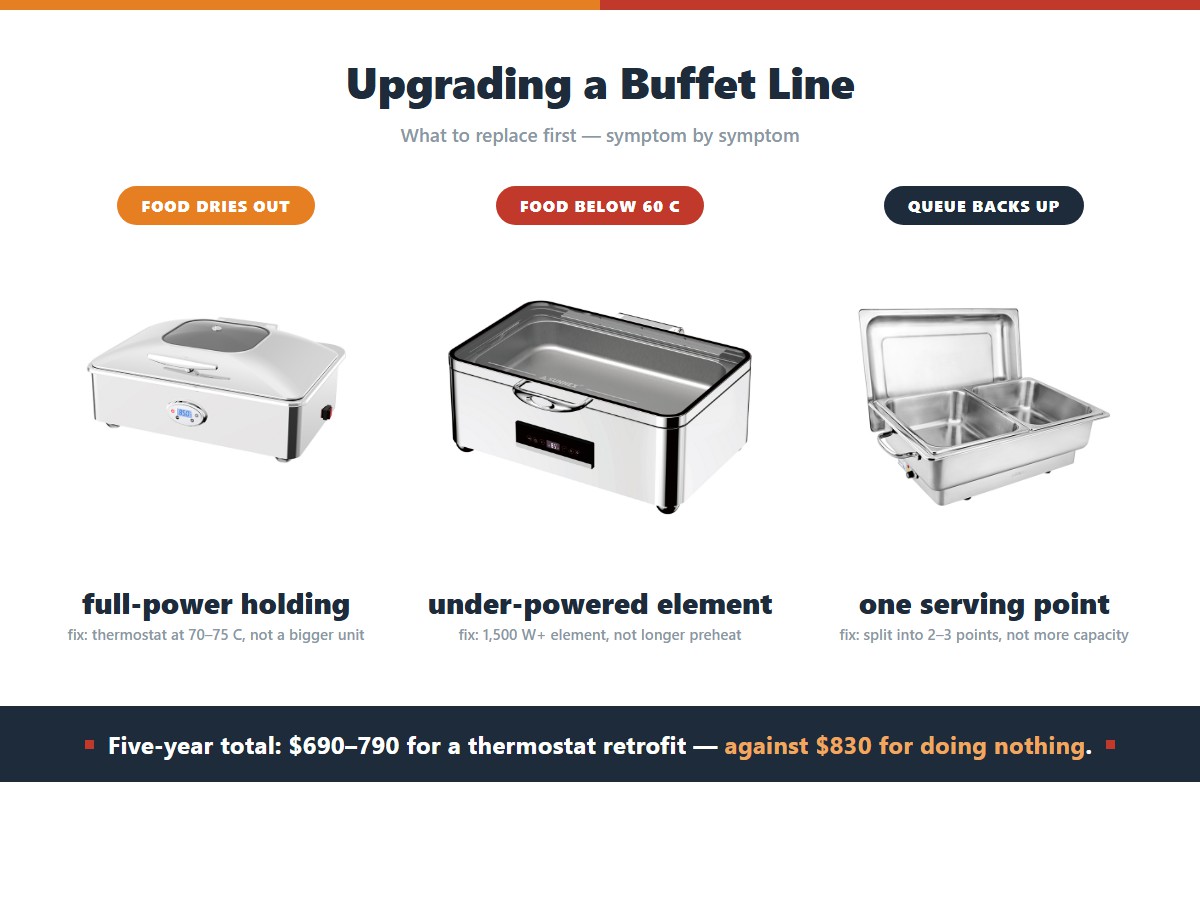
| Food dries out on the line | Full-power holding | Thermostat at 70–75°C | Bigger unit | $340–900 for nothing |
| Food falls below 60°C | Under-powered element | Element 1,500 W+ | Longer preheat | Still fails at peak |
| Queue backs up | One serving point | Split into 2–3 points | More capacity | $340–900, queue unchanged |
| Element fails often | Over-cycling, old element | Replace element, add thermostat | Buy a bigger stove | $340–900 |
| Line looks tired | Cosmetic wear | Polish, replace lids | Replace the line | $1,000–3,000 |
| Bills rising | No thermostat | Thermostat retrofit | Digital display | $120–320 for no saving |
Cost of Each Upgrade Path Over Five Years
| Path | Upfront | Energy, 300 services | Parts | Five-year total | Verdict |
|---|---|---|---|---|---|
| Do nothing | $0 | $650 | $180 | $830 | Baseline |
| Thermostat retrofit only | $140–240 | $370 | $180 | $690–790 | Best first move |
| Thermostat plus new elements | $230–380 | $370 | $120 | $720–870 | Do both together |
| Replace two units | $680–1,800 | $370 | $60 | $1,110–2,230 | Only if parts are gone |
| Replace the whole line | $1,700–4,500 | $370 | $60 | $2,130–4,930 | Only if the line is 8+ years old |
The single most common mistake in a buffet upgrade is replacing working equipment. A unit whose element was going to fail in three months gets replaced with a new one, and the old element is thrown away, and then the same decision is made on the next unit. Upgrade the control first, because a thermostat is a quarter of the price of a unit and it recovers more energy than the unit upgrade does. Frames and bodies are the last thing to touch, and usually never.
Frequently Asked Questions
What should I replace first when upgrading a buffet line?
The thermostat first, at $25–60 fitted per unit, because it recovers 30–43% of the energy bill. Then the heating elements, but only if they are near end of life, and then the units themselves if they are over five years old with no obtainable parts. Frames are last and usually never.
Is it worth replacing old buffet stoves?
Only if they are over five years old, the parts are unobtainable, or the body is damaged. A working ten-year-old unit with a replaceable $30–70 element is worth several times more than a new one is worth buying.
How much does it cost to add a thermostat to a buffet stove?
$25–60 for the part plus $15–40 for labour if you cannot do it yourself, so $40–100 per unit fitted. It pays back in 2–5 months on 100+ service hours a month, and it is the highest-return upgrade available on a working buffet line.
Should I upgrade the whole line at once?
No. Do the thermostat retrofit on the whole line first, because it is a quarter of the cost and captures most of the saving. Then replace units as they fail, one at a time, over the following two years, which spreads the cost and keeps the existing line working.
Do digital displays and apps improve a buffet line?
Not in a working kitchen. A digital panel shows a setpoint you already set, adds a failure point, and saves no measurable energy over a good mechanical thermostat. It is worth $120–320 only if it includes probe logging that you will actually read for audit purposes.
Related reading
- Chafing Dish Water Pan: Replacement Parts for Food Warmers
- High-Volume Buffet Stoves: What Breaks First
- Chafing Dish Pans: Replacement Pans for Food Warmers
- Chafing Dish Food Pan Sizes: Which Replacement Pan Fits Your Chafer?
- Starting a Catering Business? Buy These 5 Things First
- How Much Counter Space Does a Buffet Line Need?
- Retrofitting a Buffet Stove Into an Existing Line: What to Check