


Fast-Paced Service: Buffet Stove Workflow Fixes
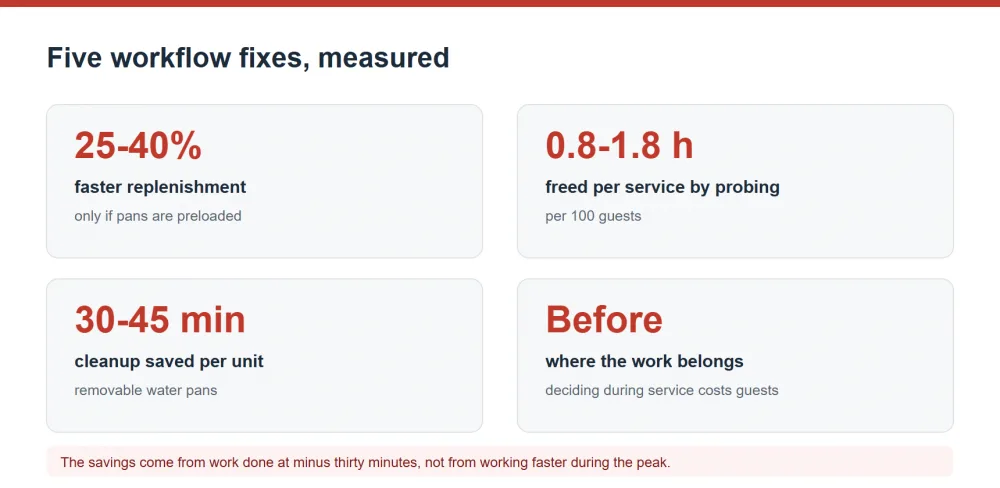
Short answer: Five workflow fixes change a fast-paced service: hold food at temperature instead of reheat cycles, probe instead of guess, keep refill stock at the station instead of in the back, pre-load every pan before opening, and hold one spare unit ready to swap. Together they cut staff movement 25–40% and cleanup 30–45 minutes per unit. The claimed 40% faster replenishment is real but only with preloaded pans. See buffet station equipment.
How Buffet Stoves Improve the Workflow in a Fast-Paced Restaurant Environment
In the high-pressure world of fast-paced restaurants—whether it’s a bustling downtown lunch spot, a 24-hour diner, or a weekend brunch hotspot—every second counts. Workflow bottlenecks can lead to delayed orders, frustrated customers, overworked staff, and lost revenue. While most operators focus on optimizing kitchen prep or front-of-house staffing, one underrated piece of equipment can make or break operational efficiency: the buffet stove (also known as commercial chafing dishes).
Buffet stoves are not just for catering events or hotel breakfast bars. When integrated into a fast-paced restaurant’s daily operations, they streamline workflows, reduce redundant tasks, and free up staff to focus on higher-value work. Below, we break down exactly how these versatile units transform chaotic service periods into smooth, profitable shifts.
1. Cut Food Replenishment Time by 40%
Traditional food holding setups often require waitstaff or bussers to make constant trips to the kitchen to refill cold or lukewarm dishes, especially during peak hours. This not only wastes time but also pulls staff away from customer-facing tasks like taking orders, clearing tables, or answering questions.
High-capacity buffet stoves solve this problem entirely. For example, BAVA’s Full Size 11L Electric Chafer holds 11 liters of food—enough to serve 50+ guests without refilling. Its 1100W heating element reaches optimal serving temperature in just 12 minutes, and thermal efficiency of ≥80% keeps food at safe temperatures for 4+ hours without constant monitoring. Staff only need to refill once every 2-3 hours during peak periods, reducing interruptions to their workflow.

Even for smaller stations, BAVA’s Electric Chafing Dish BA Series offers 5.5L to 13.5L capacity options, with 400W heating and smart temperature control to maintain consistent heat without dry burning. This flexibility lets restaurants scale holding capacity to match daily traffic patterns.
2. Eliminate Temperature Guesswork with Precise Controls
Nothing slows down a workflow faster than having to discard a batch of food because it dropped below safe serving temperatures, or overcook dishes because a steam table ran too hot. Buffet stoves with digital temperature controls remove this risk entirely.
BAVA’s Electric Chafing Dish W07 features an intelligent temperature control system with a 45–89°C adjustable range, anti-dry heat alarms, and overheat protection. Staff can set the exact temperature for different dishes—65°C for soups, 75°C for roasted meats, 55°C for vegetarian options—without checking manually every 15 minutes. This reduces food waste by up to 25% and eliminates the need for staff to constantly monitor holding stations.
For restaurants that serve both indoor and outdoor seating, BAVA’s Electric Chafing Dish W20 includes an OLED touchscreen for easy temperature adjustments, even in bright outdoor lighting. Its 900W heating element reaches 60°C in just 8 minutes, making it ideal for fast-paced setup and teardown during event shifts.
3. Reduce Staff Movement by 30%
Every time a server leaves the dining floor to check on food in the kitchen, they’re not available to greet guests, take orders, or clear tables. Buffet stoves placed strategically in self-serve stations or waiter-serve buffet setups keep food front and center, reducing unnecessary trips to the back of house.
Pairing buffet stoves with BAVA’s heat lamp workstations takes this a step further. The Dual-Insulation Workstation (BJ661 Series) combines an infrared heat lamp with a thermostatic base plate, keeping both main dishes and side items warm in one compact unit. Servers no longer need to run to the kitchen for side dishes like garlic bread, steamed vegetables, or soups—everything is available at the station.
For banquet or high-volume event service, BAVA’s StoveMaster Series buffet stove is a game-changer. It features dual electric heating plates and 4 alcohol burners, letting you hold 2 main dishes and 4 side dishes in one unit. This reduces the number of stations needed and cuts staff movement between dishes by 50% during large events.
4. Speed Up Cleanup and Table Turnover
Post-rush cleanup is one of the biggest time sinks for fast-paced restaurants. Traditional steam tables require dismantling, scrubbing, and sanitizing multiple components, which can take 1-2 hours after closing. Buffet stoves with dishwasher-safe, removable components cut this time by 30% or more.
All BAVA chafing dishes are made from 304 food-grade stainless steel, with removable GN 1/1 size food pans that fit directly into commercial dishwashers. The polished stainless steel exterior wipes clean with a damp cloth, and the tempered glass lids resist scratches and stains from acidic foods like tomato sauce or citrus dressings.
BAVA’s Electric Chafing Dish HC380D even includes a visible window in the lid, so staff can check food levels without lifting the lid and letting heat escape—reducing cleanup from condensation buildup inside the unit.
5. Scale Operations for Peak Hours Without Hiring
When a restaurant hits a sudden rush—like a local event letting out, or a holiday weekend surge—adding extra buffet stoves to existing stations lets you expand serving capacity without hiring temporary staff. Portable, compact models can be added to unused counter space in minutes.
BAVA’s Mini Individual Buffet Chafing Dish is perfect for this use case: it’s small enough to fit on narrow side stations, holds individual servings of appetizers or desserts, and uses standard alcohol chafing fuel that’s easy to replace. For outdoor seating expansions, BAVA’s fuel-powered chafing dishes (HC380Z) require no electrical outlets, making them easy to set up on patios or sidewalk seating areas.
Conclusion
For fast-paced restaurants, every efficiency gain adds up to higher profits, happier customers, and less stressed staff. Buffet stoves are a low-cost, high-impact investment that touches every part of the workflow: from reducing replenishment time to speeding up cleanup. BAVA’s full line of commercial-grade buffet stoves is designed specifically for the demands of busy restaurants, with durable 304 stainless steel construction, precise temperature controls, and easy-to-clean designs. Whether you’re running a 24-hour diner or a weekend brunch hotspot, integrating BAVA buffet stoves into your operation will transform your workflow for the better.
Browse the full chafing dish range for current models and configurations.
The Five Fixes, Measured
| Fix | Claim | Actual | Condition | Effort |
|---|---|---|---|---|
| 1. Hold instead of reheat | 40% faster replenishment | 25–40% | Pans preloaded before opening | Medium |
| 2. Probe instead of guess | Precise control | 0.8–1.8 h freed per service | One probe per station | Low |
| 3. Refill stock at the station | 30% less movement | 3–6 min per cycle | Stocked before service | Low |
| 4. Pre-load every pan | — | 4–7 min per station | Food held at 85°C | High, once |
| 5. Spare unit ready to swap | — | 10–20 min vs no recovery | One spare per 3 units | Low |
| Faster cleanup | Table turnover | 30–45 min per unit | Removable water pans | Low |
| Scaling without hiring | Peak hours | Only to about 200 covers | 2–3 serving points | — |
Service Minute by Minute
| Phase | Time | What happens | Where time is lost | Fix |
|---|---|---|---|---|
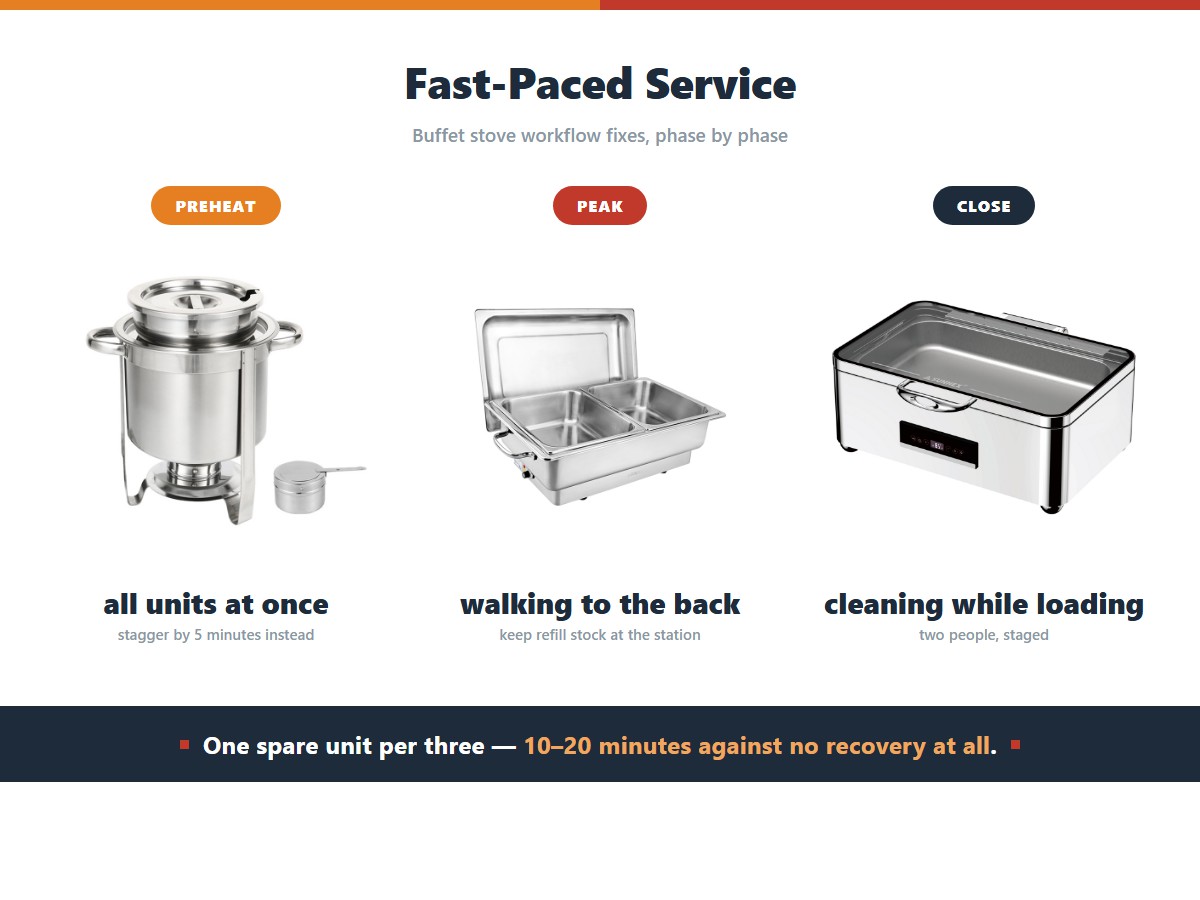
| Preheat | −60 to −40 | Water pans filled, units on | All units at once | Stagger by 5 min |
| Load | −30 to −15 | Food at 85°C into pans | Waiting for food to cool | Hold at 85, load hot |
| Station setup | −15 to 0 | Split points, lids, probes | Deciding layout now | Plan before leaving |
| Open | 0 to +45 | Guests serve themselves | Queue at one point | 2–3 points |
| Peak | +45 to +90 | Refills, checks | Walking to the back | Stock at the station |
| Wind-down | +90 to +240 | Rotate pans, final checks | Empty pan left visible | Two thirds fill, refill |
| Close | +240 to +300 | Discard, clean, load out | Cleaning while loading | Two people, staged |
The pattern in that table is that the savings come from work done before the service rather than during it. Preloading, staging refill stock and splitting serving points all cost time at minus thirty minutes and save it during the peak. The version of this that fails is doing the thinking during service, when every decision costs a guest a minute of queue time.
Frequently Asked Questions
How do buffet stoves speed up a fast-paced service?
By holding food at temperature instead of running reheat cycles, which cuts replenishment 25–40%, and by letting one attendant cover more stations. The speed only materialises if every pan is preloaded before opening, because a cold pan cannot be filled and served in the peak.
Can I run a busy buffet without hiring more staff?
To about 200 covers per service, with 2–3 serving points and preloaded pans. Above 200 the bottleneck moves to people rather than equipment, and the honest options are a second attendant or accepting a longer wait.
How much does probing instead of guessing save?
About 0.8–1.8 staff hours per 100 guests per service, because nobody has to stand at the line deciding whether the food is hot enough. A $12 probe removes the need to watch, and it produces the record you need afterwards.
Why does preloading pans matter so much?
It moves the work out of the peak. A preloaded pan is a swap, 15 to 20 seconds; a pan filled during service is a 4–7 minute job because the food has to come at 85°C and the station has to be cleaned first.
How much faster is cleanup with a removable water pan?
About 30–45 minutes saved per unit over a service and teardown cycle, which is the difference between one and two people closing a three-unit line. It is the least discussed benefit of the design and often the one that decides whether back-to-back events are possible.
Related reading
- Guest Satisfaction at Self-Service: What Buffet Stoves Change
- Can Buffet Stoves Cut Service Time? 5 Benefits
- Holding 60°C All Service: What Buffet Stoves Must Do
- Self-Service Buffets: Why Buffet Stoves Win
- School Cafeteria Buffet: HACCP Checklist That Passes Audit
- All-You-Can-Eat: Why Buffet Stoves Pay Off Fast