


Which Chafing Dish Should You Buy? 4 Questions, 2 Minutes
Short answer: answer four questions in order — indoors or outdoors (power decides electric vs fuel), how many guests (one 8 qt pan per 25–30), what food (wet for sauce, dry for crisp), and budget ($22–55 wholesale for 201 fuel, $45–90 for 304, $65–180 electric). Browse the range at chafing dishes.
You need a chafing dish. But which one? Electric or fuel? Full-size or half? Wet or dry? View window or solid lid?
Too many options. Here's a 4-step decision tree to pick the right one in 2 minutes.
PRO TIP: Most buyers oversize.
If you're between sizes, go smaller. You can always add another dish. Oversized = food sits too long = dries out. See our size guide.
KEY TAKEAWAY: 4 questions. 2 minutes. Right chafing dish.
Indoors or out? How many people? What food? What budget? Answer these 4 questions and you'll know exactly what to buy.
Step 1: Indoors or Outdoors?
| Location | Heating | Why |
|---|---|---|
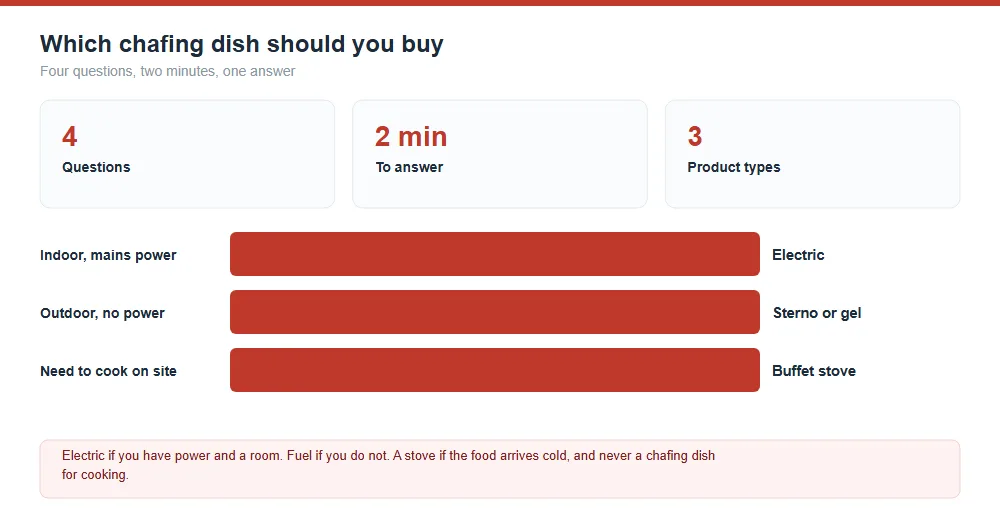
| Indoors (outlet available) | Electric | Silent, no fuel cost, no flame |
| Indoors (no outlet) | Fuel can | Portable. Use Sterno gel fuel. |
| Outdoors | Fuel can | No power needed. See outdoor buffet guide. |
Step 2: How Many People?
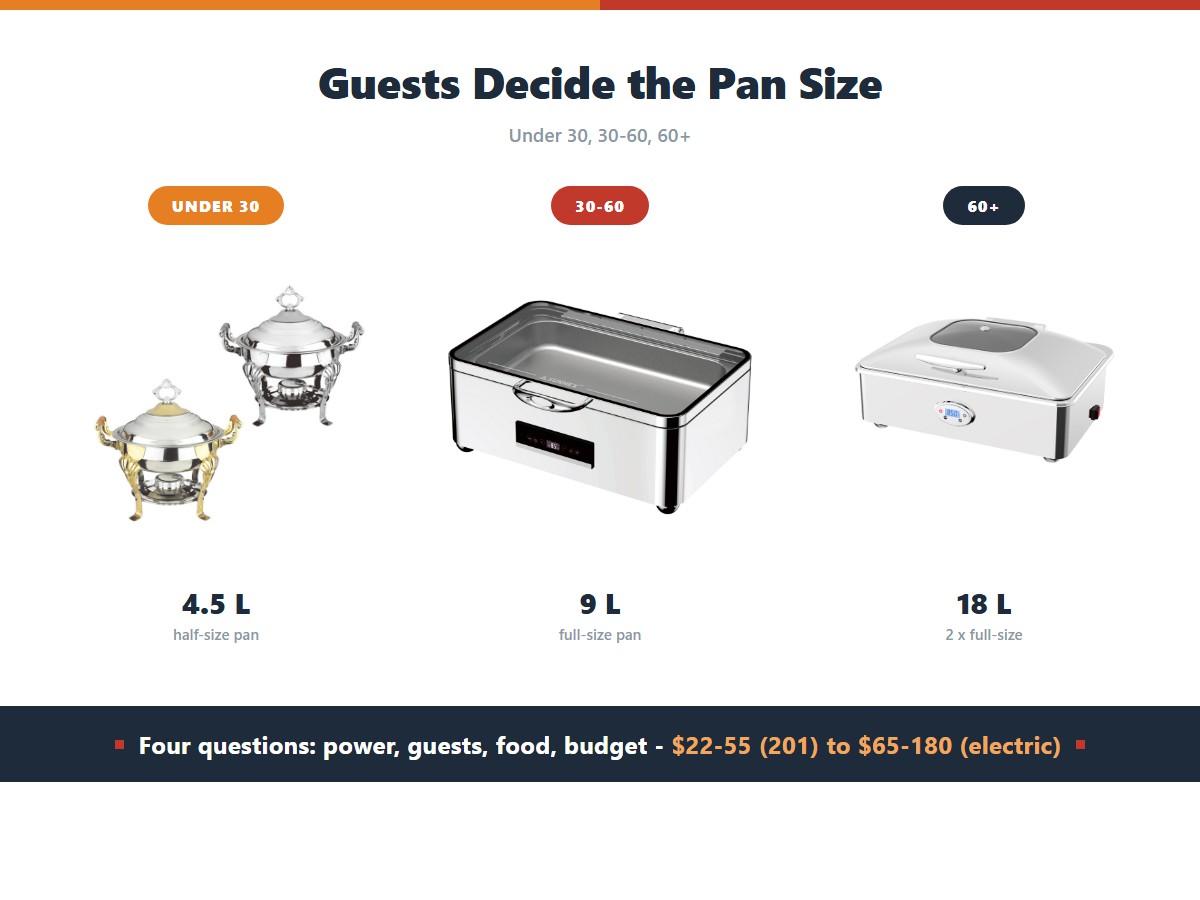
| Guests | Size | Capacity |
|---|---|---|
| Under 30 | Half-size | 4.5L |
| 30-60 | Full-size | 9L |
| 60+ | 2x full-size | 18L |
Step 3: What Food?
| Food Type | Mode | Why |
|---|---|---|
| Saucy, moist (curry, vegetables) | Wet mode (add water) | Steam keeps food juicy |
| Crispy (fried, roasted) | Dry mode (no water) | No steaming = stays crispy. See dual heating guide. |
Step 4: What Budget?
| Budget | Get | Price Range |
|---|---|---|
| Basic | Fuel can, solid lid, single wall | $80-150 |
| Mid-range | Fuel can, view window, 3-layer base | $150-300 |
| Premium | Electric, view window, dual mode | $300-600 |
Buying Guide Terms to Know
- buying chafing dish guide
- chafing dish size guide
- electric vs fuel cost
- how to choose chafing dish
- catering startup checklist
The Bottom Line
4 questions: indoors/outdoors, how many people, what food, what budget. Answer them and you'll know exactly what to buy. Don't oversize. Don't overspend. Get the right tool for your actual use case. Still unsure? Start with a basic fuel model. Upgrade later.
Looking for Chafing Dishes?
BAVA manufactures commercial chafing dishes for every budget and use case. All products CE/FDA certified, OEM/ODM available.
A worked example: 50-guest brunch
Indoors, with a socket at the line. Guests: 50, so two 8 qt entrée pans and two 4 qt side pans, plus one spare frame — five units. Food: eggs and sausage (wet), pastries (dry). Budget: 304 electric at $45–90 wholesale, or 201 fuel at $22–55 if the venue has no spare circuit.
That is the whole decision in under two minutes. The trap is answering the questions out of order: choosing a fuel unit because it is cheap, then discovering that the only socket is across the room, or buying a full-size electric when the menu is two sauces and a tray of pastries.
One field note: the fourth question, budget, is the one people answer first and regret most. A cheap 201 unit that fails at the second event costs more per use than a 304 unit that lasts six seasons. Work out cost per event — price divided by the number of times you will realistically use it — before you look at the price tag.
What to check on the unit before you pay
Four checks catch most bad buys. Lift the lid and look at the hinge: a friction hinge should hold at any angle, and a damped one should close slowly rather than drop. Drop the food pan into the frame: it should seat without rocking, and a standard GN 1/1 pan should fit if you already own pans. Look at the water pan rim for a rolled edge — a sharp edge cuts gloves and cloths. And confirm the element or fuel holder is replaceable, because those are the parts that fail first.
Frequently Asked Questions
Why start with indoors or outdoors?
Because power decides everything else. No power means fuel, and fuel changes the running cost, the consumables and the safety rules.
How many guests per pan?
One 8 qt pan per 25–30 guests for entrées, one 4 qt pan per 35–40 for sides.
Does food type really change the equipment?
Yes: sauce, rice and vegetables need a water bath; fried and baked items need dry heat or they go soft in 15 minutes.
What budget should I plan?
Wholesale: $22–55 for a 201 fuel unit, $45–90 for 304 fuel, $65–180 for electric. Retail runs 2.5–3.5 times that.
Can one unit do everything?
A 4 qt wet/dry unit covers small events. Above 50 guests you need full-size pans and a spare frame.
Related reading
- Why Chafing Dishes Rattle (And How to Silence Them in 5 Minutes)
- Cleaning a Buffet Stove: 20 Minutes a Day
- How to Set Up a Chafing Dish: 7 Steps in 25 Minutes
- Chafing Dish Guide: 5 Questions That Decide the Right Model
- Your Chafing Dish Is Too Hot: The 135°F Myth
- Dual Dry-Wet Heating Chafing Dish: One Dish, Two Modes