




High-Volume Events: Stove Count and Backup Plan
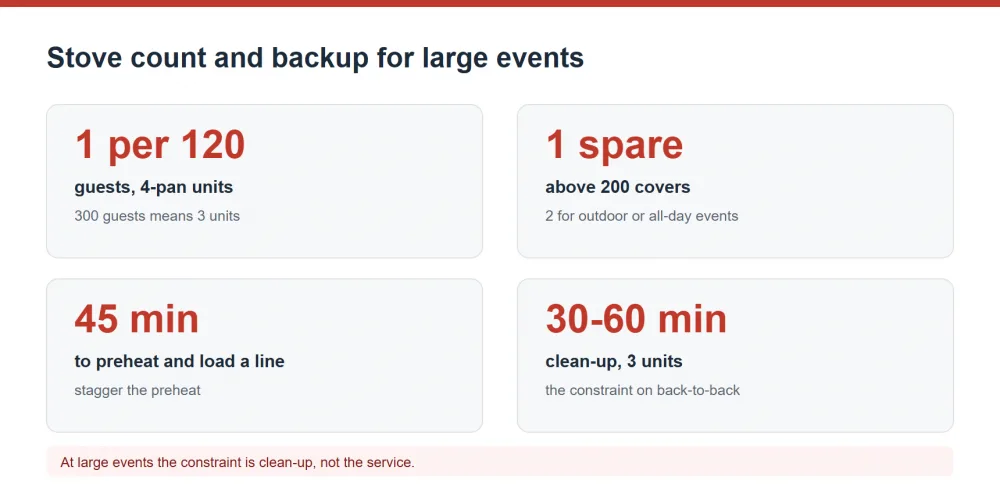
Short answer: Plan one 4-pan unit per 120 guests plus one spare unit for any event over 200 covers, and split the pans across two or three serving points rather than one line. For 300 guests over 4 hours that is three 4-pan units, one spare, 20–26 cans of fuel or three dedicated circuits, and 6–8 minutes of preheat per unit. See buffet station equipment.
High-volume events—corporate conferences, music festivals, large wedding receptions—demand catering equipment that can handle 500+ guests, non-stop service, and harsh conditions like outdoor heat or cramped kitchen spaces. For these events, standard chafing dishes won’t cut it: they run out of fuel quickly, lose heat when lids are opened, and can’t maintain consistent temperatures for hours. Buffet stoves built for high-volume use are the solution, but not all models are created equal. In this guide, we’ll cover everything you need to know about selecting and using buffet stoves for high-volume events, from capacity to durability to efficiency.
Capacity: Match Stove Size to Event Guest Count
The first consideration for high-volume events is capacity. A 5L chafing dish might work for a 50-guest dinner, but for 500+ guests, you need stoves with 11L+ capacities (like the Stainless Steel Electric Double Pan Chafing Dish) that hold enough food to serve 50+ guests per pan. Double pan models are especially useful for high-volume events, letting you serve two dishes per stove and reducing the number of units needed. For events with 1000+ guests, look for stoves that can be linked together for continuous buffet lines.
Durability: Withstand Harsh Event Conditions
High-volume events are tough on equipment: stoves get bumped by servers, exposed to outdoor elements, and run for 8+ hours straight. Buffet stoves for these events need 304 stainless steel construction (like the Electric Chafing Dish W20) that resists dents, scratches, and corrosion. Look for models with reinforced hinges, non-slip bases, and waterproof controls to handle spills and outdoor use. For outdoor events, fuel-powered models are better than electric ones, as they don’t rely on access to power outlets.

Efficiency: Reduce Fuel/Energy Costs for Large Events
Running 20+ buffet stoves for an 8-hour event adds up quickly in energy or fuel costs. High-efficiency models with thermal efficiency ≥80% (like the Full Size 11L Electric Chafer) cut energy use by 20% compared to standard models. For fuel-powered stoves, look for models with adjustable burners that let you lower heat output during slow periods. These efficiency gains can save hundreds of dollars per large event, adding up to thousands in annual savings for catering companies.
Top Buffet Stoves for High-Volume Events
When selecting a buffet stove for high-volume events, prioritize capacity, durability, and efficiency. Below are two BAVA models trusted by large event caterers:

Stainless Steel Electric Double Pan Chafing Dish
This 800W double pan stove features two GN 1/2 pans (each 400W) for serving two dishes per unit. The 304 stainless steel construction is durable enough for daily event use, and the adjustable temperature (45–90°C per pan) lets you customize heat for different dishes. It’s ideal for high-volume events where space is limited, as it serves twice as many guests per square foot as single pan models. CE, ETL, and RoHS certified for global use.

Electric Chafing Dish W20
The Electric Chafing Dish W20 features a 900W OLED touchscreen and 3-layer base for even heat distribution. With adjustable temperature (45–90°C) and a water bath design that maintains 80%+ humidity, it keeps food moist for 8+ hours. The 304 stainless steel body resists dents and scratches from event transport, and the sleek design complements upscale corporate events and weddings. It’s a versatile, high-capacity option for caterers handling 500+ guest events.
Maintenance: Quick Cleanup for Back-to-Back Events
High-volume caterers often run events back-to-back, leaving little time for equipment cleanup. Buffet stoves with removable food pans and water tanks (like both featured models) cut cleanup time by 50% compared to models with built-in pans. Look for stoves with smooth stainless steel surfaces that wipe clean quickly, and dishwashers-safe pans to speed up turnaround. For caterers handling 10+ events per week, this quick maintenance translates to hours of saved labor time per week.
Conclusion
For high-volume events, your buffet stove is the backbone of your catering operation. Choosing models with large capacity, durable construction, and high efficiency ensures you can serve hundreds of guests quickly, keep food fresh for hours, and reduce operational costs. BAVA’s Stainless Steel Electric Double Pan Chafing Dish and Electric Chafing Dish W20 are trusted by large event caterers worldwide for their reliability and performance. Whether you’re catering a corporate conference, a music festival, or a grand wedding reception, the right buffet stove will help you deliver a seamless, high-quality dining experience for all your guests.
Browse the full chafing dish range for current models and configurations.
Stove Count by Guest Number
| Guests | 4-pan units | Serving points | Spare units | Fuel cans, 4 hr | Equipment cost |
|---|---|---|---|---|---|
| 100 | 1 | 2 | 0 | 6–8 | $340–700 |
| 200 | 2 | 3 | 1 | 12–16 | $1,020–1,750 |
| 300 | 3 | 4 | 1 | 20–26 | $1,360–2,400 |
| 400 | 3–4 | 5–6 | 1 | 26–34 | $1,700–2,900 |
| 600 | 5–6 | 7–8 | 2 | 40–52 | $2,700–4,600 |
| 1,000 | 8–10 | 10–12 | 2 | 66–86 | $4,400–7,500 |
Backup Plan by Event Type
| Event type | Service length | Spare units | Spare parts on site | Recovery time | Why |
|---|---|---|---|---|---|
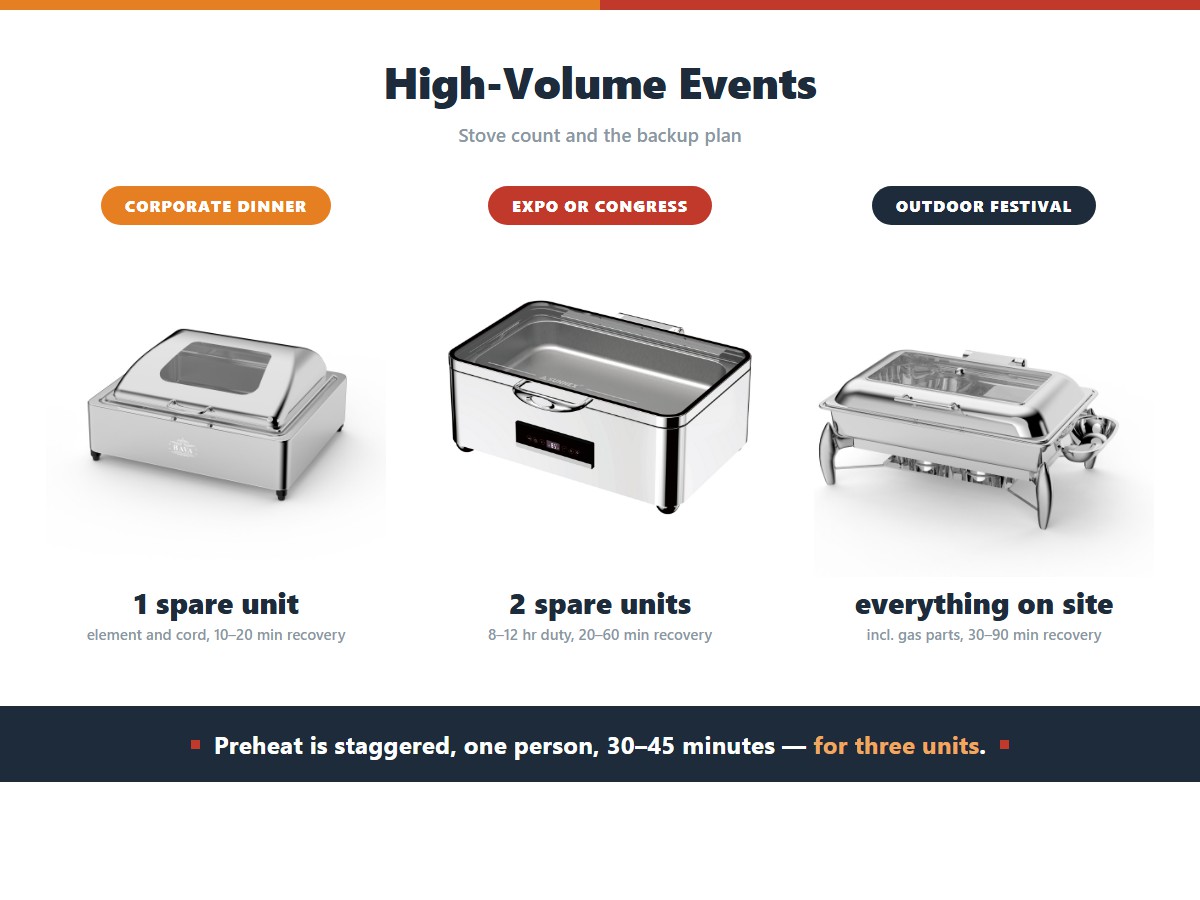
| Corporate dinner | 2–3 hr | 1 | Element, cord | 10–20 min | Power is reliable, time is not |
| Wedding reception | 3–4 hr | 1 | Element, cord, hinge | 10–30 min | Long service, late failures |
| Hotel breakfast | 1–2 hr | 0–1 | Element, thermostat | 5–15 min | Peak is short and sharp |
| Expo or congress | 8–12 hr | 2 | Element, cord, panel | 20–60 min | Continuous duty, parts wear out |
| Outdoor festival | 4–8 hr | 1–2 | Everything, incl. gas parts | 30–90 min | No local supplier on site |
Four-Hour Service Load
| Load | Time | Electric, 3 units | Fuel, 3 units | Staff task |
|---|---|---|---|---|
| Preheat | −60 min | 3 × 15 min, staggered | 3 × 10 min, staggered | One person, 30–45 min |
| Load food at 85°C | −30 min | 3 × 5 min | 3 × 5 min | Two people |
| Service opens | 0 | Monitor | Watch flame | One person on the line |
| Peak | +45 min | Refill from back | Refill and change cans | One person on the line |
| Check temperature | Every 45–60 min | Probe at rim | Probe at rim | Included in the line task |
| Service closes | +240 min | 30–45 min clean-up | 45–60 min clean-up | Two people |
The number that catches people out at large events is the clean-up, not the service. Three units take 30–45 minutes to clean properly, and a fuel line takes longer because of soot. That has to be staffed, and on a back-to-back event schedule it is the constraint that decides whether the next event is ready on time.
Frequently Asked Questions
How many buffet stoves do I need for 300 guests?
Three 4-pan units split across four serving points, plus one spare unit. That is $1,360–2,400 of equipment and 20–26 cans of fuel for a four-hour service. One unit per 120 guests is the working rule, and a spare is not optional above 200 covers.
How many spare buffet stoves should I bring to an event?
One for any event over 200 covers, and two for outdoor festivals or all-day expos where a local supplier is not reachable. A failed element cannot be sourced on site in most venues, and the service cannot wait five days for a delivery.
How long does it take to set up buffet stoves for a large event?
Thirty to forty-five minutes of preheat, staggered across units, plus 15 minutes to load food at 85°C. With two people and three units the whole line is serving within an hour, and staggering the preheat is what makes that possible on a single circuit.
Do I need backup power for a large buffet?
Yes for any event over 400 covers. Electric buffet stoves draw 10–13 A each, so three units need a 32–40 A supply, and a hotel ballroom circuit often cannot provide that. A generator or a hybrid unit with alcohol burners is the standard answer, planned in advance rather than on the day.
What is the most common failure at large events?
Thermostat or element, and it happens in the second or third hour rather than at the start. Plan a temperature check every 45–60 minutes at the pan rim, keep a spare element and cord on site, and hold a spare unit ready to swap rather than repair, because a swap takes 10–20 minutes and a diagnosis takes an hour.
Related reading
- Are Buffet Stoves Worth It? Payback by Event Volume
- High-Volume Buffet Stoves: What Breaks First
- Banquet Buffet Stoves: Features Worth Specifying
- Catering Buffet Stoves: 5 Specs That Matter on the Road
- Store Buffet Equipment Between Events: Damage Guide
- Heavy Duty Chafing Dishes: Durable Options for High-Volume Use